-
-
December 27, 2018 at 9:24 am
sma4t
SubscriberHi,
I'm trying to solve the following problem in fluent:
The flow is assumed to be 2D, inviscid and incompressible. The flow domain has an inlet at the bottom and an outlet on the right face.
Boundary conditions are given in terms of Psi (stream function) where:
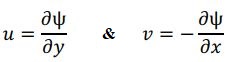
The governing equation is:
It is required to plot the streamlines (Psi = constant lines) of the flow.
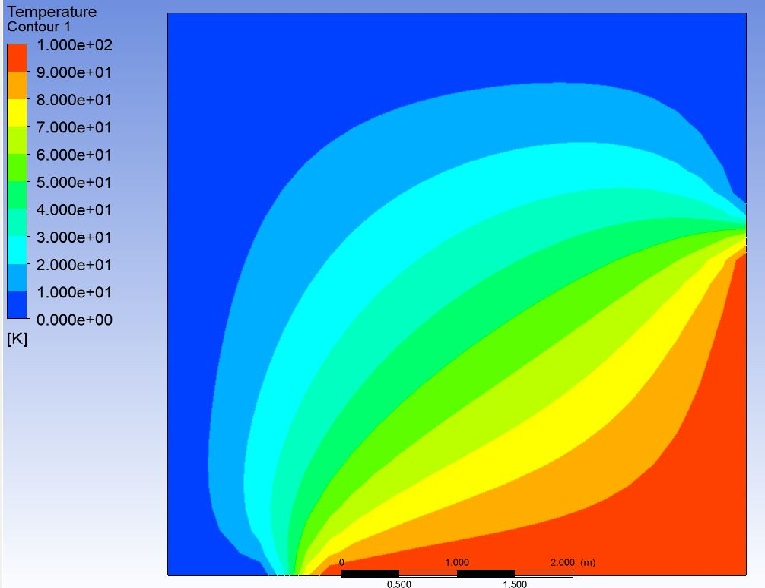
The first Idea that came into my mind was to assume Psi=Temperature and the governing equation will become the Laplace equation. Therefore the Psi-constant B.Cs will turn into Temperature constant and the inlet and outlet velocities can be simulated as the heat flux in the vertical and horizontal direction.
I wanted to know if it's possible to simulate the actual flow in Fluent regardless of the trick above. I don't have any ideas how to set Psi=constant B.Cs in Fluent.
Any help is appreciated.
Kind Regards,
Mohammad

-
January 2, 2019 at 5:30 am
seeta gunti
Ansys EmployeeHello Mohammad,
You can refer any of our tutorial on inviscid flows. The following link has one example on inviscid flow modeling of airfoil.
https://www.youtube.com/watch?v=_7DJeS-E9Us
You can get more on youtube.Â
Â
Regards,
Seeta
Â
Â
-
January 2, 2019 at 12:28 pm
sma4t
SubscriberHi Seeta,
Thank you for your reply.
I watched the video but it didn't talk about giving a Psi = constant boundary condition.
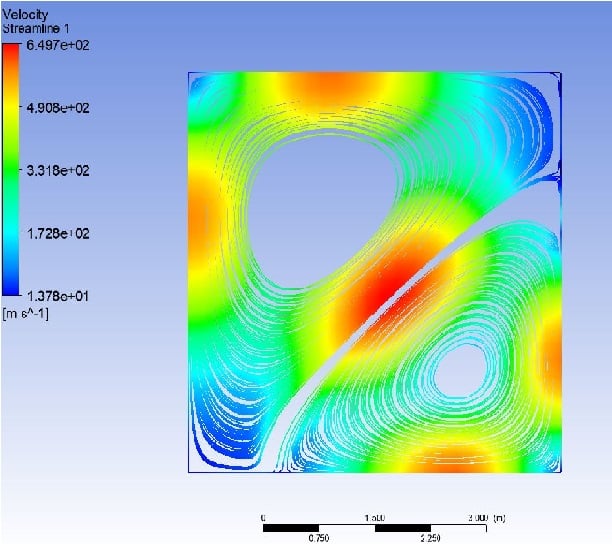
Moreover, I simulated the two cases that I mentioned ( treating the problem as a steady 2D heat transfer or solving as inviscid flow with wall boundary conditions and two velocity inlets):
The result from the heat transfer simulation look fine but the inviscid flow solution shows two big vortices in the domain.
Both methods are describing the same problem but in different ways. Not sure why the results differ.
-
January 3, 2019 at 7:40 am
seeta gunti
Ansys EmployeeWhat is the reynolds number of the flow? Generally inviscid option will be used for high speed flows. Inviscid flow analysis neglect the effect of viscosity on the flow and are appropriate for high-Reynolds-number applications where inertial forces tend to dominate viscous forces. One example for which an inviscid flow calculation is appropriate is an aerodynamic analysis of some high-speed projectile. In a case like this, the pressure forces on the body will dominate the viscous forces. I could see such applications in your geometry.
Â
Regards,
Seeta
-
January 3, 2019 at 10:04 pm
sma4t
SubscriberThis is a project for "An Introduction to CFD" undergraduate course. There is no Reynolds number defined for the problem since there is no viscosity (m) defined (inviscid assumption).
Â
Regards,
Mohammad
Â
Â
-
February 24, 2019 at 3:28 pm
sma4t
SubscriberHi,
Thanks everyone for contributing to this thread.
I had to stick with the thermal analogy method and wasn't successful in simulating the problem as an actual fluid flow.
The project report is available via the link below if anyone is interested:
https://www.dropbox.com/s/d0ba5l830yilnsr/CFD%20Proj.pdf?dl=0
Â
Regards,
Mohammad
-
- The topic ‘2D Inviscid Flow Problem’ is closed to new replies.
-
5874
-
1906
-
1420
-
1306
-
1021
© 2026 Copyright ANSYS, Inc. All rights reserved.