
TAGGED: 2d-simulation, inverse-design, lumerical, Lumerical-FDTD
-
-
September 18, 2021 at 1:38 pm
kiranm
SubscriberI wanted to use the inverse design provided by Lumerical. I downloaded the example for the 2D grating coupler but I was unable to run it properly such that I get the results posted on their source website. According to the online guide I should just hit the run button and get the same/similar result as they have presented on the website. Unfortunately, I get the following message:
ABNORMAL_TERMINATION_IN_LNSRCH
Line search cannot locate an adequate point after 20 function
and gradient evaluations. Previous x, f and g restored.
Possible causes: 1 error in function or gradient evaluation;
2 rounding error dominate computation.
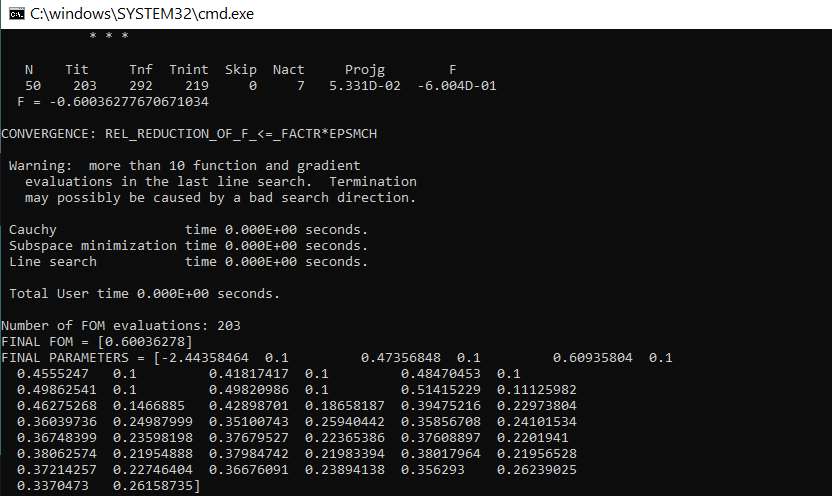
I have added the log output from the optimization. I do not understand what problem causes this termination. It indicates, that the optimizing function is too flat for a gradient to be found, how could I resolve this? Maybe the bounds are too small?
September 27, 2021 at 10:17 pmTaylor Robertson
Ansys Employee
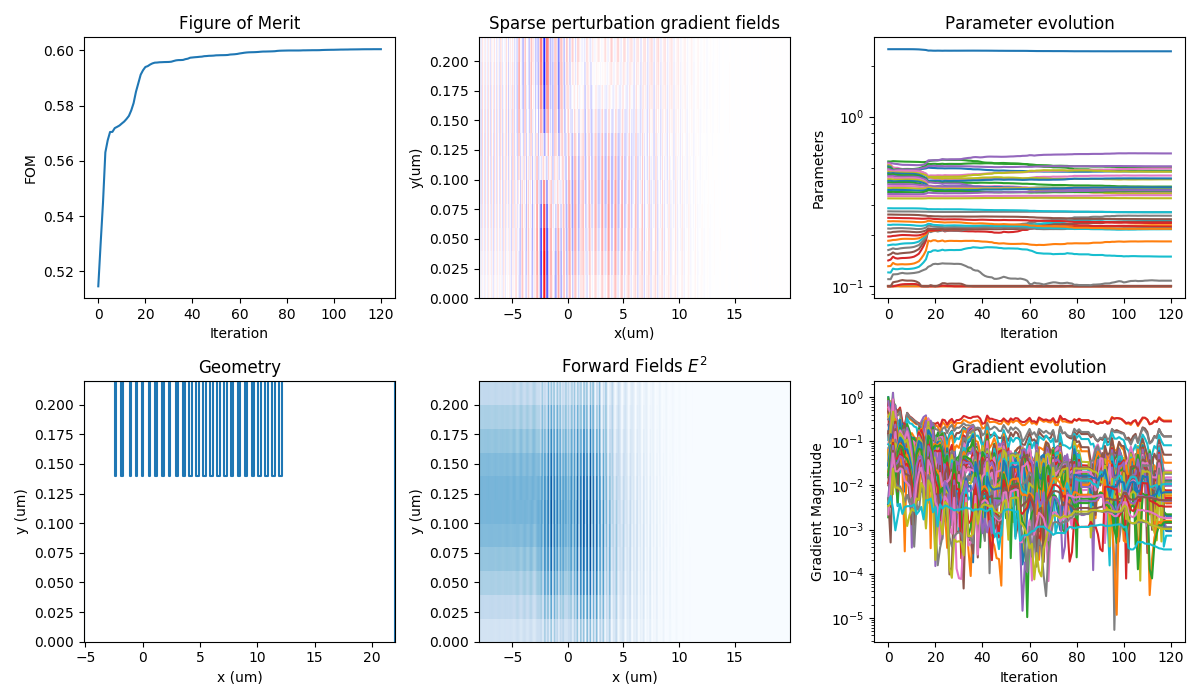
The results are a bit different than the example, but I wouldn't say they didn't run correctly. A line search happens when lumopt changes the parameters in the direction of the calculated gradient such that it should lead to better performance; however when it steps in that direction it finds that the performance is not improved. This is typically the result of stepping too far in the direction of steepest decent, but in can also happen when the gradient calculations isn't exact. Numerical precision can cause this termination, and the best way to avoid it is to use a smaller mesh size and Precise Volume Average PVA mesh refinement option.
Perhaps you could update the software to a newer release, the gradient calculation is very sensitive and often fails in this way. I believe there were some updates since 2020a that could effect the calculations. I just ran the example, on 2021R2, with the same exact starting parameters, but it is showing much different evolution by the 5th iteration.
Even in the example the optimizer finishes with a line search, it is after 200 iterations and plateauing performance. So in that case I would be quite confident that you are very close to a local maximum.
Best Regards
Viewing 1 reply thread- The topic ‘2D GC Inverse Design Lumerical Example’ is closed to new replies.
Innovation Space Trending discussions
 Top Contributors
-
peteroznewman
 6420
6420 -
scabo
 1906
1906 -
Dennis Chen
 1457
1457 -
javat33489
 1308
1308 -
Shyam Prasad V Atri
1022
Top Rated Tags
© 2026 Copyright ANSYS, Inc. All rights reserved.
Ansys does not support the usage of unauthorized Ansys software. Please visit www.ansys.com to obtain an official distribution.
-


 You are navigating away from the AIS Discovery experience