Hello,
I'm new to Ansys and I have been trying for a while now to set up the following simulation: a 2D cylinder in a narrow channel subjected to a uniform flow of water, the cylinder is free to move in the direction transverse to the flow.
- mass 4.14kg/m
- diameter 6cm
- plate spacing 10cm
- v=1m/s at inlet, so Re~10^4-10^5
- the channel walls are comoving with the uniform flow, so v=1m/s boundary condition
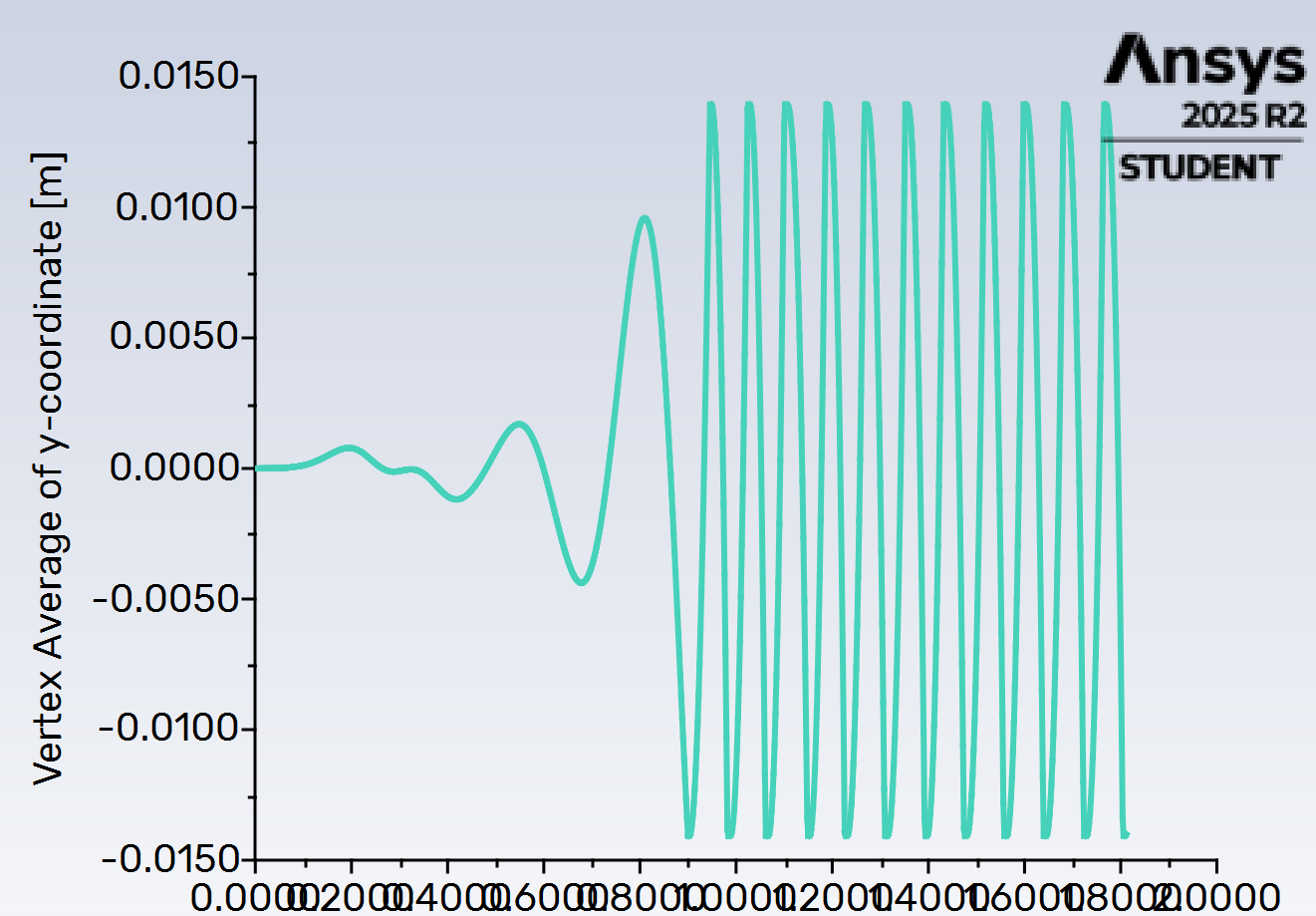
From my experiments and experiments in literature [1] the cylinder should periodically collide with the two walls with a frequency close to 4Hz, but my simulations give 10Hz or higher...
So far I've used the following implementation strategy: I'm using an overset mesh for the cylinder with 6DOF solver. For now I simply set some Ansys built-in translation limits for the cylinder at +0.014 and -0.014 (so 6mm from either wall, i.e. 3 cells of my 2mm square cell background mesh), giving a collisions without restitution. I also have a custom UDF in which the walls are modeled as a spring-damper system. This UDF works fine, giving a nice immediate rebound, and it's what I intend to use later instead, but for testing purposes I am sticking to the translation limits. To model the flow blockage upon collision I use the gap method with flow modeling, with threshold 6.4 mm (so slightly in front of my artificial walls) and gap Reynolds number Re=1. I'm using fixed timesteps of dt=0.001-0.005s until the turbulent wake has somewhat developed and the cylinder becomes unstable, to then resolve the collision I switch to 0.0002-0.001s.
Further simulation and solver details: The background and component mesh are 2mm square cells, inflation and local sizing is applied to the cylinder boundary (picture provided). I use k-omega SST for turbulence modeling, PISO pressure-velocity coupling with first-order implicit spatial discretization. Implicit update is turned on with update interval 1, motion relaxation 0.1, residual criteria 1e-5. I usually do 20 iterations for each timestep.
In the simulation I
get the expected periodic collisions, but the frequency is way too high, closer to 10Hz (see picture for typical trajectory, corresponding animation: ). This doesn't match literature and experiment, and the cylinder peak velocity ~1-2m/s is quite high for what I see in practice, so I'm suspicious of my simulation setup. So my questions to you:
1) Do you agree with the general strategy of setting up this simulation? Am I doing this properly?
2) Were did I go wrong?
My suspicion is that either the cylinder moves too fast and distorts the liquid too quickly, so the liquid speeds up lowering the pressure, and this is creating sort of a positive feedback loop. This could be a mesh or timestep issue. I tried using an adaptive timestep (I tried both starting at t=0s and also with 0.3s of fixed timestep simulations first), but for some reason adaptive timestepping makes the cylinder speed up even further (sidenote: In general, the timing and amplitude of the initial oscillations seem to depend on the timestep I choose, but this I suppose is normal since the initial instability should be due to numerics breaking the symmetry). In the animation video you can see slight distortion of the fluid at the overset mesh interface in the cylinder back. I'll try to address that, but I would be surprised if this had caused such an increase in frequency. Sometimes you see white holes in the narrow gap, but I believe that's just a rendering issue due to the inflated component mesh.
My other explanation is that the collision gap of 6mm is too big, and so there's too much liquid underneath the cylinder pushing it away again. So I'm considering refining the mesh, making a BOI of even smaller 1mm cells close to the cylinder so I can put the artificial wall closer. Not sure yet it will help.
I tried many many different things, among them:
- I have tested both Ansys' built-in translation limits (+-0.014m) and the custom UDF with spring-damper system. Both yield a ~10Hz frequency
- I tried using no gap method, higher gap Re=100 for flow modeling, and the flow-blocking gap method
- pressure inlet instead of velocity inlet, apparently more compatible with the gap method, but it didn't change a lot
- tripling the cylinder mass (only slightly lowered the frequency)
- initializing with a steady state solution of the turbulent flow (little to no effect)
- initializing with a transient solution for 0.4s with 6DOF turned off, until the symmetric wake developed, then turning 6DOF on (cylinder just settled 0.3mm off-centered, no oscillations... Probably I should have initialized longer, until vortex shedding had fully developed, but the paper [1] suggests that the initial build-up is important for the instability of the cylinder due to some hysteresis effect, so for most runs I didn't include this initial period with 6DOF off)
For the ones that don't fail, the oscillation period is still close to the 10Hz.
I would really appreciate your help on this issue. I'm happy to provide more information.
Raffael
[1] Kim, Junyoung, and Daegyoum Kim. "Flow-induced vibration and impact of a cylinder between two close sidewalls." Journal of Fluid Mechanics 937 (2022): A28.


















 You are navigating away from the AIS Discovery experience