-
-
April 24, 2020 at 10:45 pm
Jonahbt40
SubscriberHello Everyone,
Â
I am performing a 2D axisymmetric steady-state thermal analysis on a cylindrical shell, and I had a question regarding how to set up heat flows into the shell.Â
Â
I want 10W of heat to be flowing into the interior wall of the shell (that is 10W total distributed over the entire wall).Â
Â
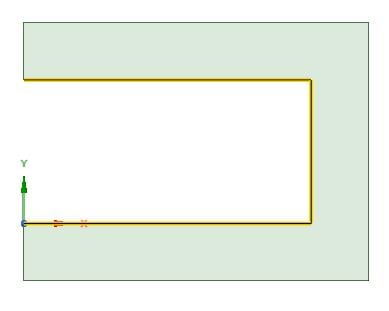
I am doing this as a 2D axisymmetric problem, so I am setting up heat flows on a rectangle that will be rotated around. Would I simply set up a heat flow of 10W into the inner edge of the rectangle, or is it more complicated than that?Â
Â
This is question I have in general, how to translate the forces, heat flows, etc… that will be applied to a 3D object, into those that will be applied to the cross section used for a 2D axisymmetric analysis.Â
Â
I am rather new to ANSYS so thank you for your patience.Â
-
April 25, 2020 at 12:58 am
peteroznewman
SubscriberIf you have a cylindrical cavity in an axisymmetric model, then there are three edges that represent the top, side and bottom of that cylindrical cavity. You could apply a total heat flow of 10 W to those three faces by picking those three edges.
If this answers your question, click Is Solution below this post or ask a follow-up question. Please use the Insert Image button and give a sketch or screen snapshot of a specific example where you are uncertain how to convert a 3D problem into 2D.
-
April 27, 2020 at 7:59 am
Jonahbt40
SubscriberHello peteroznewman,Â
Â
Thank you for the quick reply! And that would be physically equivalent to applying 10W to the entire inner surface of the 3D geometry?Â
-
April 29, 2020 at 12:29 am
peteroznewman
SubscriberYes.
-
- The topic ‘2D Axisymmetric Steady State Thermal Analysis’ is closed to new replies.

-
6625
-
1906
-
1469
-
1311
-
1022
© 2026 Copyright ANSYS, Inc. All rights reserved.