Hi everyone,
I’m running a VOF simulation of a 4mm steel ball dropping into water using an overset dynamic mesh (Fluent 2025 R2). My 3D setup works fine, but I want to run a 2D Axisymmetric case to save computational time as the 3d setup is computationally too expensive. I am struggling with how to handle the moving overset boundary at the axis of revolution Y=0.
Here is what happens depending on my topology:
Approach 1 (Boundary exactly on Axis): Fluent throws an (sometimes) instant floating-point exception (AMG divergence) at t=0, presumably due to zero radial volume in the overlap.
Approach 2 (Micro-gap): Moving the overset box radially upward by 0.01 mm avoids the zero-volume crash, and the run starts. However, it creates ~180 orphan cells at the sphere's bottom pole. When the ball hits the water, the pressure spike at these orphans crashes the solver.
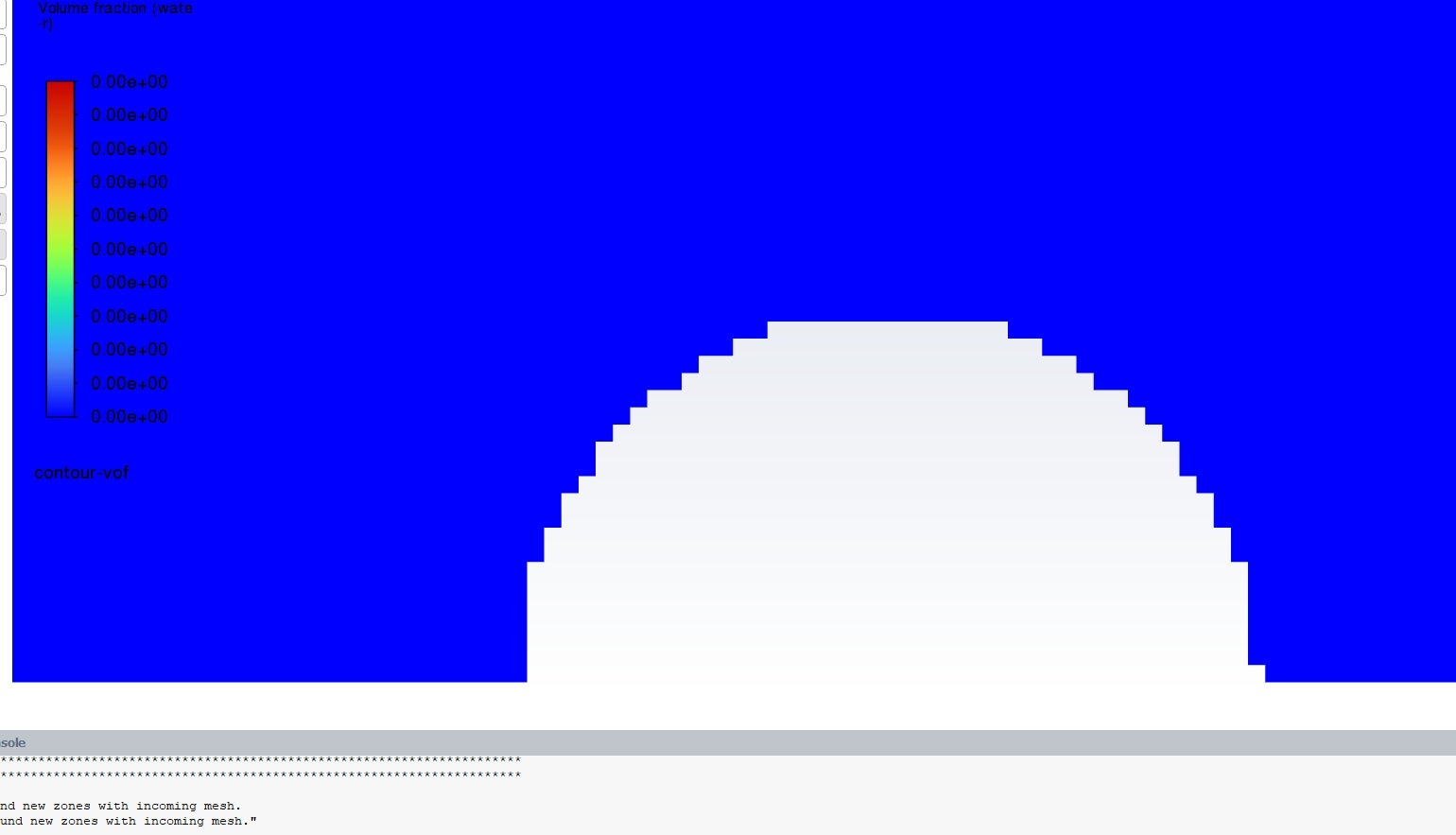
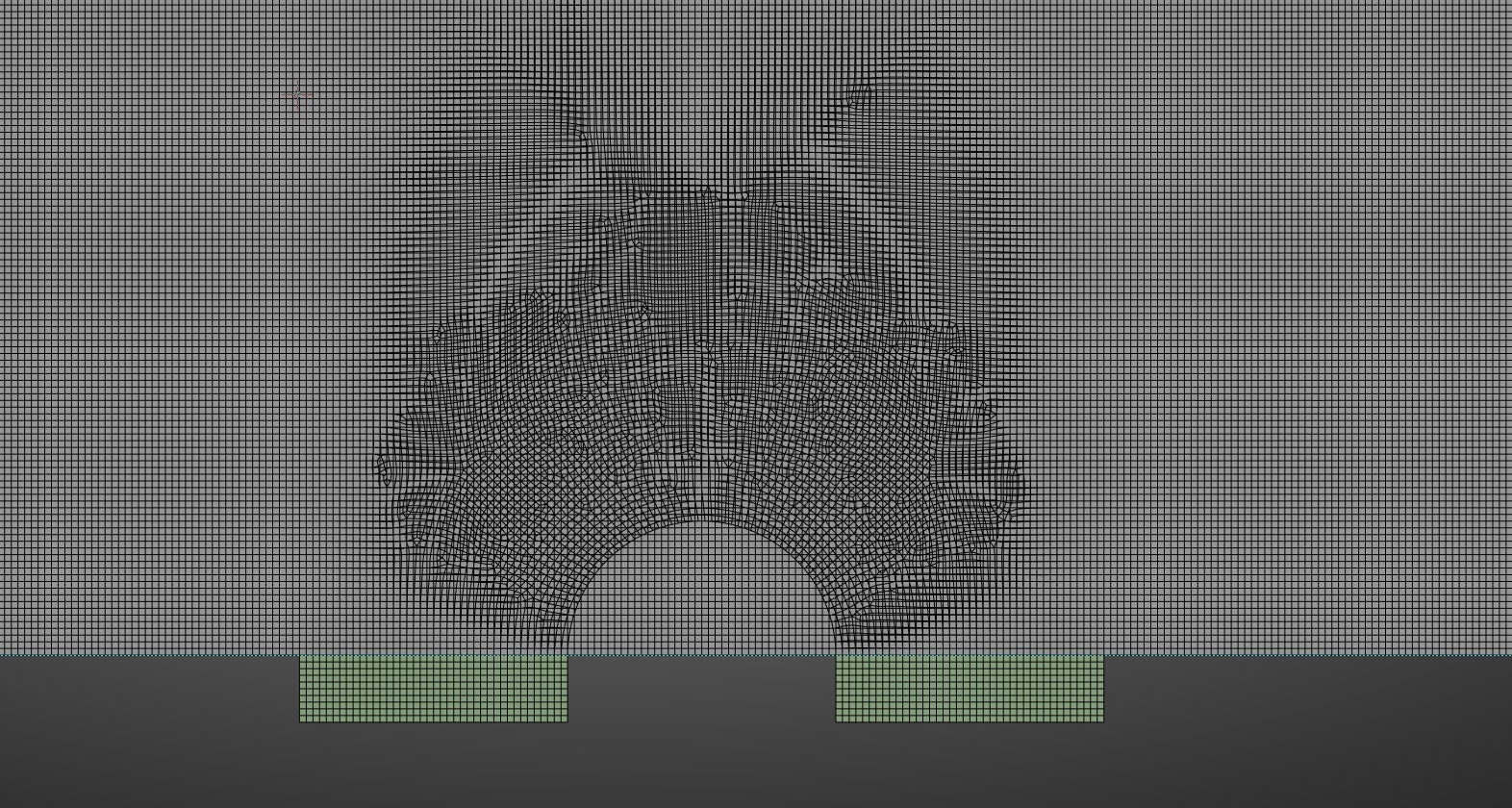
Approach 3 (Overlapping the Axis): I tried extending the overset domain slightly past the Y=0 axis. (See the two attached images showing the mesh overlap and the Fluent VOF initialization). While Fluent cuts the hole, the interface gets jagged/stair-stepped around the curved boundary and it still crashes at water impact.
What I've tried: Lowering URFs (Pressure to 0.1), variable time-stepping (Courant < 0.25), changing donor priority to boundary distance, and making the overset mesh perfectly Cartesian at the overlap.
My Question:
Since axisymmetric overset meshes should be compatible, how should I actually approach this? What is the correct workflow or geometry topology for a moving overset component that must slide along a 2D axis without generating divide-by-zero errors or fatal orphan cells?
Thanks in advance!
I also noticed that sometimes it does it quite well but than creates an orphan cell in front of the ball causing the simulation to crash when it touch the water-air boundary.

















 You are navigating away from the AIS Discovery experience