Ansys Assistant will be unavailable on the Learning Forum starting January 30. An upgraded version is coming soon. We apologize for any inconvenience and appreciate your patience. Stay tuned for updates.
Fluids

Fluids

Topics related to Fluent, CFX, Turbogrid and more.

Turbulent intensity and length scale for a fully-developed pipe flow

    • Aitor
      Subscriber
      I am looking for a reference in order to define the boundary conditions for RANS turbulence models, and I have seen two formulas for the turbulent intensity and length scale in the case of a fully-developed pipe flow (expressions 7-71 and 7-72):n7.4.2. Using Flow Boundary Conditions (ansys.com)nWhere do they come from? The most similar result that I know is that in turbulent pipe flow, Karman integral equation leads to a friction coefficient proportional to Re^(-1/7).nThank younn
    • DrAmine
      Ansys Employee
      As stated in the documentation TI formulation it is derived from a correlation. If you have your own correlation then just use it. I can recommend looking into Scaling of turbulence intensity for low-speed flow in smooth pipes, Flow Meas. Instrum., vol. 52, pp. 101–114. One can then correlate the intensity with Blasius friction factor. Do you need a precise resource for that?nThe one of the length scale is straightforward knowing the length scale from two-equation models for example.n
    • Aitor
      Subscriber
      ArrayThank you for your answer. I am performing multiphase simulations, and I have noticed that the results depend strongly on the inlet turbulence levels. That's why I would like to have some references. nIs there any article related to the turbulent length scale? In order to publish my results, I need a reference to justify my assumptions.nThank you
    • DrAmine
      Ansys Employee
      The article I referenced is a good one. If you referring to the forumla used in the documentation I need to double check.n
    • Aitor
      Subscriber
      Thank you. To have the reference of that formula would be positive for me.n
    • DrAmine
      Ansys Employee
      I will try to find the reference. All word are using the same without having a reference. I am pretty sure something to do with Pope but I will dig deep.n
    • Aitor
      Subscriber
      Thank you. I checked Pope's book, even though I found nothing. n
    • DrAmine
      Ansys Employee
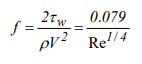
      Hi Actually I was wrong the book: It has to be from Schlichting but one needs to derive it! All is related to Blasisus Pipe Friction Law. You need just to get velocity_wall from tau_wall (stress at wall), and you divide by the mean velocity.nnn
    • Aitor
      Subscriber
      I have seen that formula in Schlichting book but with 0.045 instead of 0.079. nIn any case, how can one derive the expressions of turbulent intensitty and length scale? I understand that your message is in order to derive a correlation, but I do not see any way to obtain I=0.16*Re^(-1/8) and l 0.007*L/C_mu^(/3/4)nThank you for your attentionn
    • DrAmine
      Ansys Employee
      You derive the expression from that and you assume that fluctuation velocity is 80% of the u_tau. From that formula you can get u_tau/u_avg from that you can derive u'/u_avg.nFor the length scale, I wrote already The one of the length scale is straightforward knowing the length scale from two-equation models for example. One needs just to relate the length scale to hydraulic diameter. Here one needs again to check a couple of books.n
    • Aitor
      Subscriber
      ArrayWhere does the 80% come from? nI know the expression of turbulent length scale for the RANS models, but it implies two turbulence quantities and I only know one from the turbulent intensity.n
    • DrAmine
      Ansys Employee
      Not universal but you can estimated from DNS results of fully developed pipe flows.n
    • Aitor
      Subscriber
      Thank you for your answer.n
Viewing 12 reply threads
  • The topic ‘Turbulent intensity and length scale for a fully-developed pipe flow’ is closed to new replies.

[bingo_chatbox]