

TAGGED: acoustics
-
-
February 19, 2021 at 3:26 pm
calENG
SubscriberHello everyone,
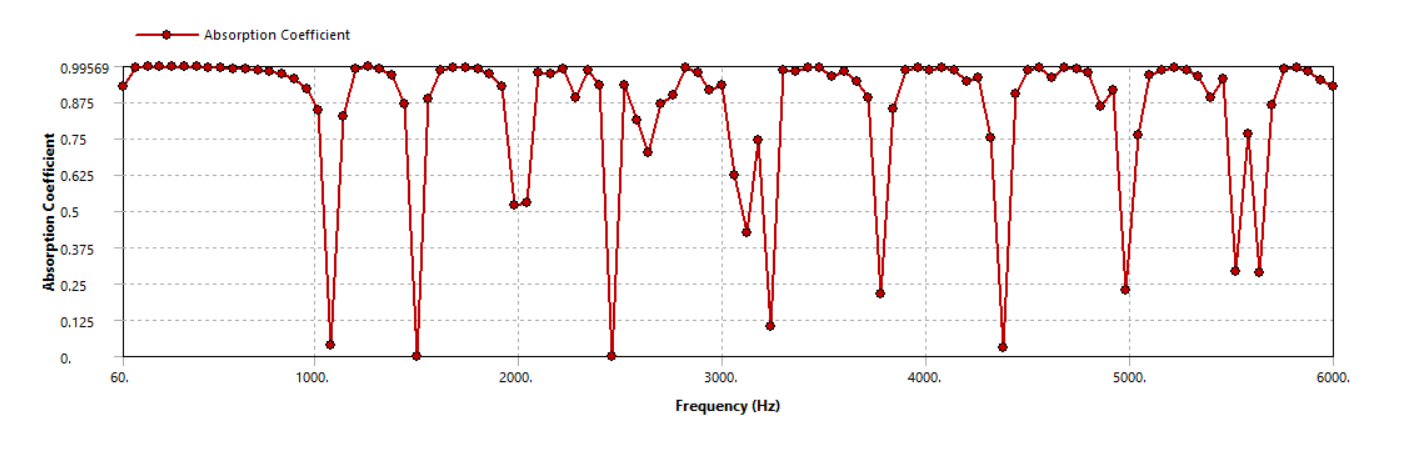
I have modelled a unit-cell of an anechoic structure in harmonic analysis. The layer is silicone and has been assigned as an acoustics physics region, with an air cavity inside (the air has been modelled and also assigned as an acoustics physics region). There is a steel backplate as well that is structural. In order to simulate the water closure on the silicone layer face I have applied an impedance boundary condition, assigned a port to this front surface and used the body of the same layer to assign the inside surface bodies. A planar wave has been applied using a 'port in duct' excitation condition (with 10000 Pa) and the acoustic absorbance is calculated.
I have used the same material parameters that I have seen in many papers, however I am getting very different results and wondered if anybody could please highlight where I have modelled it incorrectly or explain the observed behaviour? I am assuming there are certain boundary conditions I haven't applied. I have included an image of the absorption coefficient with regards to frequency in a 0-6000 kHz range.
Thank you for any help.
February 24, 2021 at 4:39 pmHui Liu
Forum ModeratorCould you give more details about the difference you see between your model and literature? Did you compare the boundary conditions and make sure they are the same? nFebruary 25, 2021 at 11:41 amSubscriberYes of course! Since posting the question I have made amendments (namely changing the anechoic layer from compressible to incompressible) and this is the result I get:n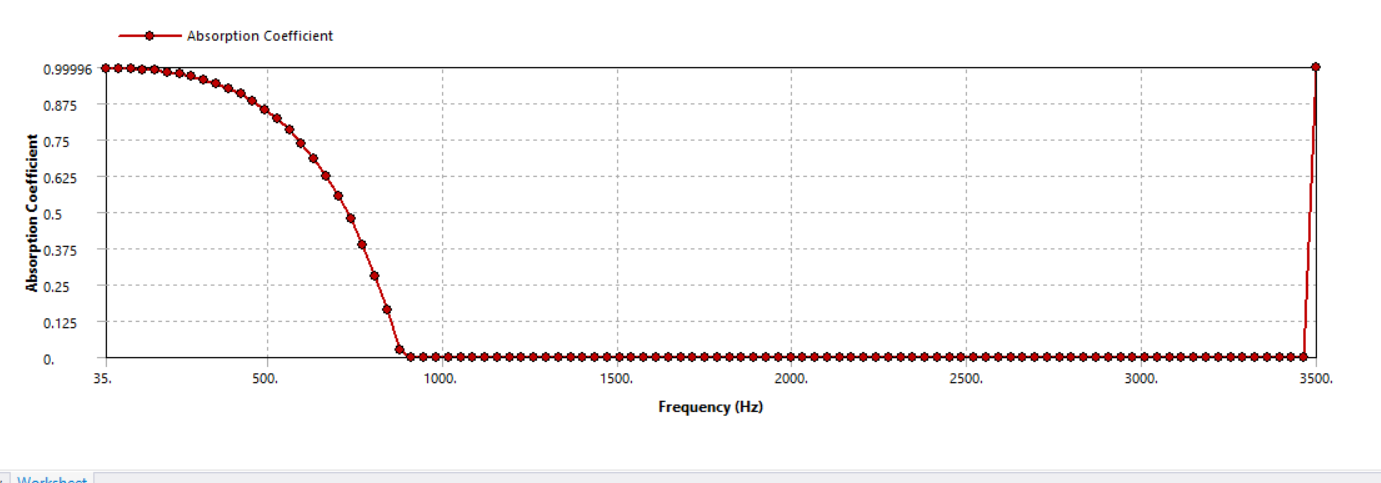 However, this is the absorption coefficient graph realised in the literature:n
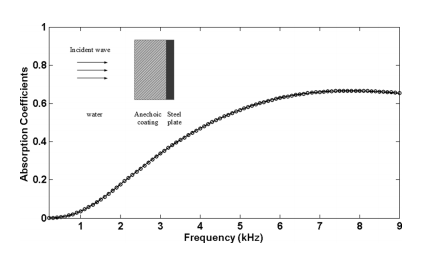 As you can see the behaviour displayed by my model is completely different. I have used the same material parameters, and have used the same equation to calculate the impedance for 100 values between 0-3500 Hz. Little other information about how the structure was actually modelled is given in the paper, though I think one big difference may be the wave speed used. I have used a value of 50.3 m/s for the speed in the silicon layer- they haven't stated what was used during simulation but the wave speed used to calculate impedance in both their and my model is 325(1+0.11i). As far as I am aware there is no way to input a complex number for wave speed in ANSYS. nI am not sure how to amend my model, though it is clearly incorrect. Any help is greatly appreciated.nThank you, Callum.n(Reference: Xinyi Fu, Zhongkun Jin, Yao Yin, and Bilong Liu, 'Sound absorption of a rib-stiffened plate covered by anechoic coatings'.)n
February 25, 2021 at 12:23 pmSubscriberSorry, I forgot to say as well that for the results above there is no air cavity modelled.nMarch 9, 2021 at 4:28 pmForum ModeratorCould you clarify the material type? Sounds like you are modeling a structure only setup, is that right? Are you using acoustic module or structural model?nMarch 12, 2021 at 4:33 pmSubscriberHello, thank you for your reply. I believe I have sorted the issue I was having. The impedance I was using was incorrect, and so I have sorted that and applied it to the Ansys model and am achieving much better results. I have included an image of the result I get compared to a similar set up given in literature.nMy result:n
As you can see the behaviour displayed by my model is completely different. I have used the same material parameters, and have used the same equation to calculate the impedance for 100 values between 0-3500 Hz. Little other information about how the structure was actually modelled is given in the paper, though I think one big difference may be the wave speed used. I have used a value of 50.3 m/s for the speed in the silicon layer- they haven't stated what was used during simulation but the wave speed used to calculate impedance in both their and my model is 325(1+0.11i). As far as I am aware there is no way to input a complex number for wave speed in ANSYS. nI am not sure how to amend my model, though it is clearly incorrect. Any help is greatly appreciated.nThank you, Callum.n(Reference: Xinyi Fu, Zhongkun Jin, Yao Yin, and Bilong Liu, 'Sound absorption of a rib-stiffened plate covered by anechoic coatings'.)n
February 25, 2021 at 12:23 pmSubscriberSorry, I forgot to say as well that for the results above there is no air cavity modelled.nMarch 9, 2021 at 4:28 pmForum ModeratorCould you clarify the material type? Sounds like you are modeling a structure only setup, is that right? Are you using acoustic module or structural model?nMarch 12, 2021 at 4:33 pmSubscriberHello, thank you for your reply. I believe I have sorted the issue I was having. The impedance I was using was incorrect, and so I have sorted that and applied it to the Ansys model and am achieving much better results. I have included an image of the result I get compared to a similar set up given in literature.nMy result:n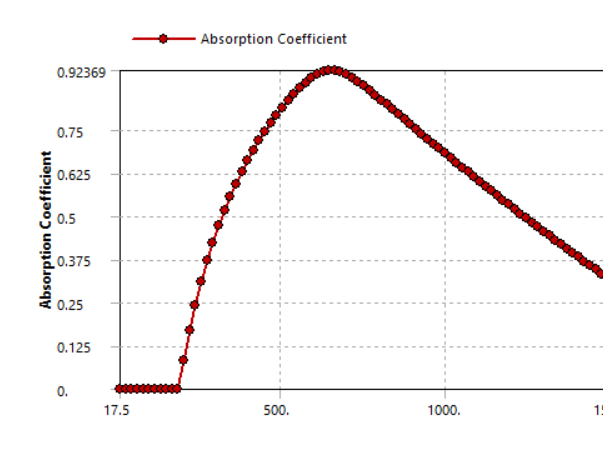 nThe result given in the literature:n
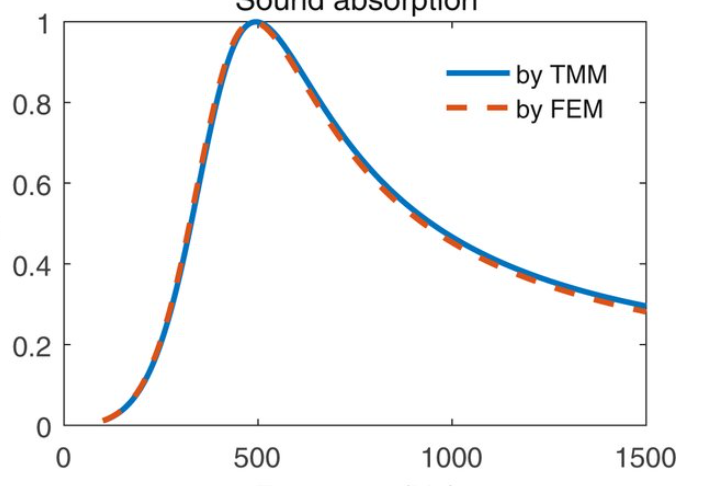 I think the difference may be explained by the wave speed and the loss factor used, I'm not sure what values they used for this but the result follows the same trend.nnThank you.n
April 2, 2021 at 2:49 pmForum ModeratorThanks for posting the updates here, and glad to see you have the results matching the same trend now. nViewing 6 reply threads
I think the difference may be explained by the wave speed and the loss factor used, I'm not sure what values they used for this but the result follows the same trend.nnThank you.n
April 2, 2021 at 2:49 pmForum ModeratorThanks for posting the updates here, and glad to see you have the results matching the same trend now. nViewing 6 reply threads- The topic ‘How to model an anechoic structure in harmonic analysis?’ is closed to new replies.
Innovation Space Trending discussions
 Top Contributors
-
peteroznewman
 6154
6154 -
scabo
 1906
1906 -
Dennis Chen
 1442
1442 -
javat33489
 1308
1308 -
Shyam Prasad V Atri
1022
Top Rated Tags
© 2026 Copyright ANSYS, Inc. All rights reserved.
Ansys does not support the usage of unauthorized Ansys software. Please visit www.ansys.com to obtain an official distribution.
-


 You are navigating away from the AIS Discovery experience