

TAGGED: 2D, ansys-fluent, dpm, fluid-dynamics, multiphase
-
-
September 25, 2020 at 5:11 am
unicrey
SubscriberHi everyone, I am doing a spray simulation with DPM. After getting the flow with VOF, I am injecting particles at breakup length. Those droplets go and hit a plate. I am trying to compare the pressure on the wall with experimental results.
I am using the default static pressure calculation at the wall in FLUENT. Does this take into account for the pressure exerted by droplets impinging on the wall?
My calculated values are around 10 Pa and experimental values are around 20000 Pa. So there is something really wrong going on. Either its my droplet size and number or the way I am calculating the pressure.
Would anyone like to suggest a better method for calculation of pressure exerted by the droplets on the wall?
Note: I am assuming that after breakup of the initial spray only droplets exist. Do I also need to enter a water inlet along with the droplets?
Attached images of the particle tracks and pressure distribution on the plate after 700 iterations with a time step of 0.0004 sec.
September 25, 2020 at 10:52 amRob
Forum ModeratorHave a look in the DPM Variables too, there are force plots available.
September 25, 2020 at 8:50 pmSubscriber.Thanks for your comment Rob.
Yes, that would have been great. For some reason, both the X and Y force plot as well as the normal pressure plot is zero at all points.
Do you know why this might be the case?
.September 28, 2020 at 11:00 amForum ModeratorDo you have a wall & wall:shadow pair?
September 28, 2020 at 8:55 pmSubscriber.No I do not have any wall shadows. I am only modelling the fluid zone in 2D.
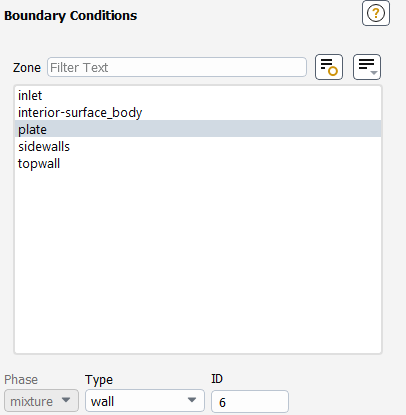 Here, 'plate' is the only wall. 'sidewalls', 'topwall' and 'inlet' are set to pressure-outlet.
 DPM Droplet particles are injected about a cm away from the inlet/topwall. The plate is at 1500 K and wall-film DPM BC is enabled.
.September 29, 2020 at 9:24 amForum ModeratorDPM is coupled?
October 2, 2020 at 7:52 pmSubscriberI am not sure what you mean by a coupled DPM.
Its not a VOF to DPM simulation since that is only available in 3D. I ran VOF separately and am now running DPM separately.
I have the species transport model enabled in addition to DPM if that's what you are asking. This is enabled to account for droplet evaporation at the plate. Plate has 'wall-film' DPM boundary condition.
Energy equation is also enabled. And realizable k-ε turbulence model is being used with standard wall functions.
October 12, 2020 at 8:45 pmSubscriberI realized you probably meant if the interaction between the continuous and discrete phase was enabled. Yes, this is enabled and DPM iteration interval is set to 10.
October 13, 2020 at 4:13 pmForum ModeratorTry without the wall film, I can't remember what that does to the reporting as technically the particles may hit the film rather than the wall once it's formed.
November 13, 2020 at 11:25 amSubscriberApologies for the delayed response to the last comment.
Switching the plate BC to 'reflect'* did result in non-zero values for wall normal pressure. But this does not imitate the physical situation very well.
Wall film boundary condition seems to be the most appropriate. It would be great if there was a way to get wall normal pressure with the wall film BC.
*it works only for 'reflect'. For 'trap' and 'wall-jet' condition, normal pressure is zero.
November 13, 2020 at 1:54 pmForum ModeratorEnhancement request is now in the system, so you'll have to wait for the "easy" option. Short term you may be able to use a UDF or some other reporting option, but it may not be straightforward: you'll need parcel mass & impact velocity for a start.
November 16, 2020 at 9:50 pmSubscriberOkay, got it. I am trying out different ways of calculating the impact pressure now.
Thanks for your help.
January 5, 2021 at 5:03 pmSubscriberHi Rob, hate to bring up this old issue again but among other things, I still don't have a definite way of calculating the impact pressure.
Based on papers like this one (https://doi.org/10.1098/rsos.181101), the maximum pressure rise for a single drop hitting a solid surface is given by
rho*s*V, where rho is the density of the liquid and s is the speed of sound in undisturbed liquid and V is impact velocity
Other papers have mentioned damping coefficients for damping of impact pressure associated with a wet wall.
But the common theme is that for numerical simulation, the pressure is obtained from the pressure in the cell adjacent to the wall boundary. There is no other formula used to calculate impact pressure.
However, in ANSYS, there is static pressure and there is DPM wall normal pressure. As far as I understand, static pressure is the term from all the equations we are solving. But I am not sure how the DPM normal pressure is calculated. Would you be able to refer me to any references for that?
Here, I am talking about the case without any wall film.
January 5, 2021 at 5:16 pmForum ModeratorIf it's not in the manual I can't comment, however, the data for rho.s.V is all available (and there's an example in the UDF guide for erosion) so it should be possible to code. As you say, the static pressure (and other fluid pressure values) are for the flow so won't take the particle mass etc into account.
January 5, 2021 at 5:24 pmSubscriberOkay, thank you for the comment. I will look in the erosion example.
March 22, 2021 at 11:25 amTE_Haf
SubscriberHi,
I have a similar problem. The DPM wall normal pressure is at least in the ballpark of what I was expecting.
Unfortunately, I cannot save it during the simulation.
I added the variable to the additional quantities list, but I cannot find it in CFDpost. Other DPM variables, such as concentration, are saved though.
Is that a known issue?
March 22, 2021 at 1:41 pmSubscriberJust an update.
If I stop the simulation and export the DPM wall normal pressure as a .cdat file (cfdpost) it works, and I can check it.
If I use the automatic save, it only saves the DPM Mass and concentration. Momentum, and forces are not saved, even though I selected them.
March 22, 2021 at 4:25 pmForum ModeratorIs the automatic save also a cdat? There shouldn't be any difference.
March 22, 2021 at 4:40 pmSubscriber.Hi TE_Haf , can you share the boundary conditions that you are using? And mesh details?
Thanks.
.March 23, 2021 at 8:05 amSubscriber.The automatic save is .dat.
.My case is just a particle jet against an inclined wall, with air as fluid. I am not using the film BC, just solving the wall collision with DEM.
March 23, 2021 at 10:46 pmSubscriberHi Array , thanks for getting back to me.
So are you using the 'reflect' bc for the wall?
March 24, 2021 at 9:46 amSubscriberYes, but with the DEM collision.
September 9, 2021 at 6:11 amDaidalos
Subscriber.Hi unicrey, im doing a similar CFD simulation as you and would like to ask if u managed to solve Ur problem and also is it possible for you to send me the details in the setup of the case you did? Thanks much aprpeciated!
.Viewing 22 reply threads- The topic ‘ANSYS FLUENT: DPM Simulation – Wall Impingement Pressure’ is closed to new replies.
Innovation Space Trending discussions
 Top Contributors
-
peteroznewman
 6495
6495 -
scabo
 1906
1906 -
Dennis Chen
 1458
1458 -
javat33489
 1308
1308 -
Shyam Prasad V Atri
1022
Top Rated Tags
© 2026 Copyright ANSYS, Inc. All rights reserved.
Ansys does not support the usage of unauthorized Ansys software. Please visit www.ansys.com to obtain an official distribution.
-


 You are navigating away from the AIS Discovery experience