I am using Fluent 2022 R2 (v222, build 10212) for a transient LES/WALE simulation with Partially Premixed Combustion, FGM, C-equation, Non-Adiabatic Energy Treatment and Finite-Rate turbulence-chemistry interaction. Radiation is off. The mesh contains 10.69 million polyhedral cells.
The physical configuration contains a hot burnt pilot adjacent to the cold premixed burner stream. The pilot must remain in the model.
Current pilot boundary:
- mass-flow-inlet
- mass flow = 1.43e-4 kg/s
- Total Temperature = 2000 K
- Mean Mixture Fraction Z = 1
- normalized Progress Variable C = 1
- both variances = 0
Z=1 represents the premixed CH4/air reactant stream at equivalence ratio 0.8; Z=0 is ambient air.
Original numerical symptom
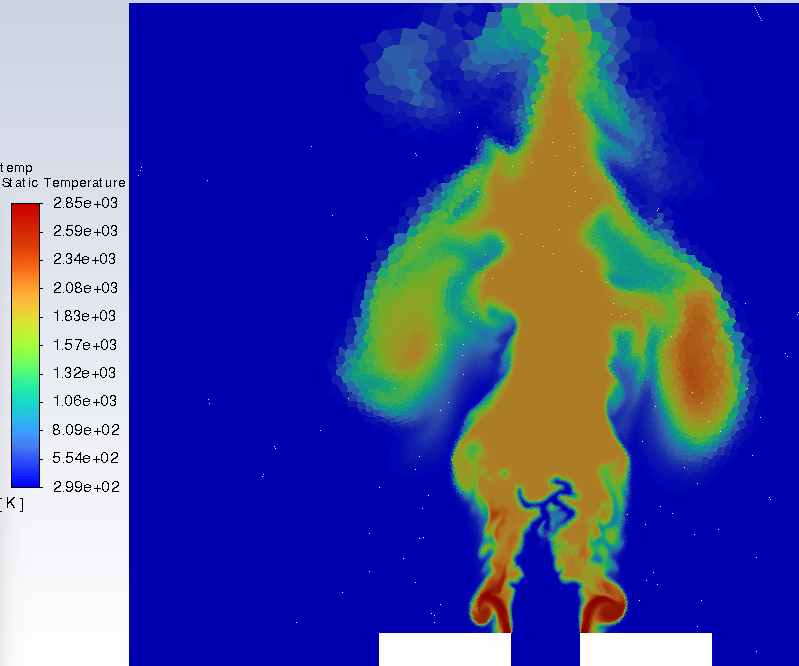
We initially investigated persistent "Maximum PDF table enthalpy exceeded" warnings and a very large high-temperature population. At a trusted saved checkpoint:
- T > 2200 K: 607,239 cells
- T > 2400 K: 454,109 cells
- T > 2600 K: 282,747 cells
- T > 2800 K: ~103,329 cells
- Tmax = 2849.998 K, exactly the upper temperature limit of the current PDF table.
Of the cells above 2400 K, 82.3% have cell enthalpy above their local PDF-table maximum enthalpy. Above 2600 K this fraction is 87.8%.
Numerical/model sensitivities already tested
We have already performed a substantial set of controlled sensitivity tests, so we would particularly appreciate guidance beyond generic URF/time-step recommendations:
- Time step: reducing dt from 2e-5 to 1e-5 s did not materially change the solution at matched physical times.
- Energy URF: reducing Energy URF from 1.0 to 0.8 produced essentially the same high-temperature population; in a clean sibling comparison it was slightly worse rather than better.
- PDF enthalpy resolution: increasing the enthalpy coordinate from 20 to 80 points (H80) produced only a modest reduction (~5% in T>2400 and ~3% in T>2600 populations at comparable times); the underlying behaviour remained.
- Adaptive Grid Refinement of the PDF table: AGR = 0.10 changed the high-temperature counts by less than approximately 0.5%.
- Extrapolation: turning solution extrapolation OFF produced essentially the same result. At the same physical time, T>2200 / T>2400 / T>2600 counts were 676,287 / 485,091 / 288,294 versus 671,044 / 482,312 / 288,988 in the comparison branch.
- Poor-mesh numerics: Poor Mesh Numerics correction was tested and had essentially zero effect on the high-temperature population.
- Operating density: changing the specified operating density to a representative value produced essentially identical early behaviour.
- Pilot temperature/flow adjustments: increasing the pilot temperature toward the experimental ~2230 K worsened the PDF-enthalpy warnings; reducing the pilot flow did not eliminate the problem and in one test increased the warning count.
- Heat-gain range: increasing the heat-gain range moved the PDF temperature ceiling from ~2425 K to ~2850 K, but the solution then populated temperatures up to the new ceiling rather than removing the underlying anomaly.
Global transient mass balance closes to approximately 1% of the net boundary flux. All walls are adiabatic and radiation is off. Therefore we have found no indication that a gross mass imbalance, wall heat input, Energy URF, time step, table resolution, extrapolation, or isolated poor cells are the primary origin.
Key boundary-enthalpy diagnostic
We then measured the pilot boundary state directly.
On all pilot inlet faces:
- F_T = 2000.000 K
- F_Z = 1
- F_PREMIXC = 0.1221857, corresponding to the burnt maximum of the transported un-normalized progress variable
- F_H = +2.015300e6 J/kg
Fluent's own native heat-transfer report independently gives:
pilot heat-transfer / pilot mass-flow = +2.0153e6 J/kg
so this value is not a UDF post-processing artefact.
However, cells at essentially the same burnt thermochemical state (Z≈1, normalized C≈1, T≈2000–2050 K, enthalpy inside the PDF bounds) have:
H ≈ -2.064e5 J/kg
and Pdf_Adiabatic_Enthalpy(Z=1) also gives approximately -2.0644e5 J/kg.
Therefore the pilot boundary carries approximately:
+2.219 MJ/kg more total enthalpy than the corresponding burnt state.
The anomalous enthalpy is already present on the pilot boundary and in the first downstream cell layers, whereas the main heat-release-rate peak occurs farther downstream. Thus the excess enthalpy is not first generated inside the main reaction zone.
Furthermore, the pilot boundary value +2.015300e6 J/kg agrees almost exactly with an independently measured PDF upper enthalpy value on the unburnt (C=0) side, +2.0152998e6 J/kg. We regard this only as an observation; we have not determined whether it represents clipping/limiting, a particular T→H inversion path, or another mechanism.
The main cold velocity inlet provides a useful sanity check: T=300 K, Z=1, C=0 gives F_H≈-2.0644e5 J/kg. We recognize that this does not isolate boundary type because the main inlet is a velocity inlet whereas the pilot is a mass-flow inlet.
Mesh/modeling questions
The flame-region mesh size is approximately 0.30 mm. Our estimated laminar flame thickness is approximately 0.534 mm. Poor-mesh-cell treatment had essentially no effect, but we would like your assessment of whether the spatial resolution itself is inadequate for this Partially Premixed FGM/C-equation LES formulation and could materially contribute to the observed temperature field.
More importantly, our PDF table uses adiabatic premixed flamelets with the Non-Adiabatic Energy Treatment / heat-loss-gain enthalpy extension. Because a ~2000 K fully burnt pilot stream enters immediately adjacent to a ~300 K premixed reactant stream, is this application within the intended validity of that standard non-adiabatic FGM treatment?
Could the large local enthalpy difference between the hot burnt pilot and cold main stream require true non-adiabatic flamelet generation at multiple reference temperatures/enthalpies (or burner-stabilized flamelets) rather than an adiabatic flamelet manifold with enthalpy extension?
Requested guidance
We would like a specific recommendation for Fluent 2022 R2:
- How should a physically required ~2000 K fully burnt pilot be specified in Partially Premixed FGM?
- For a mass-flow inlet with T0=2000 K, Z=1 and normalized C=1, why does Fluent assign approximately +2.0153 MJ/kg total enthalpy instead of the ~-0.206 MJ/kg adiabatic burnt-state value?
- Is this expected behaviour, a known 2022 R2 limitation/defect, or an incorrect boundary/model specification on our side?
- Is a different inlet treatment required for the burnt pilot?
- Is our ~0.30 mm flame-region mesh insufficient for this model?
- For a hot burnt pilot immediately adjacent to a cold premixed burner stream, should we generate genuinely non-adiabatic flamelets instead of using adiabatic flamelets with the heat-loss/gain extension?
- What is the recommended correction that preserves the physical pilot and avoids the observed PDF-table enthalpy exceedance/high-temperature population?
We can provide the full case/data checkpoint, PDF table, native Fluent flux reports, UDF diagnostic and detailed sensitivity results.

















 You are navigating away from the AIS Discovery experience