Ansys Assistant will be unavailable on the Learning Forum starting January 30. An upgraded version is coming soon. We apologize for any inconvenience and appreciate your patience. Stay tuned for updates.
Electronics

Electronics

Topics related to HFSS, Maxwell, SIwave, Icepak, Electronics Enterprise and more.

Graphene Definition in HFSS (for Patch Antenna Design)

    • rihen.laifi.doc
      Subscriber

      Recently, I am learning to simulate the graphene-based antenna using HFSS software. There are some issues I did not figure out.

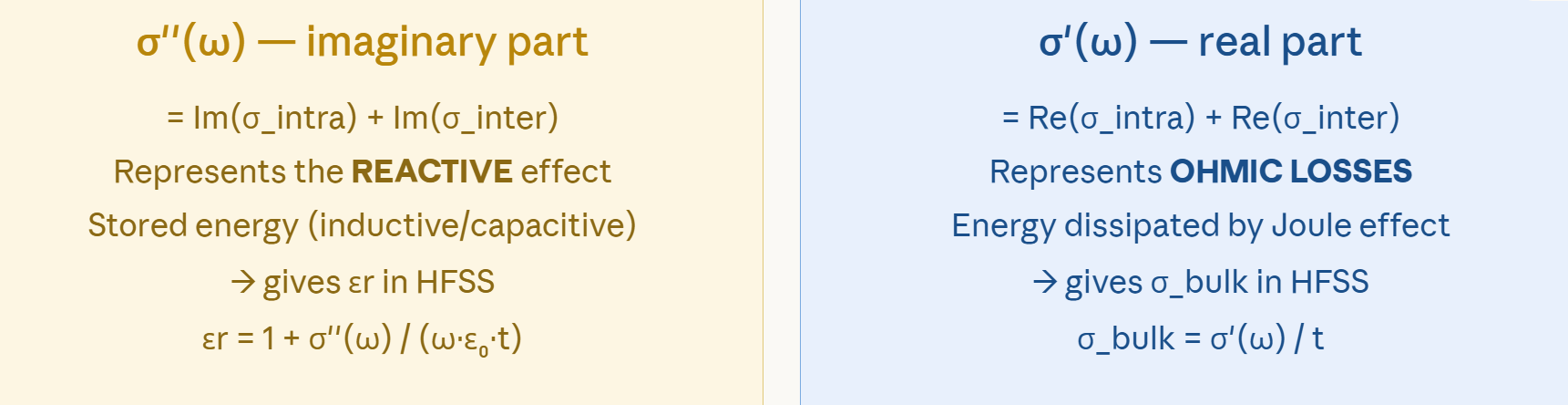
      According to my understanding, since there is no graphene material defined in the HFSS software, we need to define the material ourselves in the HFSS software. From the Kubo formula or Drude model, the complex conductivity of the graphene can be calculated, which is frequency dependent. However, in HFSS, the properties to define material only allows real values . 

      Is what is shown in this image correct/accurate?
       

    • Takeshi Itadani
      Ansys Employee
      In HFSS, the complex permittivity is defined by two factors: Relative Permittivity and Dielectric Loss Tangent. The Dielectric Loss Tangent is the ratio of the real and imaginary parts of the complex permittivity.
       
      On the other hand, it is known that Bulk Conductivity and Dielectric Loss Tangent are equivalent, and traditionally, HFSS uses a method of setting the frequency dependence on Bulk Conductivity when setting frequency-dependent materials.
       
      The equations for Relative Permittivity and Bulk Conductivity that you have pasted are thought to demonstrate how to set the complex conductivity in HFSS using the above relationship.
Viewing 1 reply thread
  • You must be logged in to reply to this topic.
[bingo_chatbox]








