Ansys Assistant will be unavailable on the Learning Forum starting January 30. An upgraded version is coming soon. We apologize for any inconvenience and appreciate your patience. Stay tuned for updates.
Fluids

Fluids

Topics related to Fluent, CFX, Turbogrid and more.

Successful simulation (with Pressure-based method) diverges with Density-based

    • killian153
      Subscriber

      Hello everyone,


      I try to simulate a convergent-divergent nozzle flow based on this subject https://ntrs.nasa.gov/search.jsp?R=19820006179
      Following the method used by these people: https://tfaws.nasa.gov/TFAWS11/Proceedings/TFAWS2011-AE-001.pdf?fbclid=IwAR28cKI5Ghk_hSVQ5ckgZiXs3ibXEyAWBguCsy7cCUrd8aXHURRLa3gRX1E


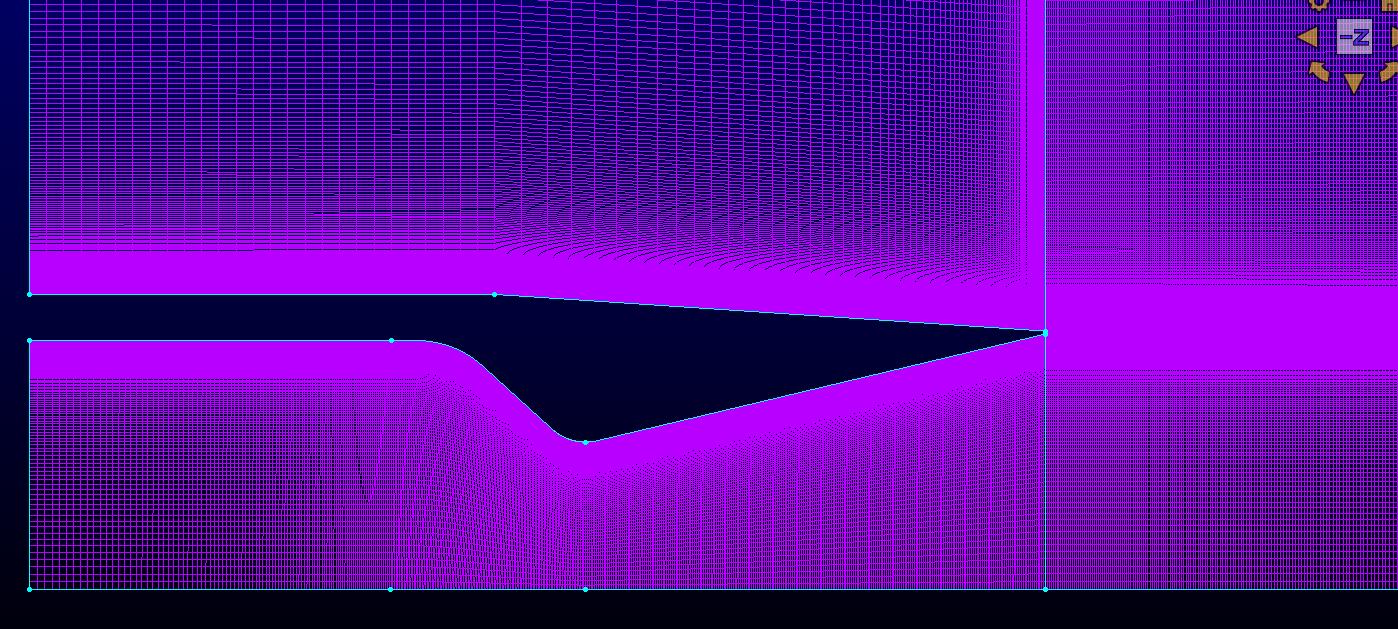
      I went from a simulation where I wasn't satisfied about the results I got regarding the pressure coefficient results and the flow separation position. So I came back to my mesh and refined it nicely, with y+ consideration. My new results with a pressure-based method are way better than before, the target y+ is good and the pressure coefficient near the wall finally fits the experimental one.
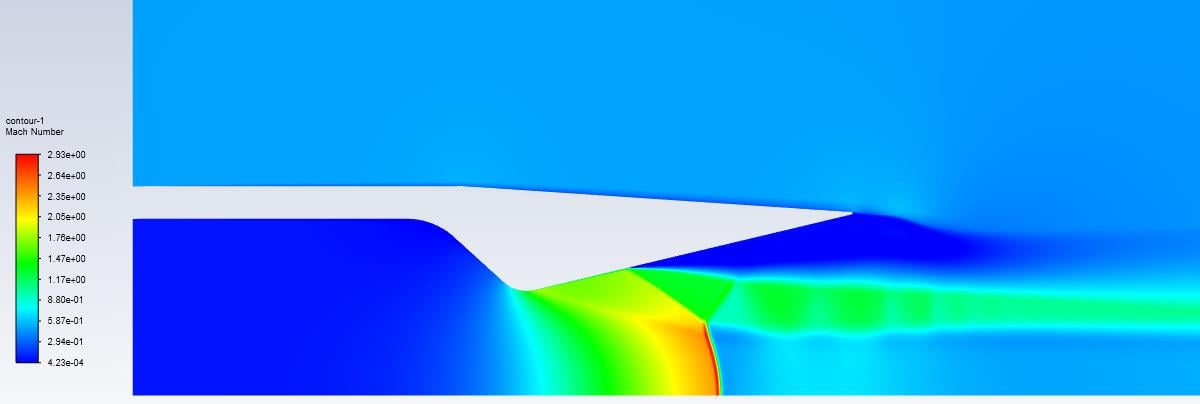


      BUT, when I switch to Density-based method, things go wrong. Simulation fails to start well and diverges very quickly. I tried everything : CFL number variation, changing from AUSM to FDS, using standard or hybrid initialization etc.


      The methods used are:


      - Pressure Based Coupled Solver (PBCS) with 1/ 2nd order for all equations


      - Density Based Solver (DBNS) with 2nd order for all equations


      Input parameters:


      Material: Air (ideal-gas)


      Model: SST k-omega (2 equ.)


      Boundary conditions: 1 pressure inlet (2.5 atm), 1 pressure outlet (1 atm)


      Solution method: AUSM - Least square - 2nd order


      Initialization method: Hybrid or Standard


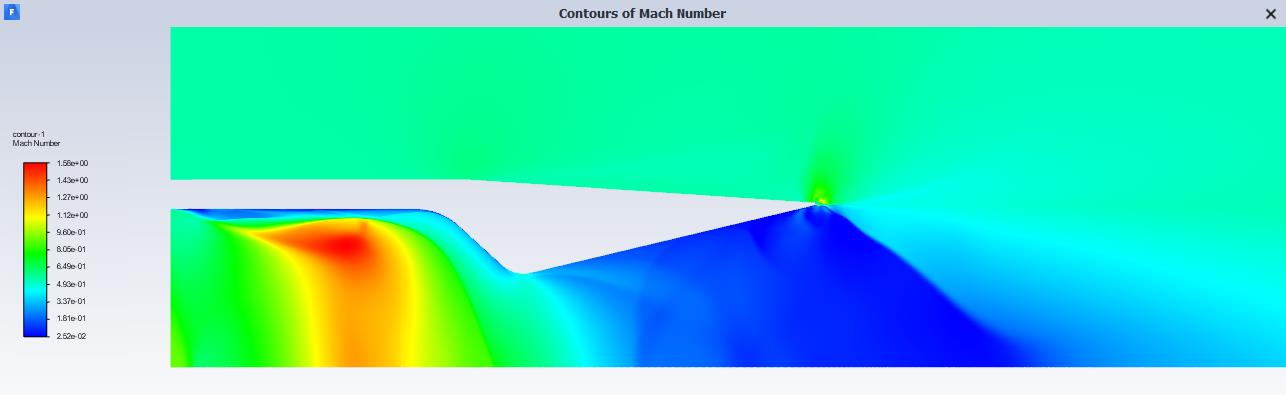
      It seems like a shock wave is created at the first iteration (ignoring the initialization) and is at the origin of the divergence.


      I screened the first iterations :
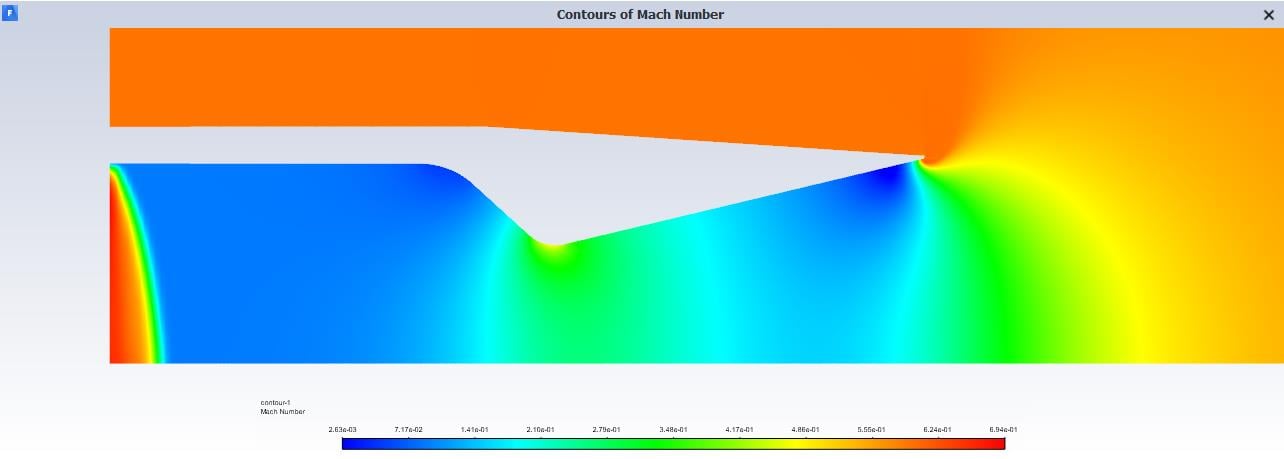


      Do you have any idea what could be the origin of this failure?


      Best regards.

    • Kalyan Goparaju
      Ansys Employee

      Hello,


      Can you try using 1st order schemes to launch the simulation and if/once the solution settles, change them to 2nd order?


      Thank you, 


      Kalyan

    • killian153
      Subscriber

      Hello Kalyan,


      Currently running the simulation but the residuals don't look very good..


      " alt="" width="668" height="279">


    • killian153
      Subscriber

       After 9355 iterations :


    • Rahul Kumar
      Ansys Employee

       Hello, 


      When you using DBNS, can you try with explicit formulation and let us know what you get. 

    • killian153
      Subscriber

      Hello rahkumar,


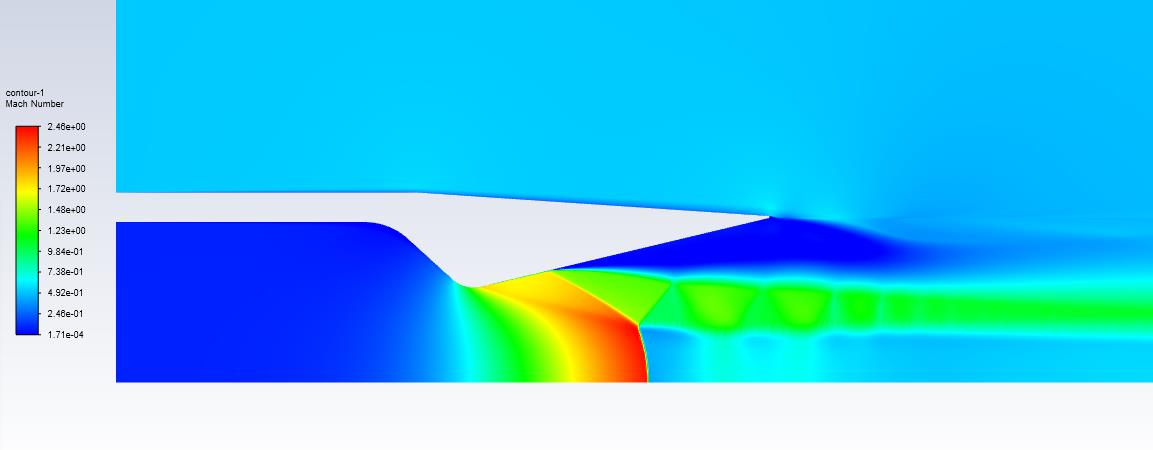
      Here's what I get with a 1st order to 2nd order simulation (Implicit):


      The solution looks good but the result is not right, as you can see below with the orange curve (the flow separation occurs too early):


    • Kalyan Goparaju
      Ansys Employee

      Hello, 


      Shock waves are discontinuities in the flow which create instabilities. By using first order, you are artificially adding a lot of dissipation and ensuring that any numerical instabilities/disturbances are smoothed out. It is always best to "establish" a reasonable flow-field and then switch over to high order schemes to ensure stability of the numerical scheme.


      Thanks, 


      Kalyan

    • killian153
      Subscriber

      Ok I see, so this fact increases with the mesh quality? I mean, with a poor mesh I was able to start at 2nd order directly, but not with the actual mesh.


      And do you now why I can't get the right results? Is my CFL = 1 too high? With Implicit formulation CFL should not be too high with this value.


      Thanks.

    • Kalyan Goparaju
      Ansys Employee

      With a poor mesh, you are diffusing the shock. So, it might be helping you in stabilizing the solution. 


      CFL=1 is a good choice. In fact, you can even go higher when using an implicit formulation. Unfortunately, without digging into the depths of the problem, I don't think I can comment on the cause for discrepancy in the results. 


      Thanks, 


      Kalyan

    • killian153
      Subscriber
      Hello Kalyan
      Indeed, I've seen that CFL can be way higher with Implicit.

      I would really like to go in the depths of the problem. Do you think we should start with the mesh? Can I send you the .cas file containing the mesh?

      Best regards
      Killian
    • Kalyan Goparaju
      Ansys Employee

      Hello Killian, 


      Unfortunately, support through this forum is limited to providing guidance and debugging (when possible) only. If I were to debug the problem, I would definitely start with the mesh. 


      Thank you, 


      Kalyan

    • killian153
      Subscriber

      Hello Kalyan,


      So to solve my problem I went back to the mesh as you recommended. I decided to reduce the number of boundary layers at the nozzle wall, in order to make the shock diffusion easier while keeping my targeted y+. Indeed, my thoughts were that too many thin boundary layers could make shock wave attachment to the wall really difficult.


      And it worked! I reduced the boundary layers to 20 with a 1.2 growth rate and now I have good results even when starting directly with 2nd order.


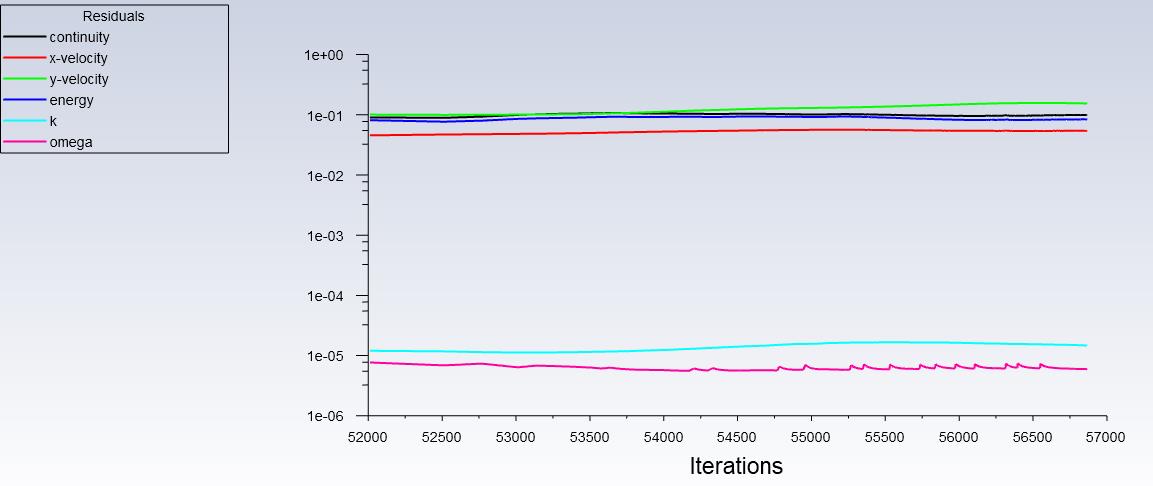
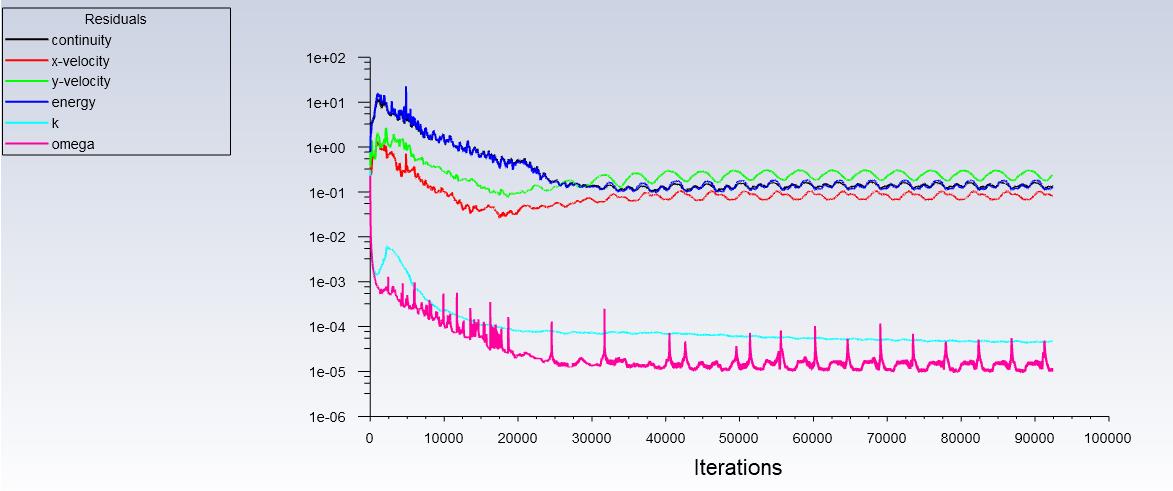
      Just a question: how do I know when my solution is converged/finished? I mean, as you can see below, it seems that after 40000 iterations I have a some stability and cycle pattern.


      Thank you!

    • Kalyan Goparaju
      Ansys Employee

      Hello, 


      I am glad that you were able to work things out. The default setting for convergence is for the residuals to fall below a threshold of 1e-03. If there is any unsteadiness in the flow, the residuals generally start oscillating. This behavior is usually the cue for conducting a transient analysis to check for the cause of unsteadiness. If you know for a fact that you should get a stead-state solution, but the residuals are flat/oscillating instead of monotonically going down,  I would recommend reducing the under-relaxation factors for the 'higher' residuals and checking if that helps stabilize the simulation and take it to convergence. 


      Thanks,


      Kalyan

    • killian153
      Subscriber

      Hello,


      How do I know which URF I should reduce? And do I have to restart the solution? In my solution controls I have:


      • Turbulent kinetic energy : 0.8

      • Specific dissipation rate : 0.8

      • Turbulent viscosity : 1

      • Solid : 1


      My residuals seem to show that 4 residuals cannot converge (continuity, x-velocity, y-velocity and energy).


      Thanks.

Viewing 13 reply threads
  • The topic ‘Successful simulation (with Pressure-based method) diverges with Density-based’ is closed to new replies.
[bingo_chatbox]