Ansys Assistant will be unavailable on the Learning Forum starting January 30. An upgraded version is coming soon. We apologize for any inconvenience and appreciate your patience. Stay tuned for updates.
Platform

Platform

Topics related to optiSLang, HPC, DesignXplorer, Cloud and more.

Issue on system coupling mapping in rotating machinery

    • KirillKabalyk
      Subscriber

      Good afternoon,


      I am currently working on a transient one-way FSI (CFX-Mechanical) analysis through System coupling. My object is a centrifugal compressor impeller. I simulate whole 360 degree meshes both in CFX and Mechanical, therefore it's a case of two usual transient runs (no transient rotor-stator). My goal is to analyse the structural response of impeller to fluid-induced excitations. No need for heat-transfer analysis, I create only Force transfer interfaces. Even though I more or less gathered the basics of data transfer and mapping from the Help, there is still one issue where I experience difficulties.


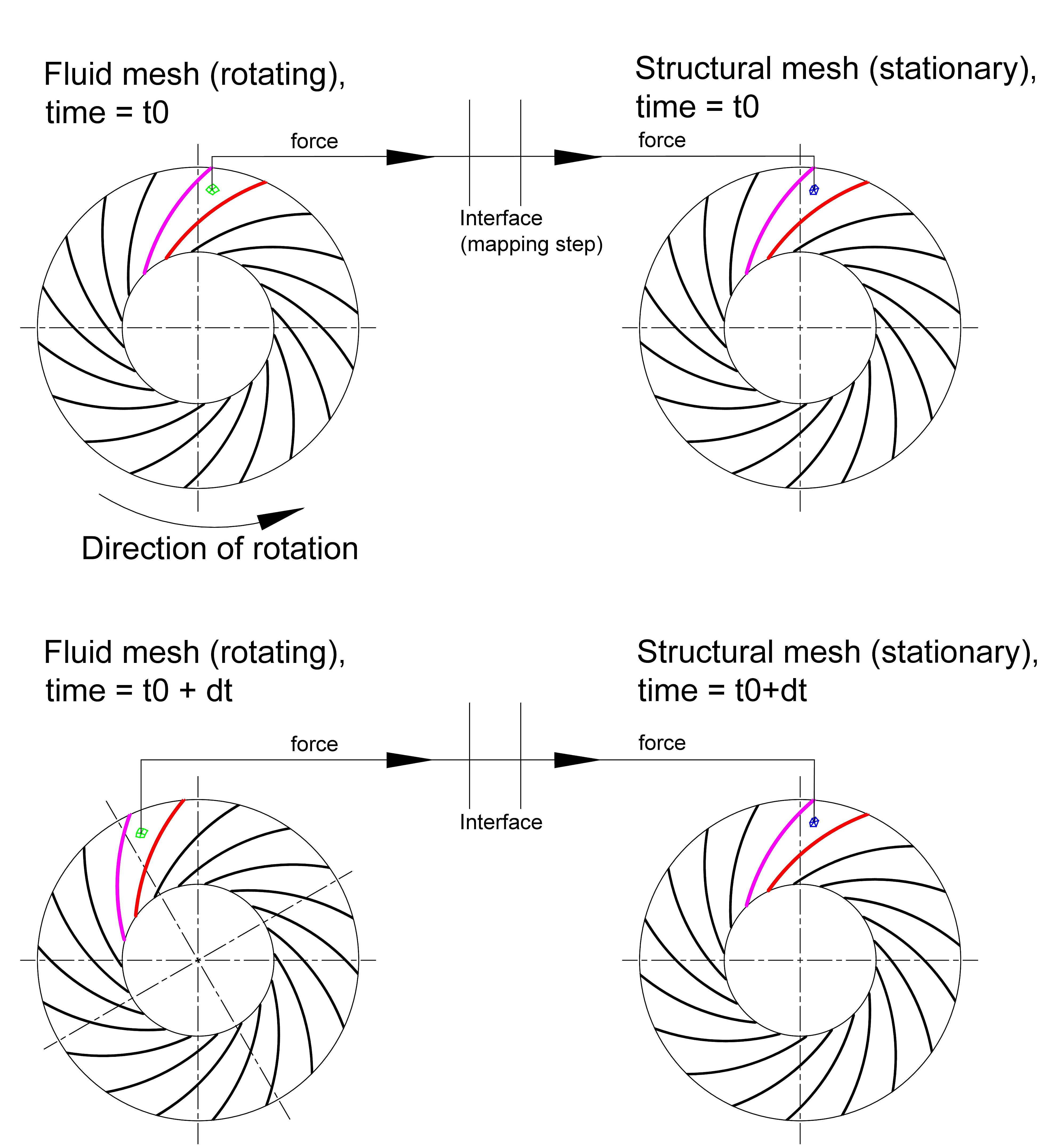
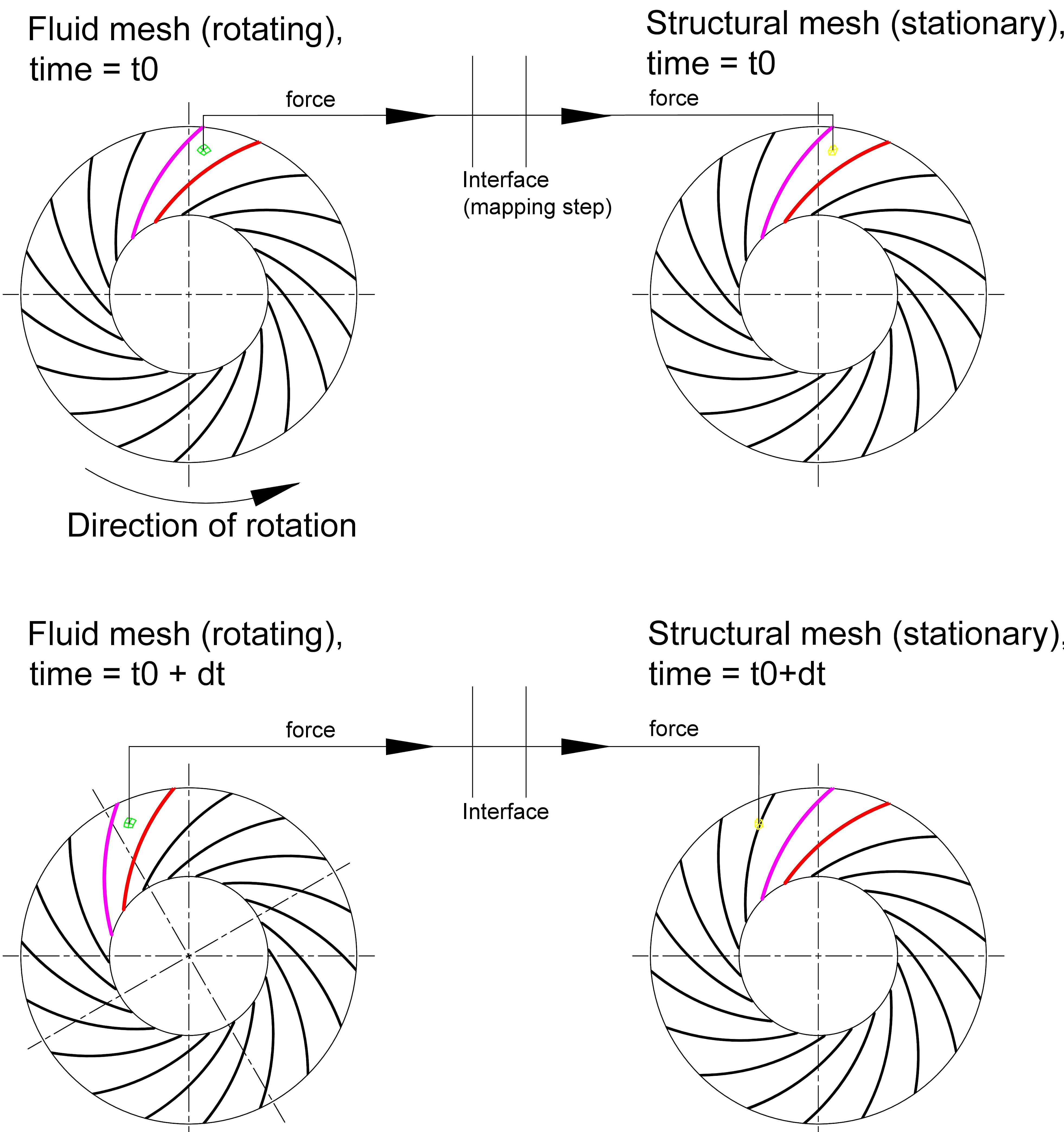
      Since I employ a transient rotor-stator interface in fluid domain, the fluid mesh rotates during the simulation. The structural mesh, though, stays stationary, since the rotation velocity load is only specified to count for centrifugal forces (zero displacement is on shaft-fitting surface, fluid-solid interfaces are specified on 15 blades individually, on impeler hub and shroud). To believe that the solution I recieve is sensible  I need to be sure that the data from rotating (source) mesh's nodes is always transfered to the same nodes in the stationary (target) mesh (see the Figure below).


      Desired_mapping_result  


      I am aware that there is only one mapping step in the entire simulation and this should ensure the requirement I need, but if for some reason the mapping is not strictly "node-to-node" but "node-XYZcoordinate-XYZcoordinate-node" I may obtain the following result, which is then incorrect:


      Undesired_mapping_result


      Will be grateful if anyone can commnent on this issue.


      Kirill.


    • Steve
      Ansys Employee

      It's better not to use System Coupling for 1-way FSI turbo cases.


      For Harmonic Forced Response (CFX pressure to Mechanical), see this tutorial:


      https://ansyshelp.ansys.com/account/secured?returnurl=/Views/Secured/corp/v201/en/cfx_tutr/i456895420556.html?q=%22harmonic%20forced%20response%22


      For Blade Flutter (Mechanical displacement to CFX), see this tutorial:


      https://ansyshelp.ansys.com/account/secured?returnurl=/Views/Secured/corp/v201/en/cfx_tutr/cfxtbrftflutter.html

    • KirillKabalyk
      Subscriber

      Dear Steve,


      thanks a lot for reply and for the tips. Importing loads from CFX to Mechanical as imported loads was actually what I had started with (this was without Transient blade row, just normal transient run with 360 degree mesh). Then I realized that the  pressure fields on hub and shroud surfaces imported to Mechanical at two subsequent timesteps were rotated with respect to each other nad the trend was cyclic. I used three interfaces (hub, shroud, blades) , did not divide each of them into to 15 transfers (45 transfers for one step, too much). Not finding the option to correct this, I switched to system coupling.


      I suspect, I found out the answers concerning my initial post. I ran two simple cases with coupling between stationary meshes (case 1) and  between rotating fluid-stationary structural (case 2). 


      There is some issue with uploading the figures, but I found out two points:


      1, The mapped meshes must be at the same mutual locations at the mapping step.


      2. Once the mapping is done, there is no difference, whether the fluid mesh rotates or not, the load on the structural mesh is transferred from node-to-node.


      Thanks again, 


      Kirill

Viewing 2 reply threads
  • The topic ‘Issue on system coupling mapping in rotating machinery’ is closed to new replies.
[bingo_chatbox]