Ansys Assistant will be unavailable on the Learning Forum starting January 30. An upgraded version is coming soon. We apologize for any inconvenience and appreciate your patience. Stay tuned for updates.
General Mechanical

General Mechanical

Topics related to Mechanical Enterprise, Motion, Additive Print and more.

Help with Convergence Issues in Static Structural Analysis

    • Zeel
      Subscriber

      Hello Everyone,

      I’m working on a static structural analysis in Ansys Mechanical (workbench) where beams (bristles) rotate and contact a backplate, but I’m facing persistent issues with the convergence. Here’s a summary of my problem and trials:

      • Geometry: Around 220 beams (consider the bunch of the beams as a rectangular shape) with the near far contact status intially. These beam are rotated with time*8 rotational displacement (8 deg per second) against one fixed plate which 1/6th of the size of the beams and is working as a stopping plate to these rotated beams. 
      • Material: Structural Steel (Young’s modulus 2e11 Pa).
      • Load: Rotation applied as 8 deg/sec 
      • Latest Mesh: Face sizing 0.00007 m (backplate), edge sizing 0.0005 m (beams), body sizing (global) 0.0009 m.
      • Contact: Frictional (with frictional coeffiecient 0.1) (PurePenalty) with normal stiffness factor 0.012 for beam-beam and beam-backplate pairs. There are around 600 beam - beam contact pairs and 20 beam - backplate contact pairs. 
      • Issue: Total DOF and amount of force increases extensively during the solution process, which could be beyond the limit of the ansys. (Max DOF 8.8746e+6, and Max Force 1.6109e+11 during the solution process). I also tried NCNV,0,1e8 command to elimiate the limit fo the ansys, but it is still not working out. The beams simply messes up, in all the direction like shapeless. 

        I am currently applying the following APDL commands: 
      • NCNV,0,1e8  
      • NEQIT,80
      • CONTACT, adjust, all, 0.

      I also tried increasing the normal stiffness factor upto 0.1 to 1 to 10 but it still didn't work out. 

      Instead of all the 220 beams, when i try to run the simulation only for the nearest beams to the backplate, it converges. But when i try to get the solution for all 220 beams, it doesn't converge. 

      So is there any method, or trick or specific parameter i can use here to find the solution? Anyone has ever worked with this much high amount of the DOF and Forces? If yes, it would be great if you could share some insights on how to get the solution. Even the smallest help would be appreciated.  

      Thanks for your help!

    • peteroznewman
      Subscriber

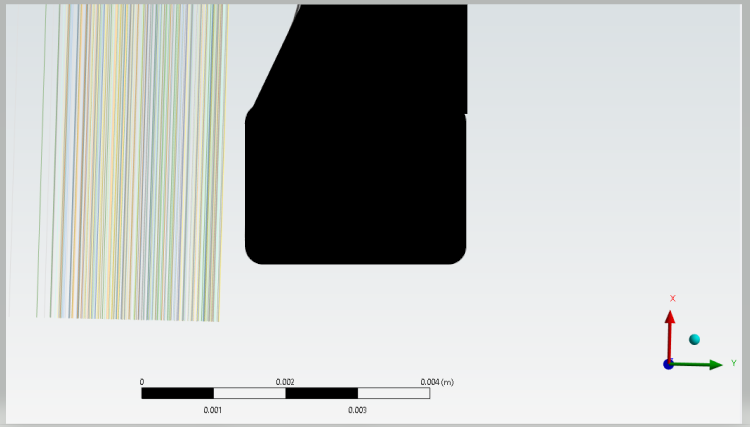
      An image would be nice Zeel.

      I suggest LS-Dyna or Explicit Dynamics because explicit solvers don't need to converge and are excellent at detecting contact.


    • Zeel
      Subscriber

      Thank you for your reply. Due to data privacy, i cannot provide the exact geometry, but as you can see in the figure, the beams and the backplate geometry is almost similar to the original geometry. After providing the rotational displacement to the beams (from the top vertices), when the beams comes in with the contact to the backplate, it tries to hold the beams. but as mentioned in the previous question, DOF and amount of force increases too much due the beam- beam, and beam -backplate contact pairs. 

      Regarding the LS Dyna, i can only use the Ansys MAPDL solver as of now. So that's not the option.

    • peteroznewman
      Subscriber

      You describe this as a Static Structural analysis. You say the beams are rotating at 8 degrees/sec. What axis are the beams rotating about? You show the outline of the backplate with a gap to the beams. How is that gap closed?

      If the beams contact the backplate with friction, stick, flex, and then need to slip, that seems like a dynamic event and a Static Structural analysis will fail to converge when the next load increment requires a dynamic, snap-through type of response. There are special methods to get past a single event like that in a Static Structural analysis which can be useful if the subsequent load increments will be stable after that snap-through, but in your case with so many beams, that will be a constant problem. I suggest you try using a Transient Structural analysis which, with a small enough time step might get past a snap-through event. However each time step still has to converge, so though you don't currently have access to LS-Dyna, it may be required to solve this model.


Viewing 3 reply threads
  • You must be logged in to reply to this topic.
[bingo_chatbox]