-
-
April 5, 2020 at 6:13 pm
Nyurons
SubscriberHello,
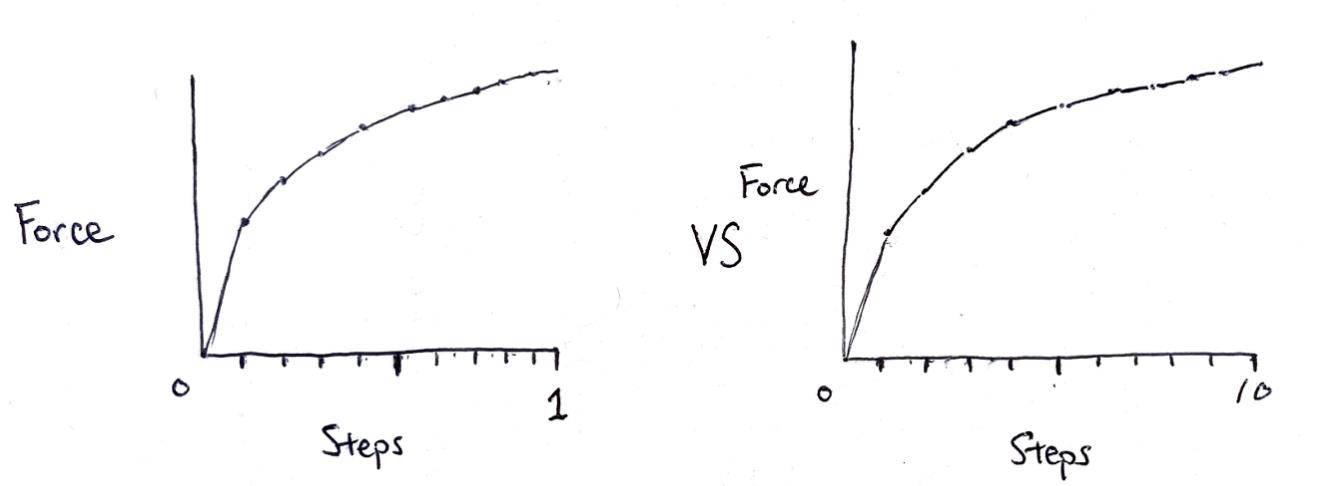
In transient structural, what is the difference between applying a load that varies in its magnitude over 1 step vs multiple time steps (like 10 steps, for example)? Which method is considered more conventional? Please see the picture below for your reference. Both represent a simulation of 1 second.

Also, I will be coupling this transient structural with fluid flow (Fluent). Would the "1 step method" or "multiple steps method" affect convergence during coupling?
Thank you so much for your help.
-
April 5, 2020 at 6:50 pm
peteroznewman
SubscriberIt is easier to have 1 step and let the substeps define the intermediate points.
One reason to have 10 steps is if you need data at exactly 1 second increments, and the automatic substeps might not land on an exact integer time.
-
April 5, 2020 at 8:37 pm
Nyurons
SubscriberThank you for your quick reply.
Can you please elaborate on what becomes "easier"?
If I chose to do the 1 second simulation with varying load over 1 step (10 increments like the photo),
- Is 10 the appropriate Number of Substeps?
- Would the simulation be affected in any way if I chose 100 substeps?Â
- What should the Step Size be in Fluent/System Coupling?
Again, thank you so much for your help.Â
Edit: Ideally I want 100 "pictures" or data over 1 second (so, "pictures" at every 0.01s).                                                                                     Â

-
April 6, 2020 at 1:22 am
peteroznewman
SubscriberIf you have 10 steps, the Analysis Settings for each step have to be done one at a time, which is one reason one step is easier.
If you want 100 pictures, then just set the Initial and Minimum Substeps to 100. The Maximum substeps can be 200.
There is no penalty in using 100, it just makes the solution take more time to finish because more data has to be computed and written.
-
April 6, 2020 at 1:30 am
Nyurons
SubscriberThank you again for your help.
Ok, so if I was to get 100 "pictures" or data using 100 substeps, is it correct to have 0.01s for my Step Size and End Time of 1s in System Coupling?Â
Thank you for being patient with my questions!
-
April 6, 2020 at 1:33 am
peteroznewman
SubscriberYes, that is correct if both systems can converge with that time step.
You might need smaller time steps so that each system can converge.
-
April 6, 2020 at 1:42 am
Nyurons
SubscriberThank you. I am amazed that you have mentioned convergence because I am actually facing convergence issues. Fluent side of system coupling does not seem to converge from around 0.35s (and ANSYS gets stuck at around 0.40s). How can I improve the chances of convergence from the aspect of time step or step size?
-
April 6, 2020 at 11:11 am
peteroznewman
SubscriberIs the error on the Structural side actually fails to converge or is the error highly distorted elements, because there are different corrective actions. But in general, smaller time steps may be necessary to obtain convergence, but they may not be sufficient to obtain convergence. Better element quality may also be required or some other changes that are very model dependent.
There is a whole workflow laid out in the ANSYS Help for developing a model of coupled systems, which entails solving each physics without the coupling first. Have you done that?Â
-
April 6, 2020 at 12:38 pm
Nyurons
SubscriberThank you for your reply. The Transient Structural side does seem to converge according to the solution information on system coupling. However, the Fluent side starts to not converge in the middle of the system coupling.
I have only skimmed through the System Coupling User's Guide, so I will take a look at it. While I cannot find the exact cause of the error, highly distorted elements are most likely the large factor in the error (or the Setup of the Fluent side).
-
- The topic ‘Varying Load over 1 Step vs Multiple Steps.’ is closed to new replies.
-
6570
-
1906
-
1463
-
1311
-
1022
© 2026 Copyright ANSYS, Inc. All rights reserved.