-
-
March 31, 2020 at 11:54 pm
bryce.hesterman
SubscriberCould someone explain how to calculate the magnetic dipole moment using the Maxwell Calculator?
-
April 13, 2020 at 2:05 pm
Paul Larsen
Ansys EmployeeThere are are a few definitions/calculations of magnetic moments. The easiest is defined with respect to torque aligning to an external field. So, the easiest way to calculate the dipole moment is to apply an external field (or use a Helmholtz coil to create a uniform field around the object), and then calculate the torque vs angle around the center of the object/assembly. So, first you might try to create a uniform field without any objects, for which you could use a Helmholtz coil arrangement. Or you could use a combination of boundary conditions (Tangential H-field to define the direction tangent, and Zero Tangent to define the ends where the flux enters/exits the domain). Then insert the geometry, and use a Torque parameter on the entire assembly to calculate the T = m x B moment torque.
-
April 13, 2020 at 5:08 pm
bryce.hesterman
SubscriberThanks for the information. One issue of this approach is determining the center point of a complicated set of conductors.
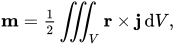
I found this information on Wikipedia:Â https://en.wikipedia.org/wiki/Magnetic_moment#Localized_current_distributions
I have been trying to implement this in the fields calculator. I can define r in terms of x, y & z, and enter r x j. I'm not sure how to implement the integral. My intention is to integrate over the current-carrying conductors in a magnetostatic simulation.
-
April 13, 2020 at 7:44 pm
Paul Larsen
Ansys EmployeeHi Bryce, All methods that I am aware of require either assumptions, estimates, or maybe iterative methods of determining the center reference point (such as your r-position reference).
You can perform the calculation around one axis at a time, so you could calculate m_z for positions with reference to the global Z-axis with the following Field Calculator commands:
- Function > Scalar: X (global X position)
- Vec? > VecX
- Function > Scalar: Y (global Y position)
- Vec? > VecY
- + (this is a radial position vector, you can add VecZ position to obtain full position)
- Quantity > CurrentDensity (J)
- Cross
- Scal? > ScalarZ (integral needs to be performed on scalar components separately)
- Geometry > Volume Object
- Integral
You can then repeat for X and Z axis. Apply the 1/2 scaling at any time.
-
January 25, 2023 at 2:48 pm
Ismail Ata Asan
SubscriberÂ
Â
Hi Paul,
i couldn’t follow the directions you provided. I am relatively new to Ansys Maxwell so I can’t say, I understand what you mean with Function>Scalar.
I’ve tried with two permanent magnets to cause a homogenous Field to then let Ansys solve for torque and then calculated the dipole moment myself. The problem with this approach is that it is in my experience unreliable. You have to pay good attention to how the parameters are set, like the relation between the magnets sizes and the probes size (so that the field is homogenous relative to the size of the probe) and the relation between the magnetic fields (which dominates, plus setting any field to strong or placing a conductive probe near the big magnets could lead to other forces to dominate thus hindering the chances of getting a reliable result) etc. are very important. Ansys gave me implausible results for some set-ups and I have no idea which parameters I choose poorly. But in certain cases I have indeed found values similar to the theoretic maximal capabilities of some magnets and the values matched. But I am on the look-out for more reliable methods. I would love it if you could help, since I am also using the measurements for my thesis and would appreaciate the option of also simulating them (at least knowing that it is possible).
Â
PS:
I don’t think using Helmholtz Coils would deliver a different result since what I am doing is kind of similar anyway. It might work better but still not as reliable as I would like… Unless of course I build a Helmholtz Coil in Ansys Maxwell with the apropriate circuit and use to determine the induced voltage, which is exactly what I can do in real life anyway. Basically a virutal Helmholtz test-bench. It doesn't sound very efficient
Â
Â
-
- The topic ‘Magnetic Dipole Moment’ is closed to new replies.
-
6760
-
1906
-
1485
-
1330
-
1097
© 2026 Copyright ANSYS, Inc. All rights reserved.