Ansys Assistant will be unavailable on the Learning Forum starting January 30. An upgraded version is coming soon. We apologize for any inconvenience and appreciate your patience. Stay tuned for updates.
Optics

Optics

Topics related to Speos.

How to analyse the luminous intensity at various distances from the light source

    • S.Manuvarshan
      Subscriber
      Hello,

      In Ansys SPEOS 2024 R1,

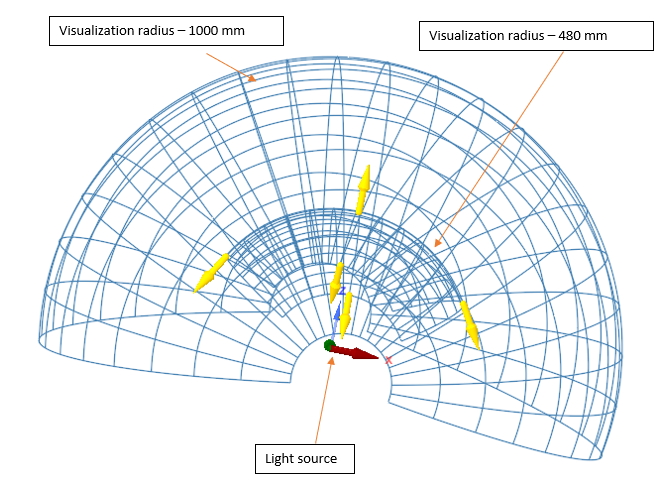
      I created two intensity sensors (same origin axis) at differenent distances from the source.

      One is located at a distance of 480 mm and the other is located at 1000 mm.

      I checked the intensity values after the simulation. Both of them showed the same intensity in candelas (cross checked with various measurement positions).

      But, according to the inverse square law, the luminous intensity must fall with greater distances right (intensity ∝ 1/d2) ?

      Why i did not see any change in intensity ? suppose if i had done a wrong sensor construction in SPEOS, kindly correct me.

      Thanks & Regards
      Manu Varshan


    • nomad
      Subscriber

      You can check this userguide, Understanding the Parameters of an Intensity Sensor.
      Also you can contact Ansys local support and ask more specific questions from https://customer.ansys.com

    • Karabasappa Tallur
      Ansys Employee

      Hello, 

      Please find the explanation for your query below

      Luminous Intensity (Candela - cd):
      Luminous intensity is the amount of light power emitted by a source in a specific direction, measured in candelas (cd). It represents how bright a source appears when viewed from a particular angle.

      Mathematically:

      I=Φ/Ω

      where:

      • I = Luminous Intensity (cd)
      • Φ = Luminous Flux (lumens, lm)
      • Ω = Solid Angle (steradians, sr)

      Key Points:

      1. It describes the directional brightness of a source.
      2. It does not change with distance (unlike illuminance).
      3. A point source emitting uniformly in all directions has a total intensity distributed over a 4π steradian solid angle.

      Luminous Intensity (cd) vs. Illuminance (lux)

      • The inverse square law applies to illuminance (lux), which measures how much light falls on a surface.
      • Luminous intensity (cd), however, describes the amount of light emitted in a specific direction. If the light source is directional, the intensity may remain constant across different distances.

        Thanks
    • Alessia Fra
      Ansys Employee

      Hello,

      the visualisation radius just affects the graphics, but the intensity sensor still have an infinite radius.

      If you want to calculate the intensity at a specific distances, you need to switch to TRUE the parameter NEAR FIELD that you have inside the sensor's definition window: https://ansyshelp.ansys.com/account/secured?returnurl=/Views/Secured/corp/v2511/en/Optis_UG_ASP/Optis/UG_ASP/understanding_the_parameters_of_an_intensity_sensor_180916.html

      Thanks and kind regards

    • S.Manuvarshan
      Subscriber
      Hello Alessia,

      It's very similar to the case of lightweight & heavyweight geometries!

      Thank you very much for clarifying.

      Have a nice day!

      Best Regards
Viewing 4 reply threads
  • You must be logged in to reply to this topic.

[bingo_chatbox]