-
-
February 3, 2025 at 8:23 am
bb52123130
SubscriberDear Supporters,
 I hope this email finds you well. I am currently working on a nonlinear finite element analysis (FEA) involving a pneumatic soft actuator subjected to negative pressure conditions and contact interaction with an external object. As these analyses involve complex nonlinear behaviors, I would appreciate your advice on improving the stability and convergence of the simulations.
â—ŽOverview of the Analysis
The analyses I am conducting include the following cases:
Negative pressure deformation: Internal air pressure is set to -0.05 MPa.
Contact analysis with remote displacement: The actuator is not actively pressurized, and an external object is pressed against it using remote displacement.
Contact analysis with force application: Instead of remote displacement, a 100N force is applied.
Combined analysis: The actuator is subjected to both -0.05 MPa internal pressure and a 100N force.
For each case, I have two versions of the solid model: one with fillets and one without. This was done to examine differences in computation time, but so far, no significant differences have been observed with the current mesh settings.
The external object’s material properties are not precisely defined, so a default material is currently being used.
â—Ž Current Issue and Question
The simulations partially progress but do not complete successfully.
I suspect that refining the time step might help, but I am uncertain if that alone is sufficient.
What additional methods should I consider to improve stability and ensure the simulation completes successfully?I would greatly appreciate any insights or recommendations you may have.
I have attached the relevant files for reference:
https://www.dropbox.com/scl/fi/z30hpbwv2qdjsw7gjb0j4/Pneumatic.wbpz?rlkey=rmyimzlff2gijqx3l0i18etn9&st=t53sq5q8&dl=0Â
Thank you for your time and assistance. I look forward to your advice.
Best regards, -

February 3, 2025 at 10:34 am
ErKo
Ansys EmployeeHello
Ansys employees are not allowed to download any files (perhaps other forum members might be able to do that and help).
We would like though to offer some advice. There are a few videos from ANSYS channel partners and users that offer extensive troubleshooting (nonlinear problems) advice:
https://www.bing.com/videos/riverview/relatedvideo?q=convergence+issues+and+troubleshooting+and+advice+and+ansys&mid=306CEEEA423CE8E18B28306CEEEA423CE8E18B28&FORM=VIREAll the best
Erik
Â
-
February 3, 2025 at 12:50 pm
bb52123130
SubscriberThank you for your prompt support! I really appreciate it.
I watched the YouTube link you shared, but I’m still struggling with the issue of element distortion during large deformation analysis.
To investigate the problem, I checked the Newton-Raphson residuals, but I’m not sure how to use this information to resolve the issue. Whenever I identified distorted elements, I refined the mesh locally, but this did not solve the problem.
Would nonlinear adaptive meshing be necessary in this case?
Additional Note:
I realized that my input file did not properly account for the 1/4 scale model conditions.
The internal pressure remains at -0.05 MPa.
The external force should be reduced to 25N instead of 100N.
I truly appreciate your help and guidance! Looking forward to your insights.
Best regards,
-
-
February 3, 2025 at 2:38 pm
Sai Deogekar
Ansys EmployeeHello,
The following video might help you with regards to the excessive element distortion error:
How to Handle Element Distortion Errors in Hyperelastic Materials — Lesson 3 | ANSYS Innovation CoursesHope it helps!
Â
-
February 4, 2025 at 6:35 pm
bb52123130
SubscriberThank you for your response.
I have looked at the material you linked to and could not solve the problem. When the force applied to the hyperelastic is too large, is the only solution to make the time step finer from the point where the error occurs?
I have made some improvement with this method, but not to the point of my target analysis.
Thank you again for your support!
-
February 5, 2025 at 10:02 pm
peteroznewman
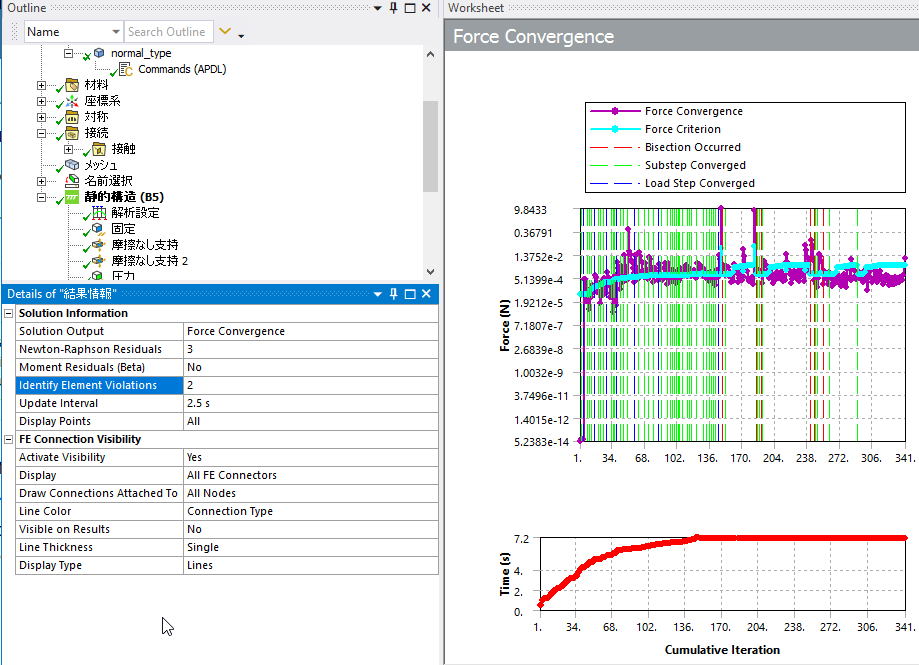
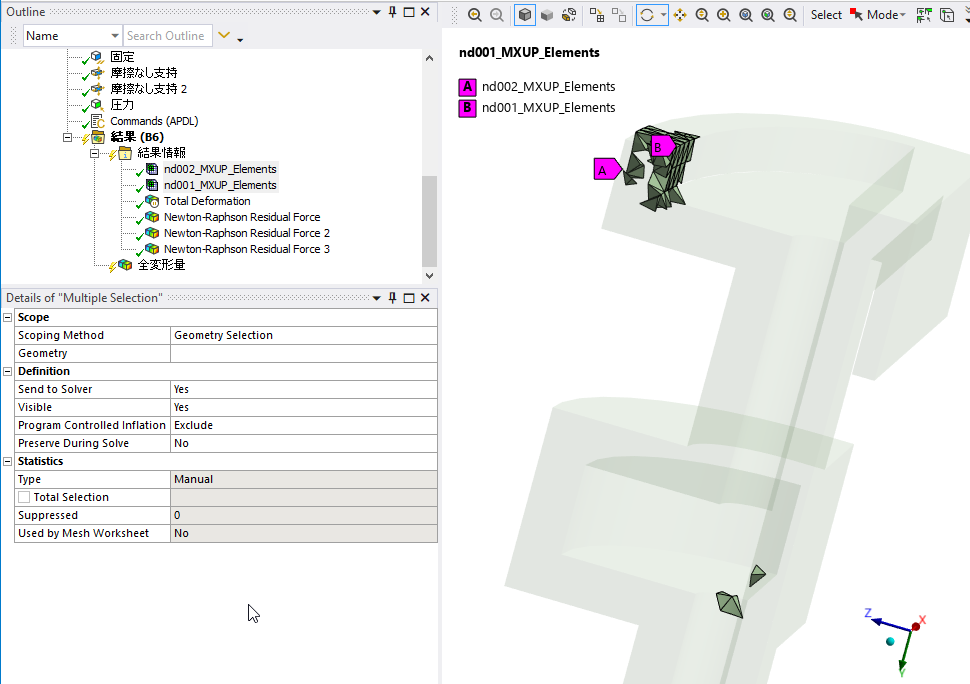
SubscriberI looked at your model and ran the B analysis on Normal -0.05 MPa spead out over 10 steps in 10 seconds. It failed at t=7.2 with highly distorted elements. Under Solution Information folder, you should set some non-zero values for Newton-Raphson Residuals and Identify Element Violations. The later will create a plot showing where the distorted elements are.
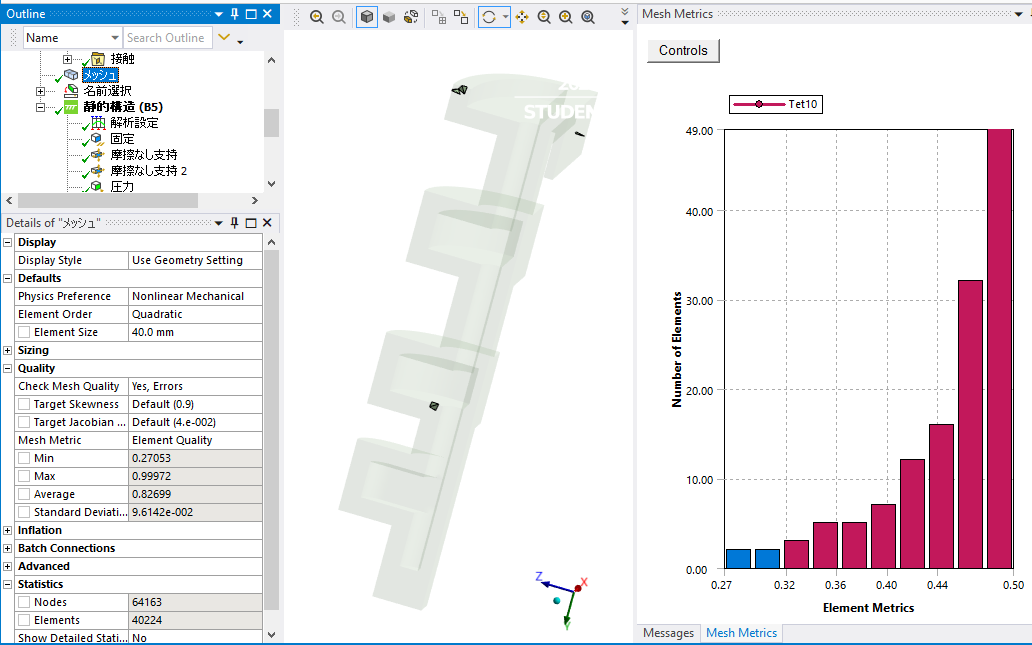
If you check the element quality metric, you can see where the low quality elements were before any distortion was added by the load.
You see that some of the low quality elements in the mesh are the same ones that produce element quality violations.
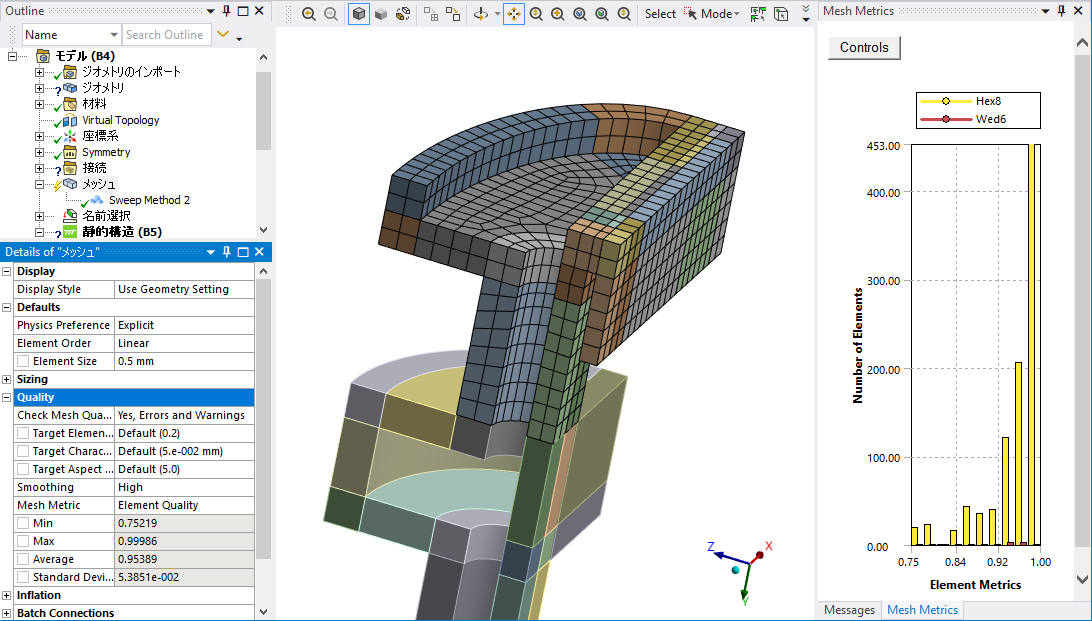
The corrective action is to create a higher element quality mesh. One way to do that is the slice the geometry up into easilty meshable shapes and use the Share button in SpaceClaim so that you can get a high quality hex mesh. -
February 7, 2025 at 3:51 am
-
- You must be logged in to reply to this topic.
-
6765
-
1906
-
1485
-
1330
-
1102
© 2026 Copyright ANSYS, Inc. All rights reserved.