Hi everyone,
I’m currently running a transient heat transfer simulation in LS-DYNA on a large model with over 5 million elements. The setup applies a short-duration heat flux to the top surface, and I extract nodal temperatures for post-analysis.
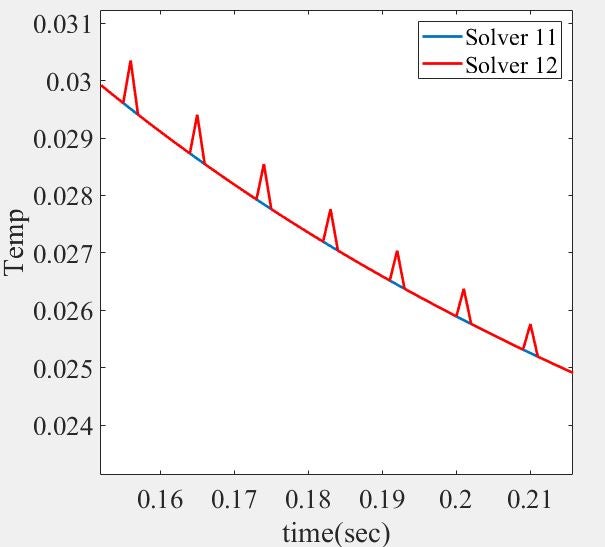
Using the direct solver (Solver 11) yields accurate results but takes days to complete, which is challenging as I need to run multiple simulations. Switching to Solver 12 (conjugate gradient) significantly reduces execution time but introduces considerable oscillations (spikes) in the temperature output, even though I’m using fully implicit time integration.
I’ve already adjusted the time step based on the minimum element size. While this setup produces smooth results with Solver 11, the oscillations persist with Solver 12 as seen in Figure
Are there any specific parameters or settings I can tweak to eliminate these oscillations in Solver 12? Any suggestions or advice would be greatly appreciated!


















 You are navigating away from the AIS Discovery experience