Ansys Assistant will be unavailable on the Learning Forum starting January 30. An upgraded version is coming soon. We apologize for any inconvenience and appreciate your patience. Stay tuned for updates.
Electronics

Electronics

Topics related to HFSS, Maxwell, SIwave, Icepak, Electronics Enterprise and more.

Leakage Inductance Calculation of an Induction Machine Using Ansys Maxwell 2D

    • ghandeb
      Subscriber

      Hi,


      I am trying to verify an induction motor's magnetizing and leakage inductance parameters using Ansys Maxwell. The motor model that I've been working on has already been manufactured, which means I can perform experiments on it. I did a series of analyses using RMXprt, Maxwell 2D and 3D. Further, I performed no-load and locked-rotor tests on the machine to estimate the parameters.


      However, I noticed that there is a discrepancy between the inductance values of the motor for 2D-3D simulations and experimental results.


      Considering the results of locked-rotor test, I calculated the leakage inductance around 6-7 mH (which is actually reasonable).


      In Rmxprt, I obtained similar results (shown in the attachment).


      However as I obtained the inductance matrix in 2D and 3D, I recognized that the leakage inductance is calculated as 22 mH, which is too large. (also in the attachment. As $L_m$ can be found as $2 L_{ab}$ or $2 L_{ac}$, it can be found as 74 mH and $L_{ls}$ is computed as $L_a - L_m = 96-74 = 22 mH$.).


      How can I calculate the leakage inductance of an induction motor using Maxwell 2D?


      Thanks in advance.


      rmxprt inductance


      3d inductance

    • Paul Larsen
      Ansys Employee

      Based on your RMxprt Stator Leakage Reactance result and your calculation of 6-7mH, I assume that you are operating at nearly 100-120Hz.  I'm just double-checking that because everything else you said sounds correct to me.


      Two subtle points to consider.  First, your calculation of Maxwell inductance with RMS should probably be switched to calculating the transient average inductance.  Second, in Maxwell, are you using No-Load (you mention both Locked-rotor and no-load)?  This would be best for only considering the stator contributions, as well as limiting nonlinear saturation effects that might increase leakage.


      Please also note, in 2D, the leakage result only includes the in-plane leakage effects, such as slot leakage and air-gap harmonic leakage.  Any additional end-effect leakage or skew leakage would need to be included separately.

    • ghandeb
      Subscriber

      First of all, many thanks for the reply.


      Yes, that's correct. I'm not operating at 50 Hz.


      In fact, the rotor is not salient at all, so would it make a difference to switch RMS to average? They both give the same result by the way.


      I run the simulation for both no-load and full-load cases. I am far beyond the saturation point, (using m19 steel and maximum B that I've seen is around 1.2 T), I run the simulation for both linear and non-linear cases. In all of them, the resuls are the same.


      I am aware that end winding effects are not included, but that's not my concern for now because these would increase the leakage inductance value even more.


      Is there a point that I'm missing? Did I misunderstand the definition of inductance matrix in Maxwell? Or should I create too much meshes inside the slots to calculate the leakage? My meshes are fine in the airgap and slot openings, moderate for the rest.


      Thanks in advance.



    • ranjanpal999
      Subscriber

      Hi,


      Thanks for putting up this question, even I had the same doubt.


      To add to this question, could you please share a link of some relevant research paper or standard reference book wherein we have the saturation curves along with the values of B and H of silicon steel that are used in motor manufacturing!

    • ghandeb
      Subscriber

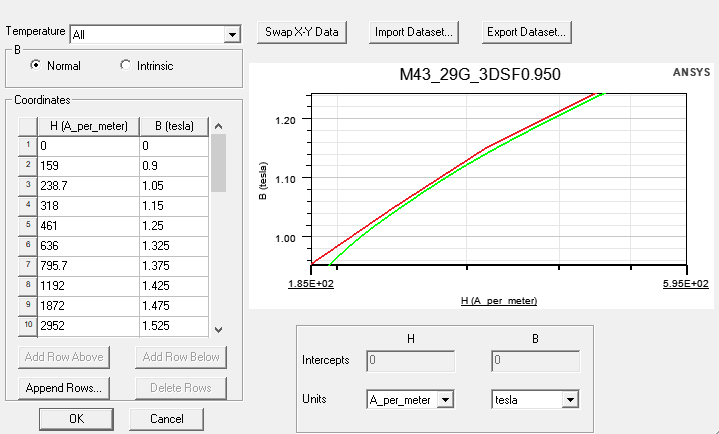
      Here is the BH-curve that I used in the model:


      As a reference, you can also check the datasheets that are published by electrical steel manufacturers, e.g. thyssenkrupp

    • Bharathi123
      Subscriber

      Hi all


      I'm simulating 3D Maxwell electric transient solver, all the mesh operations are valid and when it's solving for solutions I run into an issue where it says; '3dts' terminated abnormally. Could have been killed by the user or may have run out of memory.' even though my RAM is 8Gb and I did not abort the simulation.


      the second error is 'simulation completed with execution error on server: Local machine.


      could anyone please advise me on this.


      Thank you

    • ghandeb
      Subscriber
      Hi This question is irrelevant to this topic. Why don't you start a new discussion topic rather than adding a comment here?
    • Paul Larsen
      Ansys Employee

      Going back to the original question about leakage inductance.  I highly recommend the paper "Determination of slot leakage inductance for three-phase induction motor winding using an analytical method" by Jan Staszak, because it can be found online, and it gives an overview of the model and physical mechanisms of slot leakage inductance. 


      I wonder if the winding slot layout is not quite right according to your expectations.  Maybe the Maxwell model winding uses too much or too little of the slot - perhaps try to adjust the size of the winding cross section.  Maybe the Maxwell model is assuming a top/bottom double-layer layout, but you have a left/right double-layer layout.  Maybe the Maxwell model includes tooth tips that are too big (creating too much leakage within the stator).  You might try one case that simplifies the tooth/slot/winding geometry and see how that affects your leakage inductance.

    • Sadegh
      Subscriber

      Hi ghandeb


       For calculating leakage inductance of a machine slot you don't need to draw the whole machine, instead of it you can draw one of the slot by its corresponding conductive and applied currents (or current density) and apply symmetry boundary (or Even symmetry) to all outside edge of slot except the top one, which is horizontal and you should assign Dirichlet (or vector potential)  boundary condition with Az=0 to it.


      Now If you want to calculate leakage inductance in "slot"  by Maxwell calculator do the following steps :


      1: after analysis completion draw a (non-model) line from the bottom of the slot to top and assign it the desired name( for example Hight_1). 


      2:go to built-in calculator and calculate all the magnitude of B (flux density) on Hight_1 (line integral of the magnitude of B on Hight_1) your expression in the calculator should be like this : Scl : Integrate(Line(Hight_1), Mag( ) )


      3:calculate phi (flux)  :   multiplying the result of "step 2" by L( stack length or machine length)   (flux= B* Area)


      4: calculate flux-turn : multiplying flux by number of turn (lambda= phi*N)

      5: calculate (leakage) inductance : Divide flux-turn by current (L=lambda/current)

    • ghandeb
      Subscriber

      The result is still not compatible with analytical ones or RMxprt output, but I think we have no other option or another solution approach. Thanks for your help.

    • Sadegh
      Subscriber

      ghandeb


      for calculating slot leakage inductance, you could send the following information and I will check it for you.

      1-slot geometry


      2-conductor diameter


      3-number of conductor


      4-nominal current


      5-stack length

Viewing 10 reply threads
  • The topic ‘Leakage Inductance Calculation of an Induction Machine Using Ansys Maxwell 2D’ is closed to new replies.
[bingo_chatbox]