-
-
September 16, 2019 at 6:54 pm
TriovMeats
SubscriberHello,
I am trying to simulate strain gauge data for a wave propagating through variations of plate geometries in Explicit Dynamics. I have distance between the impact and a single hole parameterized with DesignModeler with the idea that I should be able to vary the distance and evaluate the experiment at each distance.
When I try to parameterize a full strain result, all I see are options for maximum, minimum, and average, which are undesirable as they apply to the whole body, and would not seem to allow one to get data for a specific point. Using a strain probe, I checked the parameter box for equivalent strain under results.
When this comes over to design of experiments, the parameter returns a single floating point number. The data I would like to see is a time series of strain at 200 times through the experiment. I found a workaround by parameterizing display time of the probe and manually entering time steps to appropriate resolution, but judging by run time it runs a fresh simulation for each individual design point, and where I look for about 200 time steps, evaluation time for a single experiment has now gone up 200 fold, which will not scale well for further models, especially when catching unexpected failure in a reasonable time.
Â
Is there a more elegant way to extract some time series data from a parametric analysis without initializing a new model for every step?

-
September 16, 2019 at 6:58 pm
-
September 16, 2019 at 8:53 pm
peteroznewman
SubscriberYou can extract the maximum value over time from a result probe.Â
What is the benefit of having 200 points over time? How do you use that to make improvements?
The screen snapshot images you inserted lack the detail needed to read them.
Â
-
September 17, 2019 at 3:04 pm
SlochaniSamon
SubscriberHello peteroznewman,Â
Â
   Thanks for the fast response. Although we are using DOE, our goal is not to optimize any design. We plan on monitoring multiple sites, and collecting relevant data - strain, deformation, and stress. We plan on using this time-series data in deep learning.
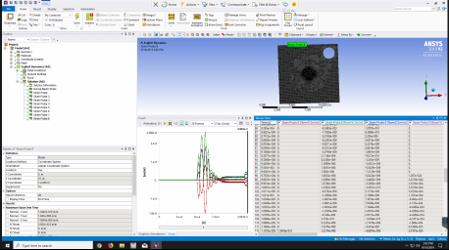
   To give better insight, the first image shows how we seek to collect 200 time steps of data from a single variation of the geometry.(as shown in the "Modeling" window of Workbench)
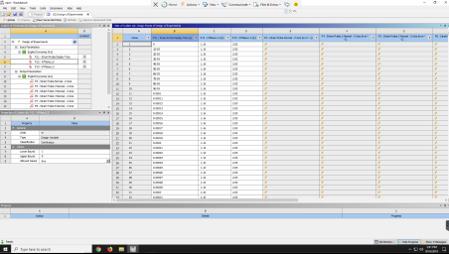
   The second image shows how we attempted this, using DOE design points + parameters. This method is not realistic, as we are solving the same system 200 times for 200 data points. Ideally we solve it once for every 200 points, just as you can within "Model" of Explicit Dynamics.
The issue we are running into is that we are solving for a new system for every design point, and it is taking far too long to collect the data we need from a parametric study. Our question is if there is whether we have overlooked some functionality of Workbench, or if there is a better way to go about this process entirely?
Â
Thanks!
Â
-
September 17, 2019 at 3:12 pm
-
September 17, 2019 at 7:34 pm
peteroznewman
SubscriberThe way to not have the system solve 200 times for 200 time steps is to not put the time step as an input parameter.
Instead use 200 output parameters, one each for a specific time, then it will solve once and give 200 outputs for one station.
I understand this creates 200 columns and you want 200 rows, but that is not how the Parameter Set table works.
Another approach is to have the solver write an output file with the data from each time step in its own row in the file.
-
September 17, 2019 at 10:28 pm
SlochaniSamon
SubscriberWow, thanks!
Â
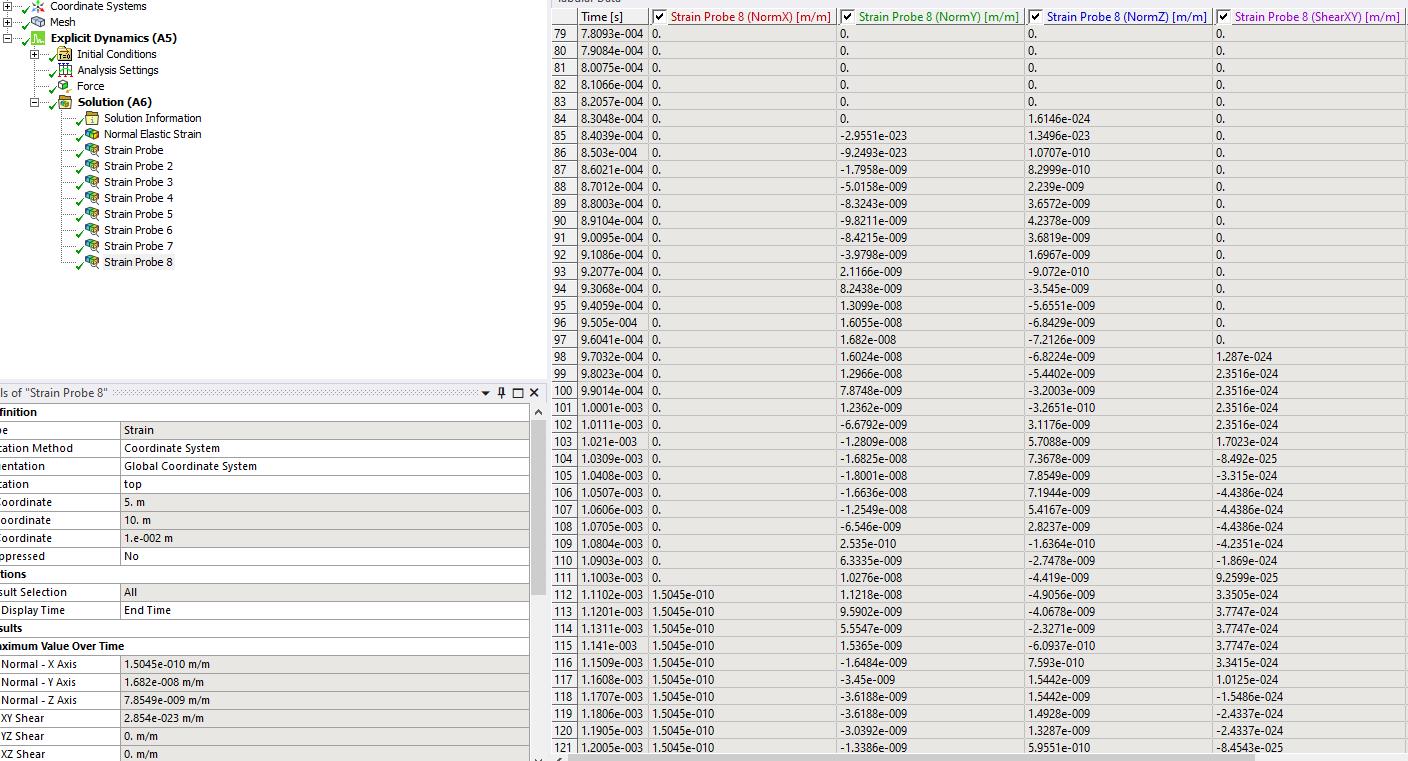
Is there anyway I can script in the creation of all of these points? Say I have 8 probes, and 200 points for each. I can reformat the columns into rows later. The question I have now is - how can I use the ACT console to script the creation of these probes for use as outputs? Is there a way to manually create a probe with some properties, record the commands used, and automate the process use ACT? (kind of like how SpaceClaim and APDL have a record function/ working console) If not, what resource can I use to pinpoint the exact ACT commands I need?
Â
By using the pressure example in the ACT console, I can use python logic to create an arbitrary amount of pressure objects in the tree all with their own properties. I would like to do this with the probes, except with time as you've suggested.Â
Â
Thank you in advance!
-
September 17, 2019 at 11:25 pm
peteroznewman
SubscriberI don't write scripts so I can't help you here. Hopefully someone will reply with some further guidance.
-
September 18, 2019 at 4:54 am
SlochaniSamon
SubscriberI wrote a script and was able to make the points that I needed. Sadly however, the process is still very slow - I can tell my machine is not operating at maximum capacity. I am not sure whether this is a limitation of the ANSYS engine when it comes to solving for many parameters, or I have missed an option -Â Is there a way to allocate more resources to design points to accomplish this task?
Â
Thanks for all the help
-
September 18, 2019 at 11:34 am
peteroznewman
SubscriberIf you have a computer with lots of cores and memory and you have several ANSYS licenses, you can execute a specified number of design points to run in parallel using Remote Solve Manager.
For example, I have access to a 16-core computer and 4 licenses, so I can run 4 jobs, each on 4 cores, in parallel.Â
-
June 1, 2021 at 12:38 am
user deleted
Subscriber.SlochaniSamon That would be nice and useful for the community, if you can share your solution or, at least, main steps, so that someone else can use it if needed.
. -
June 1, 2021 at 2:32 pm
Ram Gopisetti
Ansys Employee.Hi TriovMeats , How about implementing the APDL code to export the path results to secure location, I recommend to go through the Guide written by PADT in the following link where it discuss about the pre implementation examples on using the APDL and by understanding the content you can make your own.
.
-
- The topic ‘Time Series Parametric Outputs in Design of Experiments’ is closed to new replies.
-
5844
-
1906
-
1420
-
1305
-
1021
© 2026 Copyright ANSYS, Inc. All rights reserved.