-
-
August 5, 2019 at 7:58 am
Akshaykumar717
Subscriberhi
my professor gave me a 3 layered octagonal honeycomb panel with 0.5mm thickness on upper skin and 0.5mm thickness of lower skin and a core, which I can change the thickness until I get natural frequencies greater than 40hz in modal analysis. but before doing that he gave me flexural rigidity formula to find and put the value in model analysis .i am totally confused that there is no term called flexural rigidity in Ansys workbench, in google its showing bending stiffness and flexural rigidity are same. I am confused and trying to finding this answer. can anyone just tell me what is the procedure to solve this and to get high natural frequencies.
Thank you in advance
-
August 5, 2019 at 8:26 am
jj77
SubscriberIn FEA software like ansys (general purpose FEA), one does not give that.
Â
What you assign is Young's mod., Poisson's (density if you have inertial loads or doing dynamics), thickness of the plates/shells (skins,..) and then Ansys will calculate everything.
Â
So these three parameters you assign in your engineering material data and the last one (thickness) in DM or Space Claim or in the FE model for your different parts
Â
See this tutorial for modelling shell structure.
Â
https://www.youtube.com/watch?v=9zW9Qs5t1VE
Â
Â
-
August 5, 2019 at 6:36 pm
peteroznewman
SubscriberNote that honeycomb core is an orthotropic material, so you need three values for Young's modulus and three for Shear modulus, rather that just one Young's modulus for an isotropic material. That also means you have to pay attention to which direction the honeycomb core is assembled into the sandwich so you put the right shear modulus in the right direction that matches the orientation of the geometry in your model.
-
August 6, 2019 at 10:07 am
Akshaykumar717
Subscriber@peteroznewman
I have 3 parts for my honeycomb which is a core attached between two skins. for both skins, I am using aluminum 2024 T6 materials and for core, I am using aluminum 5052, so the density, youngs modulus will differ for skin and core.
my question is :
1.how can I calculate the youngs modulus of core and skins for X, Y and Z direction? (in Ansys or any other process)
2.after calculating this separately for skin and core, am I going to give these inputs to skin and core individually?
Â
-
August 6, 2019 at 10:14 am
jj77
SubscriberOK - it became a bit confusing. Orthotropic properties you would need to give to the honeycomb if you were approximating this structure with a single 3D plate/volume part thus using 3D brick elements, but if you represent the actual honeycomb geometry in 3D then you do not need that (Orthotropic). This can be called homogenisation of properties. See here for details for thisÂ
https://paginas.fe.up.pt/comptest2006/proc/files/abstracts/comptest06_61.pdf
Â
So for using the actual honeycomb geometry (shell geometry)
The skins and your core are made of isotropic aluminium which you can find the Young's modulus on say mat-web or from the manufacturer (say something like ~ 73 GPa). Density you have (~2800 kg/m3), so that is all you need, with Poisson's. Thickness as shown in the tutorial you can assign to the surface parts.
Â
Use also appropriate connection between them (Say bonded contact or something reasonable).
Â
Â
-
August 6, 2019 at 2:12 pm
peteroznewman
Subscriber@Akshaykumar717,
As jj77 says, there are two ways to build an FEA model of a honeycomb core sandwich composite panel.
I used a solid block and assigned orthotropic properties to represent the behavior of the core without having actual hexagonal cells. This is an efficient way to model the panel.
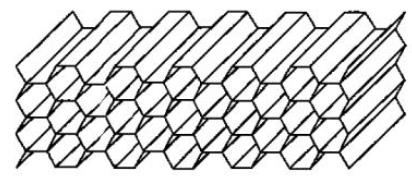
The other method is to model the actual honecomb cells made of isotropic aluminum foil in hexagonal (not octagonal) shape.
Note that the wall is double thickness on 2 sides and single thickness on 4 sides.
Please reply and clarify which approach you are taking.
-
September 6, 2019 at 12:02 pm
Akshaykumar717
Subscriber@peteronewman
unfortunately, none of them about ways helped to solveÂ
I even don't know why
let me explain what I have done till now:
1.i have aluminum 2025 and 5055 materials which I have given them all the inputs and named as my materials in Ansys
2.i have a honeycomb structure that consists of the core, sandwiched between two skins.
3.for the skins I have given alu 2025 and for core, I have given 5055.
4. D = EI(FLEXURAL RIGIDITY)
5.i have to find D or H(in some cases)
and have to submit his D in the Ansys.
6.so my question is the point after calculating the flexural rigidity where I have to submit this in AnsysÂ
-
September 6, 2019 at 12:51 pm
peteroznewman
Subscriber2. Please insert an image of the honeycomb structure into your reply. Is it a solid brick that uses orthotropic properties or actual hexagonal walls? It's not clear what you did.
4. Wikipedia defines Flexural Rigidity as EI. You typically use EI in a hand calculation, you don't use EI in an FEA model directly. I is calculated from the geometry.
If you have a three point bending simulation of a beam of length, L, and you calculate the deflection at the center, w, for a center load P, then you can solve for EI using the formula w = PL^3/48EI .
5. What is H?
-
September 9, 2019 at 9:47 am
-
September 9, 2019 at 1:09 pm
peteroznewman
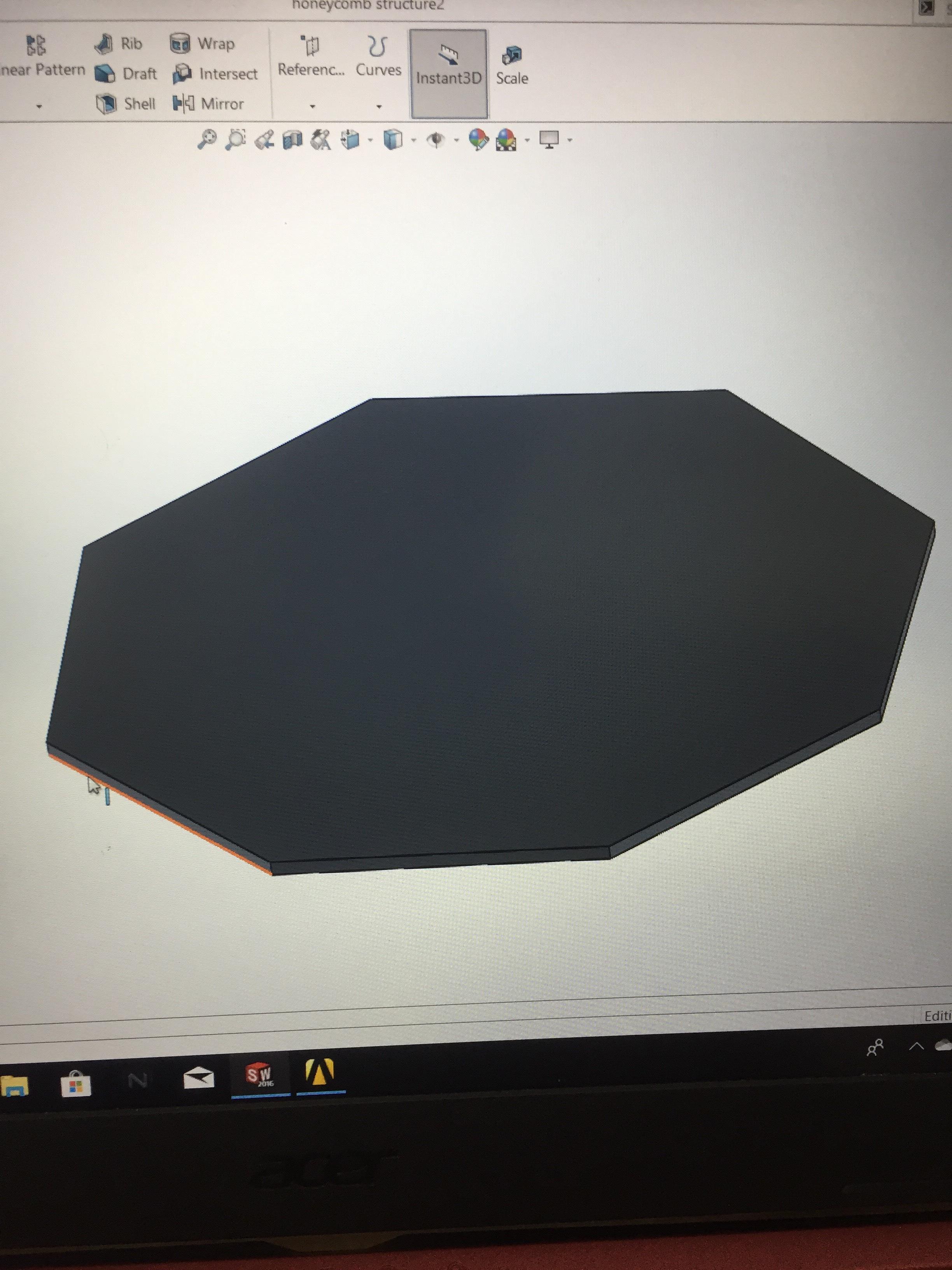
SubscriberI see the octagonal panel drawn in SolidWorks.
I understand you are using a solid volume for the core and so will use orthotropic material properties.
Is that the solid model of the core thickness only or the total panel thickness?
What is the density of the honeycomb core?
How will you model the skins in SolidWorks, are they solid bodies or midsurfaces?
-
September 9, 2019 at 2:18 pm
Akshaykumar717
Subscriber@peteroznewman
yes it is an octagonal panel
H is the total panel thickness
2.68g/cm^3 is the density of the core which is aluminum 5052
skins are also solid bodies which are 0.5 mm thickness each and attached both sides of the core
-
September 9, 2019 at 5:59 pm
peteroznewman
Subscriber2.68 g/cm^3 = 2680 kg/m^3 which is the density of solid aluminum.
That is not the density of the honeycomb core as configured between the skins.
The volume of the core is mostly air.
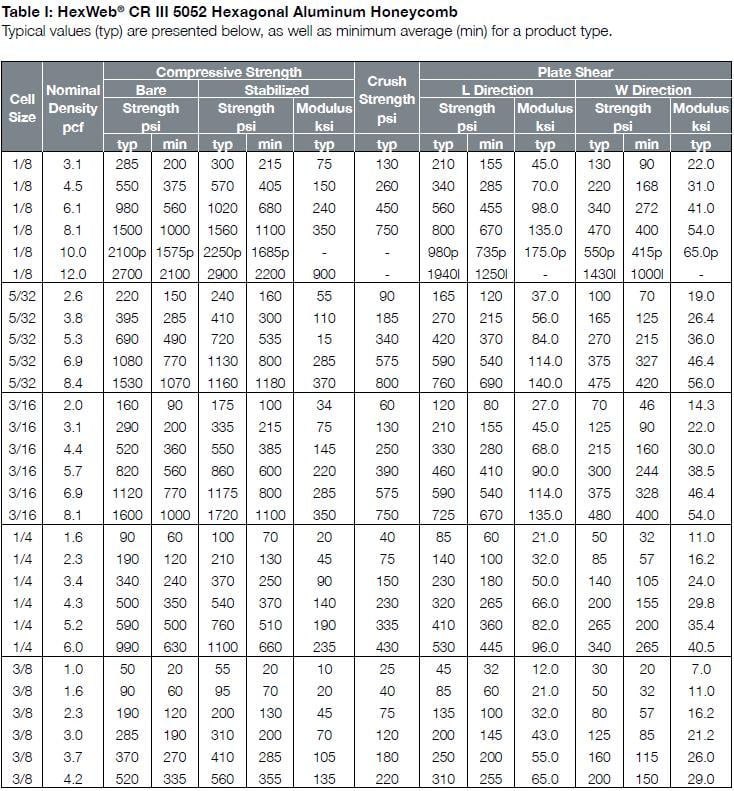
What is the cell size for your honeycomb core? For each cell size, there are a range of densities that depend on the ribbon thickness.
Let's say it is the 1/4 inch cell size at 5.2 lb/ft^3 = 83 kg/m^3 which is only 3% of the density of solid aluminum.
Now do you see the three columns labeled modulus in the table above? Those are the values you use in the orthotropic material.
-
September 17, 2019 at 1:20 pm
Akshaykumar717
Subscriber
yes! the core is solid and the skins too.
I have one questionÂ
1.is it possible to solve this problem because today I have done the model analysis of this structure by increasing the core thickness up to 100 mm but still I am getting the first three natural frequencies zeros and then from fourth I am getting 100'200 like that.
2. what I have to do to get natural frequencies greater than 40 from the beginning.
-
September 30, 2019 at 8:33 am
Akshaykumar717
Subscriber@peteroznewman
hey, thanks a lot I solved it by the information you provided.
-
- The topic ‘flextural rigidity’ is closed to new replies.
-
5874
-
1906
-
1420
-
1306
-
1021
© 2026 Copyright ANSYS, Inc. All rights reserved.