Fluids

Fluids

Topics related to Fluent, CFX, Turbogrid and more.

YPlus Value for k-epsilon Model with Near Wall Treatment

    • trippleD
      Subscriber

      Hey guys,


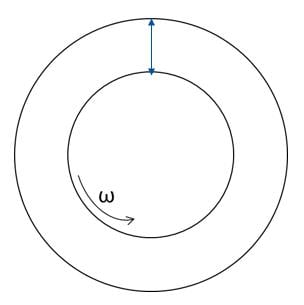
      i have the following setup. I have two concentric cylinder, the inner one ist rotating with omega and the outer one is stationary.


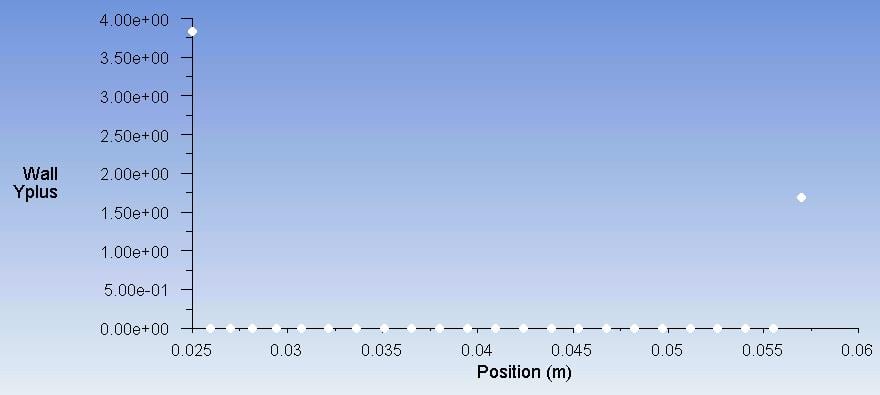
      I'm using the k-epsilon realizable model with enhanced wall treatment.  I'm not sure about the wall behaviour. Is the choice right? Near the roating wall, the normal y (mesh) is 1mm, near the stationary wall, the y ist 1.5 mm. For my simulation, i got the following results for y+. It is plotted in the middle of the length of the cylinders (along the arrows), from the top of the inner cylinder to the outer one.


      So the main question is, do i have the right setup for the simulation in relation to the y+ value or on which aspect do i have to look at that it is right? I'm a little bit confused by the help, so it would be great if someone could explain it to me. 


      Thanks a lot for your help.


      trippled

    • Amine Ben Hadj Ali
      Ansys Employee
      If you have enough points for the resolution of boundary layer than yes you have a quiet good start.

      Optimal us if You can try reducing yplus to one and maintain a good boundary layer resolution.

      I also recommend omega based models like SST but EWT is also okay for epsilon based approach.
    • trippleD
      Subscriber

      Thanks for your answer.


      What do you mean with "points for the resolution boundary layer" and how can i check it? And how can i reduce the yplus value to one. And why is it a good result when it is one? For Standard Wall Functions , a valua bigger than thirty is good, right? Where comes the "good values"?


      And what do you mean with omgea based, SST models. I dont find them at wall functions.

    • Amine Ben Hadj Ali
      Ansys Employee
      1/you need either to estimate boundary layer size or do that after running the case by looking into viscosity ratio. As it is an annular gap I will recommend at least 20 points or cells across it.
      2/better to place the first point inside viscous layer and use 10 to 20 cells across boundary layer of my you want to integrate all right to the wall. I do not recommend using wall functions here as might be the whole thing running at low or moderate Re number

      3/SST is omega based model. It contains an automatic wall treatment.

      Have a look in text books and visit our help.
    • trippleD
      Subscriber

      Okay, so i have to do a finer mesh near the walls to get a smaller value for y+, right?


      As i said, i"m using the k/epsilon model. I dont find the opportunity to turn wall functions off. Where can i do it?

    • Amine Ben Hadj Ali
      Ansys Employee

      You need to use the SST model as an option. You can still stick to your k-e model ans use EWF.

    • alisul692
      Subscriber

      You need to use the SST model as an option. You can still stick to your k-e model ans use EWF.


      @abenhadj  I daced same problem even i used k-e EWf and Y+=0.5 i can not to plot y+ can you hlep me plz?


Viewing 6 reply threads
  • The topic ‘YPlus Value for k-epsilon Model with Near Wall Treatment’ is closed to new replies.