-
-
May 21, 2019 at 3:00 pm
torleirh
SubscriberHi,
Hope someone here can help me with a problem described bellow.
Construction:
I have a problem with stress singularities or at least that is what I think it is. I have designed a midsection of a ship hull and strengthened it using stiffeners and girders (see picture 1). The L stiffeners are added as cross sections to line bodies while the girders are added as surfaces with specified thicknesses. The outer plating of the hull is divided using the slice function in DM and was done to create different thicknesses for different parts (keel, walls, etc). Â Â
Loads and supports:
Tere are two loads added. One distributed force applied to the inner floor, and a hydrostatic pressure to the outer plating. The hull is simply supported in the two ends, for the whole frame (bottom, walls and girders).
Meshing:
Have tried different mesh sizes and different mesh types (triangular and quadratic). The resulting stress increases as mesh size decreases, as one would expect in a singularity.
Questions:
When testing the structure, to check the equivalent (Von-Mises) stress, I get high peaks (assuming singularities) in the following regions (depending on the mesh size)
-Â Â Â Â Â Â Â Â Â Outer plating at the intersection between longitudinal girder and outer plating.
-Â Â Â Â Â Â Â Â Â Intersection between keel plating and regular (thinner) bottom plating. This also goes for other regions where two different thicknesses of plates meet. Â
How can I avoid getting these singularities and get correct results?
And follow up: is it possible to smooth-out a transition from one plate thickness to another. (Tried the blend function in DM unsuccessful) Â
I also find it weird that the stress maximums change position from one mesh size or type to another. Â

-
May 21, 2019 at 3:04 pm
jj77
SubscriberInteresting. Which Uni are you studying in?
-
May 21, 2019 at 3:07 pm
torleirh
SubscriberNTNU Marine Technology in Norway
Â
-
May 21, 2019 at 3:24 pm
jj77
SubscriberÂ
Â
There are a couple of things.
Â
First make sure it is a singularity so keep refining the mesh and see that the stresses do not change much. If it is changing during the refinement process at this location then it could well be a singul.
Â
If it is one (normally not very common in plates/shells), then just let it yield locally so assign a NL material curve for the steel. If the strains are small then stress will redistribute and it will be OK.
Â
Below is a good discussion on singularities:
http://www.acin.net/2015/06/02/stress-singularities-stress-concentrations-and-mesh-convergence/
Â
Have in mind that when designing, the classification societies will dictate how to carry out the FEA, and what mesh size to use, see e.g., (LR will different criteria)
 There are also extrapolation techniques (e.g., hot spot) recommended by these societies to get stresses there (ask some professor in your Uni. that has actually done ship or platform design according to DNV on shell structure - he or she should be able to guide you because it is importnat for structural engineers to understand this practice)
https://rules.dnvgl.com/docs/pdf/DNVGL/CG/2015-10/DNVGL-CG-0127.pdf
-
May 22, 2019 at 2:20 pm
torleirh
Subscriber Hi again,
Thank you so much for replying so fast!
When refining the mesh, I find that the stress increases for the specific point in the intersection between the keel plate and the rest of the bottom structure (intersection between different plate thicknesses). Same point as displayed in the picture added in original post. This has made me to believe that it is in fact a singularity. Â
When you say to assign a nonlinear (NL) material curve for the steel. How can I do this in Ansys, and can I do it just for specific regions of the structure. I found a video on YTÂ https://www.youtube.com/watch?v=dLPa3TOW-20Â
Is this how to do it, or is there a way to add a more standardized NL material curve in the Engineering Data folder.Â
Â
I have been reading up on the DNV GL guidelines for FEM analyses and I try to follow them.
Again, thanks for taking the time to help!Â
Â
-
May 22, 2019 at 3:16 pm
jj77
SubscriberNo worries - good that you are looking at DNV - many times also naval engineers know the critical areas so an area like this they will know if it is important or not - I assume that comes with experience and after having designed many ships
Â
The video you have is for nonlinear cast iron which is not what you want.
Â
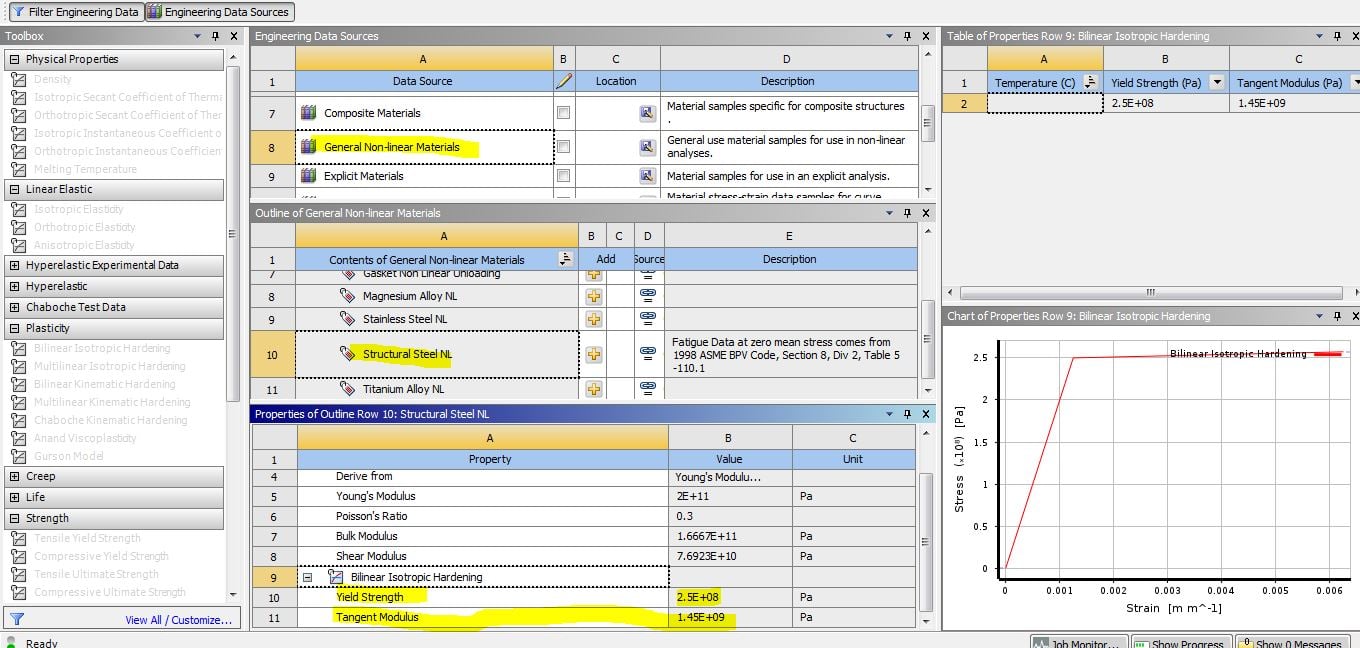
In engineering data, one can select a bilinear isotropic hardening curve, e.g., go to engineering data sources and nonlinear materials and pick one (StrSteel NL) - one would need to set the yield stress and tangent modulus. See below where it is set to 250MPa. Just press the yellow plus button and it will be added to your material - you can then choose to assign it in Mechanical (For these surface bodies or for all).
Â
See also this video:
https://www.youtube.com/watch?v=oShBSiIVi8Q
Â
-
May 27, 2019 at 12:36 pm
torleirh
SubscriberWell, I’m back again. Beaten by ansys yet another time.
I added NL structural steel for the regions where the singularity occurred (and for the whole structure, just to try), still I got the same high stress peak. Is this indicating that there must be something wrong with the way this is modelled, or do you have any other tricks or tips that might help me solve this problem? -
May 27, 2019 at 3:43 pm
jj77
SubscriberIt is very likely due to the extrapolation - NL things are enforced on the Gauss Points (GP), but when we extrapolate depending on the mesh, and the stress variation between elements we might go above yield stress.
Â
First check that we actually do get yield and that it is OK. So check plastic strains (results strains).
Â
Then if that is OK, we can look at non extrapolated results - inert a command in solution saying ERESX,NO (this command forces copy of GP values to nodes).
-
- The topic ‘Stress singularities’ is closed to new replies.
-
6019
-
1906
-
1425
-
1308
-
1021
© 2026 Copyright ANSYS, Inc. All rights reserved.