-
-
February 21, 2024 at 4:15 am
Matt Thomas
SubscriberHello : ) I have a question. Since i am still getting used to ansys, im not sure how to acomplish what im trying to do.Â
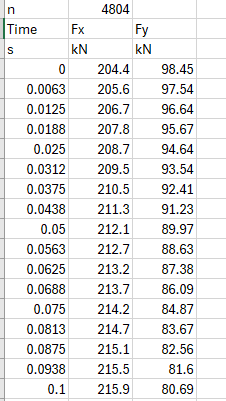
I have my model all setup, meshed, BC's, Loads, etc. I have added the fatigue tool box as well. Now, i am curious to know if ansys can take what i call a "loads file" and use that for fatigue? A loads file is basically a 3 column excel file tah has Time, Fx, Fy. Where time is in seconds and they are time stamps, Fx is force in X etc etc
Time  Fx  Fy
0Â Â Â Â Â 400Â Â 200
0.25Â Â Â 450Â Â Â 260Â
this is the basic format but imagine about 1200 cells. When graphed, it is cyclic.
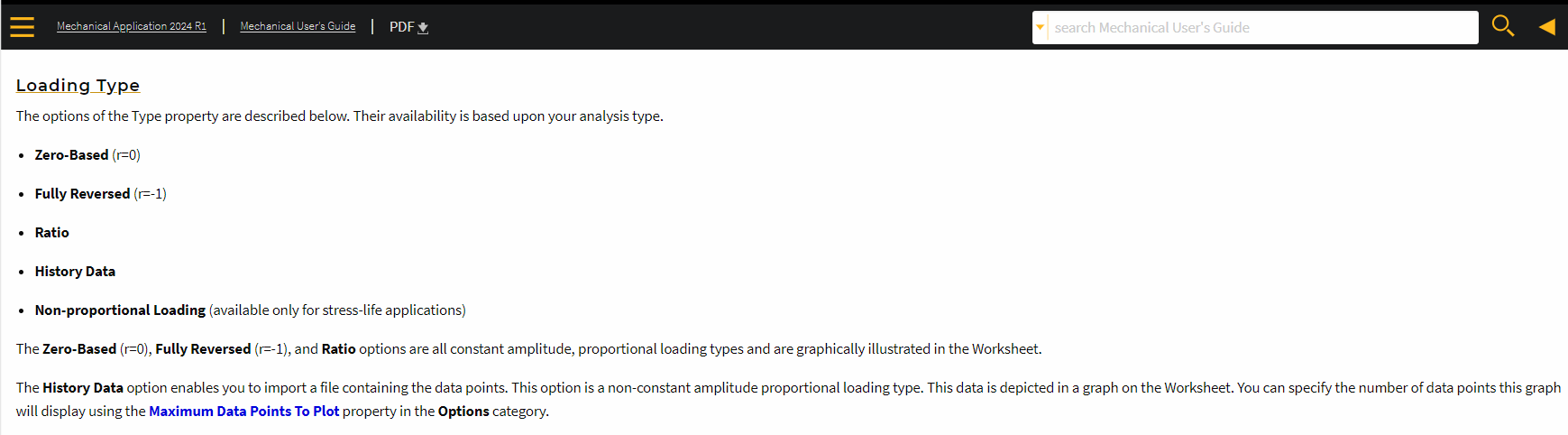
I was looking throug the types of loadin in the tool box and saw a "hisotry data" and was wondering if this is the same thing? if it is, whats the format need to look like?Â
thanks -
February 21, 2024 at 3:14 pm
-
February 21, 2024 at 4:17 pm
Matt Thomas
Subscriberok, so how should the format be?
My loads file has 3 columns, time, Fx, and Fy. What does Ansys want in the single column? Loading in the Fx only? I am going to probably assume yes since it looks like the Fy is not cyclic and time is for sure not cyclic... That would suck haha Non linear time, thats a good discussion haha.
-
February 21, 2024 at 4:49 pm
danielshaw
Ansys EmployeeThe Mechanical Fatigue Tool (FT) will accept a single column of ASCII data as History Data. Time is irrelevant because it does not affect the fatigue calculations, so the time column can be removed. The FT applies the History Data as multipliers on the total stress. It does not apply the multipliers to the loads. You cannot specify a multiplier for individual loads (FX, FY, etc.).
Â
-
February 21, 2024 at 5:36 pm
Matt Thomas
SubscriberÂ
well, there goes that idea haha. Now i am stuck
I guess ill fill in more detail and see if i can get more advice.Â
I used a NREL opensource software called OpenFAST to simulate a wind turbine in certain conditions etc. I setup the wind file, CFD etc etc. According to the developer of the program, i asked him last week if openfast generates stresses, and he said no, just loading.Â
We wrote a paper that was accepted by IEEE on wind turbine life prediction using NREL tools. Now, they want to extend the paper in a few other journals but want to verify the fatigue life that we calculated.
This is where ansys comes in. I do not use ansys at all, so this is all new to me. I have tried to use SN curve data but with terrible results since i do not know all th ematerial properties nor does the developer have any sn curves or data on this.Â
so far i have been able to verify max stresses, deflection and deformation from openfast with multiple other software, which is great, but they still want fatigue life.Â
any additioanl help or advice would be great. Thanks for taking the time to read : )
EDIT: I should probably add that i am an engineering studentÂ
-
February 21, 2024 at 6:18 pm
danielshaw
Ansys EmployeeAnsys offers two fatigue software tools: the Mechanical Fatigue Tool (FT) and Ansys nCode DesignLife. The FT is an entry level product with limited capabilities that is provided free with a Mechanical license. Ansys nCode DesignLife is an advanced tool that requires a separate license. You cannot do a precise fatigue simulation for your loading scenario using the FT.
It looks like the orientation of the force resultant vector for each loading is relatively consistent. You could find an average resultant orientation and assume that it applies for all time points. You could then convert the FX and FY loadings at each time point into a resultant force (SRSS) and use the History Data approach in the FT to predict the fatigue damage. The predicted fatigue damage would not be precise, but it should be in the ball park.
You could also use the FT to bound the fatigue results. For example, you could determine the worst-case loading scenario and then assume that the stress range caused by that loading occurs at all time points (probably assuming zero-based loading). The predicted fatigue damage using that assumption would be more severe than the damage produced by the actual loading produces.
Note:Â Regardless of the software tool or loading approach, you need either a SN or EN curve to do a fatigue evaluation.

-
February 21, 2024 at 6:42 pm
Matt Thomas
Subscriberthank you very much for your reply. I was actually researching ways to do what you were suggesting. So im glad im on the smae page as you. I will continue to see if i can find a decent sn curve.Â
i appreciate your help with all of this.Â
-
- The topic ‘Fatigue life from a loads file’ is closed to new replies.
-
5994
-
1906
-
1425
-
1307
-
1021
© 2026 Copyright ANSYS, Inc. All rights reserved.