Fluids

Fluids

Topics related to Fluent, CFX, Turbogrid and more.

Negative Pressure by using compressible liquid

    • Max4
      Subscriber

      Hi everyone,


      By simulating the expansion of a compressible flow (using compressible liquid) in a chamber, negative static pressures and total pressures appear.


      For the initialisation I set a total pressure of 200 bar in the chamber and 10 bar before the porous media (models in green).


      The red line models a piston which moves downward. The boundary conditions are shown in the picture below:
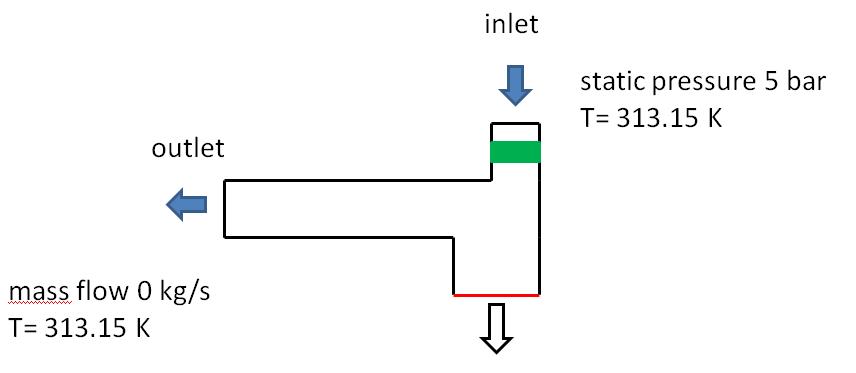


      Problems are as follow:


      - By the expansion of the fluid, the temperature in the chamber should decrease (adiabatic walls). The problem is that the temperature remains constant for the whole geometry (before and after the porous media).


      - Negative static pressure appears by the downward motion of the piston when I plot the static pressure.


      Settings: Fluent 19.2


      - Reliazable k-epsilon Model with Scalable Wall Function


      - Energy ON


      - Materials: Density using Compressible Liquid


                         Thermal Conductivy as constant


                         Viscosity as constant


                         Heat Capacity using a polynomial function depending on temperature


      - Time Step 1E-5 s with 40 max. iter/time step


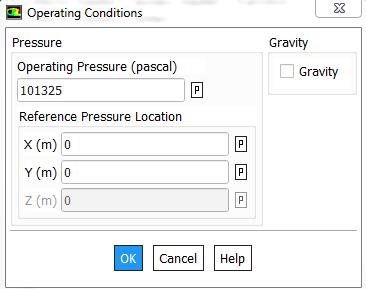
      - Operatings Conditions: Pressure 101 325 Pa


      Thank you in advance.


      Regards,


      Maxime

    • Rob
      Forum Moderator

      Maxime: please show some plots and think through how the flow is behaving. Velocity vectors will also be useful. 


      As an aside. I'm fairly sure Amine and I discussed this question yesterday and that I answered it. I can also see that your post & thread count don't tie up. The purpose of answering questions on here is to retain information for ALL users. Please do NOT delete threads as it's preventing others learning. 

    • Max4
      Subscriber

      No one had answered and I made changes. That's why I deleted the post.


      The maximal velocity in the chamber is 2.5 m/s. The porous media is not totally impermeable and a small amount can still circulate.


      The velocity of the piston follows a sinus function: -1.8326*sin(700*pi*time/3)


      The question is, how is it possible to have negative static pressure (and total pressure)?


      Regards,


      Maxime

    • Amine Ben Hadj Ali
      Ansys Employee

      Negative pressure but relative to the operating pressure. Gauge pressures can be negative.

    • Max4
      Subscriber

      The operating pressure is set as 101 325 Pa. Could the problem came from the definition of the Operating Conditions? I haven´t change the location of the reference pressure location. By default it is in the chamber, where a pressure of 200 bar is initialized.


      The absolute pressure is the sum of the operating pressure and the gauge pressure. So the gauge pressure is the sum of the dynamic and static pressure? It´s better to plot the absolute pressure instead of the static pressure?


      In my case I have negative static pressure of -4E+6 Pa and more in the chamber by the downward movement of the piston. If I plot the total pressure, it has negative pressure too.


      Or the problem came from the BC or the porous media? Moreover why the temperature isn´t decreasing by the downward movement of the piston (expansion of the fluid)?


      Regards,


      Maxime

    • Amine Ben Hadj Ali
      Ansys Employee

      Absolute pressure= static gauge pressure+ operating pressure


      Total pressure= static gauge pressure+ dynamic pressure


      If you have an opening (pressure inlet ór pressure outlet) the reference pressure location is ignored.

    • Max4
      Subscriber

      Ok, then the reference location has no influence because I´m using a pressure outlet.


      If my static gauge pressure has values in the order of -5e+6 Pa and the operating pressure is set as 101 325Pa, I obtain negative absolute pressure.


      But if the static pressure drops below the saturation vapour pressure, the fluid will in reality start to cavitate.


      I will plot the total pressure, but it´s possible to have negative values?


      Moreover, why the temperature remains constant by the downward motion of the piston?


      Regards,


      Maxime

    • Rob
      Forum Moderator

      Read the theory around the compressible liquid model: that'll explain the temperature question. 


      Pressure can drop, and if you've got a poor mesh the results can become none physical.  You're correct that cavitation could occur in reality, and low pressure regions are often used to determine the location of cavitation prior to using the model.


    • Max4
      Subscriber

      The Tait equation of state establishes a nonlinear relationship between density and pressure under isothermal conditions. Is there any possibility to model the temperature change as function of pressure and use the compressible liquid density method too?


      I use a time step of 1E-5s and the pressure within the chamber quickly decrease at each time step. The mesh seems correct to me.

    • Rob
      Forum Moderator

      Correct. If you have a relationship I don't see why you couldn't use an energy source term to add/remove energy based on the change in density. I actually put this request into the system earlier in the week for another client.


      If the pressure is changing quickly in each time step the steps may be too big. How fast is the flow going, and how big (long) are the cells?

    • Max4
      Subscriber

      I can then write an UDF for the temperature as function of the pressure for the fluid. Where should I hook this UDF?


      I have a time step of 1E-5s. There is a still amount of fluid that pass through the porous media. The maximal velocity in the chamber is 2.5 m/s but remains very weak throughout the chamber. The cells size varie from 2E-5 m to 1E-4 m but the aspect ratio is good. I have create a domain (transition) between a zone where the mesh is very fine (after the porous media) and the rest of the chamber.

    • Rob
      Forum Moderator

      Not quite, the source UDF will add or remove energy from the domain: you'll need to figure out how much based on the change in density & current temperature. Good luck as it's not going to be easy and you're possibly going to make the solution very unstable. 


      OK, so looking at the time step & cell size you're potentially running with too large a step. Remember we're aiming for the cell size (length)/velocity to be around 3-10 times the size of a time step. 

    • Max4
      Subscriber

      I have then to try with a  time step of 1E-6s. 


      At a moment the porous media will allow all the fluid to pass through, which will induce an increase in velocity. So the time step will have to be further reduced?


      For the direction vector 1 of the porous zone, should I set X=1 and Y=0 OR X=0 and Y= -1?


    • Max4
      Subscriber

      Is any correlation in FLUENT available in order to take into account the temperature change due to compression and expansion in the chamber?

    • Rob
      Forum Moderator

      The direction vector is to allow you to set the resistance coefficients: as long as you know which direction to assign which coefficient to it doesn't matter.  Porous media doesn't cause the flow to speed up unless you've specified the option: given the flow will normalise very quickly I never bother. 


      The compression & expansion effects are covered by the material models: as liquids don't (usually) compress much we've not added the feature (yet). For gases there are the ideal & real options. 

    • Max4
      Subscriber

      In my simulation I have use X=0 and Y=-1 for the direction vector. I have then set the same value for the viscous in the 2 directions and the same value in the 2 directions for the inertial resistance. As long as the both values are the same, the direction of the vector does not have any influence.


      Thank you for the information.


      Regards,


      Maxime

Viewing 15 reply threads
  • The topic ‘Negative Pressure by using compressible liquid’ is closed to new replies.