Ansys Assistant will be unavailable on the Learning Forum starting January 30. An upgraded version is coming soon. We apologize for any inconvenience and appreciate your patience. Stay tuned for updates.
Electronics

Electronics

Topics related to HFSS, Maxwell, SIwave, Icepak, Electronics Enterprise and more.

Electrically Small Antenna Simulation at VHF and UHF Frequencies in HFSS

    • shayan92
      Subscriber

      Greetings,


      I am trying to properly simulate an electrically small antenna at UHF and VHF Frequencies, i.e. 160 MHz and 400 MHz. The antennas are between 50 and 100 mm in their largest dimension and are Monocone antennas with terminated loads. The input impedance to the antennas have also been set in the port definition because they are not 50 Ohms input impedance.


      I am trying to determine the proper settings that I should use for the simulation as far as the maximum delta S, type of solver, mesh settings, and so on. I am concerned about the S11 parameters as well as the Gain simulations. I have not found any helpful information about the HFSS simulations that should be used in the case of electrically small antennas at UHF and VHF Frequencies. So far, it seems that the gain may not be correct as it is not matching up with the anechoic chamber results. I can provide the simulation files if that is helpful.


      Thank you in advance.

    • Sorceress Gia
      Ansys Employee

      -max mag delta S = 0.02


      -driven modal


      -default mesh settings


      -Is your air box (with radiation bc) at least lambda/4 from the outer-most surface of the antenna?

    • shayan92
      Subscriber

      Thank you for your reply. 


      I was reading a paper that discussed that delta S was set to 1x10^ -4     (0.0001).


      They also used a larger radiation boundary box size than the lambda/4 recommendation and they pre-meshed to obtain accuracy and overall efficiency.


      So I have used 0.0001 for the delta S and I have tried a lambda/3 and lambda/2 radiation box size along with a PML boundary.


      However, my measured gain in an anechoic chamber is higher than the simulated gain at least by a few dB for the 400 MHz and 160 MHz.


      As these are electrically small antennas, their gain is fairly low i.e. between 0 dB and -20 dB at the lower end.


      I have attached the paper I am referring to. I am just trying to figure out if anyone is familiar for simulating electrically small antennas and the proper parameters that should be used.


      Thank you.

    • Sorceress Gia
      Ansys Employee

      That paper was published 11 years ago. HFSS has made tremendous improvements in every aspect of the software over the last decade. 


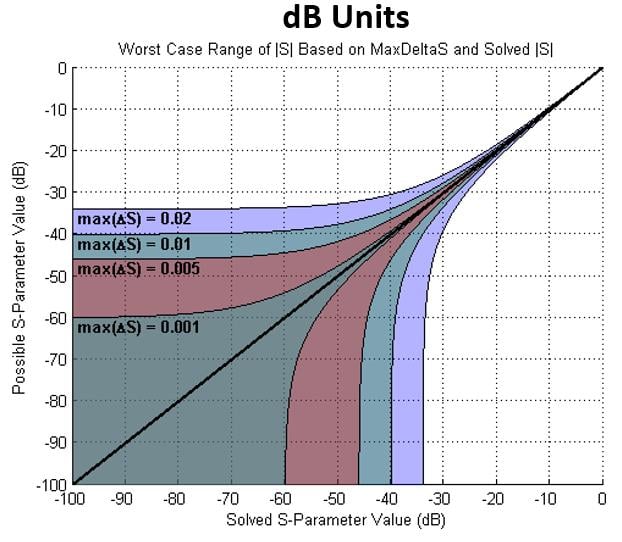
      You can lower max mag delta S to 0.01 but anything lower than that and you are just wasting time/computational resources. Take a look at the attached graph from the HFSS training course. Max mag delta S = 0.02 will provide accurate results for S-Parameters down to -40dB.


      Since you are already over-meshing the problem and your results are still not matching your simulations then I would verify that your model geometry / material definitions are correct.


      Did you make any approximations in drawing the antenna/port? How sure are you of the permittivity and loss tangent of any dielectrics?

    • shayan92
      Subscriber

      Thank you for your reply Peter. I wasn't aware of the table you provided. Thank you for the insight that I was not aware of. That will help in my simulation times. I modeled the ports per the manufacture drawing, there is some variation since they use multiple metals and I am just modeling with copper/ bronze and using Teflon as the dielectric of the SMA port. 


      I re-ran the simulation with max mag delta S as 0.02, using a lambda radiation box with a PML boundary per HFSS training documentation. One thing that I forgot to mention was that I am using Port Re-normalization on the input port because the transmitter and receiver system do not have a characteristic impedance of 50 Ohms and instead have a real and imaginary impedance. Thus I didn't realize that you need to Check the "Include Port Post Processing Effects" in order to account for the input port impedance. If I do not select this option, then I get incorrect simulation results. I have only been able to get simulation results that match the measured results for the 400 MHz frequency, I am still working on the 160 MHz frequency. Those results still do not match the measured results. I am investigating the radiation box size and PML boundary to determine what the proper size should be since I am already using a larger than normal radiation box size.


      Do you have any recommendations for electrically small antenna radiation box sizes/ PML boundary/ mesh sizes or seeding since the lambda/4 is not providing me with accurate results?


      Thank you for your insight and help.

Viewing 4 reply threads
  • The topic ‘Electrically Small Antenna Simulation at VHF and UHF Frequencies in HFSS’ is closed to new replies.

[bingo_chatbox]