-
-
March 5, 2019 at 8:51 pm
FelixJJ
SubscriberHi, I'm simulating a water droplet impacting on a solid surface with certain contact angle. I'm trying to use the dynamic gradient adaption in ansys fluent around the water/air interface. But the calculation with the adaptive grids is not correct. The adaptive grid seems okay but the calculated interface is totally wrong. Any help is appreciated !!!!
-
March 6, 2019 at 4:00 am
Keyur Kanade
Ansys Employeecan you please insert some zoomed in images of your mesh, set up?
which model you are using?
-
March 6, 2019 at 3:26 pm
FelixJJ
SubscriberHi, thanks for reply!
I'm simulating a water droplet (D0=2.5mm) impacting on a solid surface (static contact angle =101 deg) with an initial velocity (V=0.5m/s) and trying to see its spreading and receding on the surface.
The set up I'm currently using is: Multiphase: VOF; Viscous: Laminar; Materials: Air and Water; Surface Tension: CSF model; Enabled wall adhesion: contact angle=101. The minimum size of the original mesh is 20 micron. I have been able to get some good calculation results from this setting and the regular mesh.Â
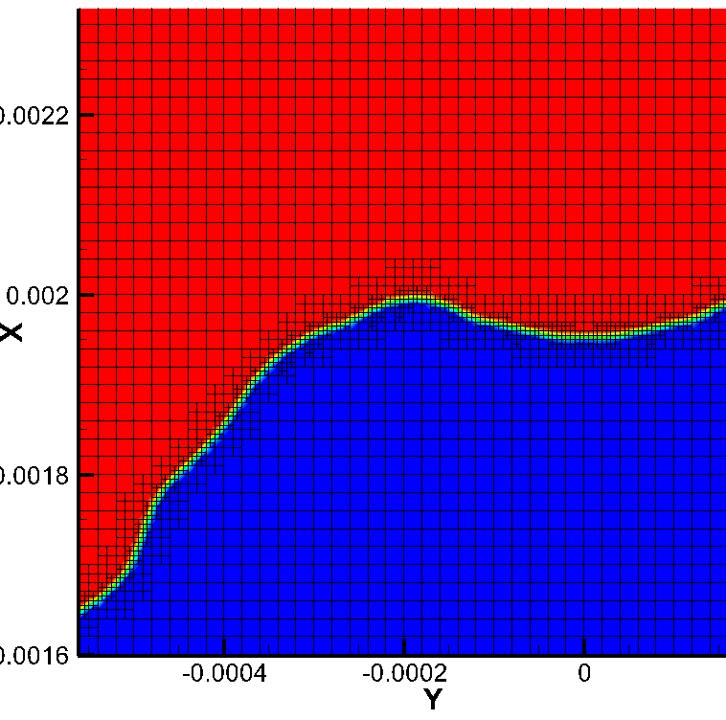
But when I try to use adaptive mesh around the interface (with the aim to better resolve the interface), the impacting droplet appears with an abnormal interface shape. I'm using dynamic gradient adaption (normalized). The refine threshold was set as 0.1 and the coarsen threshold was 0.01. It's like the mesh is adapted correctly: the adaptive region always moves with the interface. But the results turn out to be wrong somehow.Â
The zoomed-in of the adapted mesh is inserted as below:
Â
-
March 6, 2019 at 3:27 pm
FelixJJ
SubscriberHi, thanks for reply!
I'm simulating a water droplet (D0=2.5mm) impacting on a solid surface (static contact angle =101 deg) with an initial velocity (V=0.5m/s) and trying to see its spreading and receding on the surface.
The set up I'm currently using is: Multiphase: VOF; Viscous: Laminar; Materials: Air and Water; Surface Tension: CSF model; Enabled wall adhesion: contact angle=101. The minimum size of the original mesh is 20 micron. I have been able to get some good calculation results from this setting and the regular mesh.Â
But when I try to use adaptive mesh around the interface (with the aim to better resolve the interface), the impacting droplet appears with an abnormal interface shape. I'm using dynamic gradient adaption (normalized). The refine threshold was set as 0.1 and the coarsen threshold was 0.01. It's like the mesh is adapted correctly: the adaptive region always moves with the interface. But the results turn out to be wrong somehow.Â
The zoomed-in of the adapted mesh is inserted as below:

Â
-
March 6, 2019 at 4:25 pm
Rob
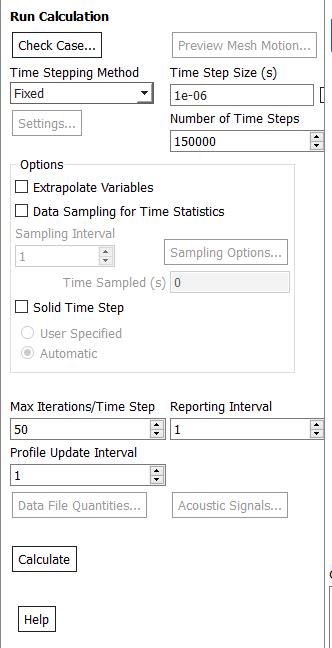
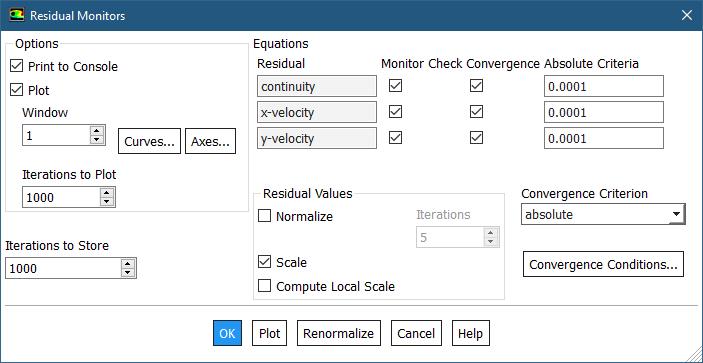
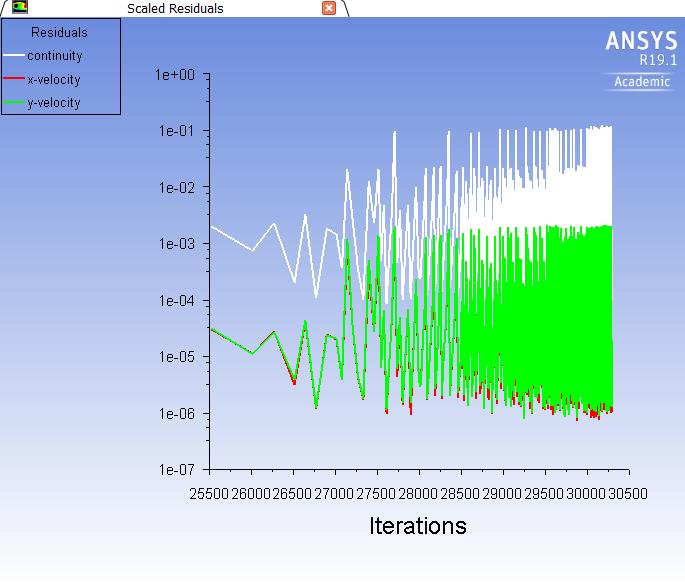
Forum ModeratorWhich solver are you using? Also, how good is convergence with each time step?
-
March 6, 2019 at 5:16 pm
-
March 7, 2019 at 2:49 am
Keyur Kanade
Ansys Employeecheck if you are using implicit body force in multiphase vof panel.Â
check operating pressure and location.Â
check operating density. give air density here.Â
use piso scheme.Â
Â
you can also have a quick look atÂ
https://www.youtube.com/watch?v=MN2zMoF3NyE
Â
-
- The topic ‘fluent mesh adaption’ is closed to new replies.
-
4728
-
1565
-
1386
-
1242
-
1021
© 2026 Copyright ANSYS, Inc. All rights reserved.