-
-
February 14, 2019 at 12:49 pm
AbhayCharan
SubscriberI am facing an issue with using multiphase.
I want to inject air bubbles of a particular diameter through my model and calculate the drag.
i would request if someone can please guide me through it.
-
February 14, 2019 at 1:52 pm
DrAmine
Ansys EmployeeWhich models are you using? Discrete Particles (DPM) or Eulerian Models?
-
February 15, 2019 at 5:37 am
Keyur Kanade
Ansys Employeeif you are using only dpm then injection panel has option of specifying dia.Â
https://www.youtube.com/watch?v=sEeCFxCVuqk
you may want to look at following for setting up ddpm
https://www.youtube.com/watch?v=wHGj_GZXS6Q
-
February 15, 2019 at 6:05 am
AbhayCharan
SubscriberThank you sir. I havent yet figured which model to use.
-
February 15, 2019 at 10:32 am
Rob
Forum ModeratorYou need to work out what the question is that you intend to answer using simulation. Once you know that, and things like volume fraction, particle size etc then you can (possibly with help) work out which model is best suited to the task.Â
-
February 26, 2019 at 2:08 pm
AbhayCharan
SubscriberSir, I want to calculate the skin friction coefficient of a flat plate by injecting air bubbles at 10% of the length of the plate at a velocity of 0.1 m/s at Fr no. 0.2.
Also the diametre of the bubbles is to be 50 um. The outer flow is of sea water.Â
Request to know which model is best suited and how do i go about it.
-
February 26, 2019 at 3:08 pm
DrAmine
Ansys EmployeeGo for DPM at first and do that as post processing step for the beginning. -
March 6, 2019 at 4:29 pm
AbhayCharan
SubscriberThank you sir.
Â
Sir, Currently Im stuck in validation of a 2 D flat plate. The shape of the Cf vs. Re plot for Re at 1x10e6, 2.5x10e6, 5x10e6, 7.5x10e6, 1x10e7, 2.5x10e7, is following a upward trend. where as the paper im refering to, follows a downward trend. Request to know if there is a better way to validate a 2D flat plate turbulent flow.
https://www.grc.nasa.gov/www/wind/valid/fpturb/fpturb02/fpturb02.html This is the paper in trying to validate.
-
March 7, 2019 at 9:27 am
Rob
Forum ModeratorPlease can you plot your data on here & show how you've set up whatever it is that you're monitoring?Â
-
April 8, 2019 at 4:45 pm
AbhayCharan
SubscriberSir,Â
I am trying to prove the reduction in the skin friction coefficient of a flat plate. The normal value of the skin friction resistance of a 2m flat plate at a reynold number of 31000 is 0.00245, (validated using David Eaton's paper on "The reynold number scaling of a flat plate), Velocity of water : 0.027m/s.
Now I want to reduce the drag by injection microbubbles.
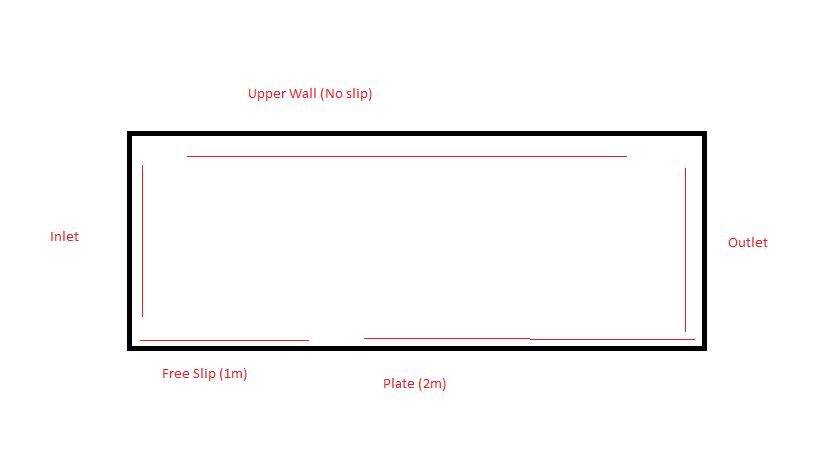
For that, i used the same domain, Intel (velocity inlet), Outlet (pressure), Upper wall (Wall), initial free slip, and then the plate. (1m free slip, 2m plate, ht of domain was 1m).
I used VOF method, Descrete Phase : ON. Implict. Injection :Â single, at a location of 1.2m, at 0.01m/s, Flow rate of 0.001m/s. diameter of bubbles as 0.00001m, stop time as 100s.Â
Im using k-omega model.
Phase 1 : Water
Phase 2 : Air
But my Skin Friction Coefficient has increased to 0.075.
Request to know where my mistake is.
Request for urgent help sir.
Thank you sir.

-
April 8, 2019 at 4:52 pm
-
April 9, 2019 at 5:05 am
AbhayCharan
SubscriberAlso, any change i make in the injection setting is not reflected in the solution.Â
It is my sincere request if you could help me identify my problems.Â
Thank you.
-
- The topic ‘How do I inject bubbles of a particular size ?’ is closed to new replies.
-
6515
-
1906
-
1463
-
1309
-
1022
© 2026 Copyright ANSYS, Inc. All rights reserved.