Ansys Assistant will be unavailable on the Learning Forum starting January 30. An upgraded version is coming soon. We apologize for any inconvenience and appreciate your patience. Stay tuned for updates.
Fluids

Fluids

Topics related to Fluent, CFX, Turbogrid and more.

Question about the equation used to predict the decay of turbulence intensity

    • mutianzi1
      Subscriber

      Hello!


      I would like to predict the decay of turbulence intensity downstream of an inlet. In this way, I could apply a correct turbulence intensity at the inlet in order to get the expected value at the location of interest. The following equation is provided in ANSYS Custom Portal under Solution #2042913.
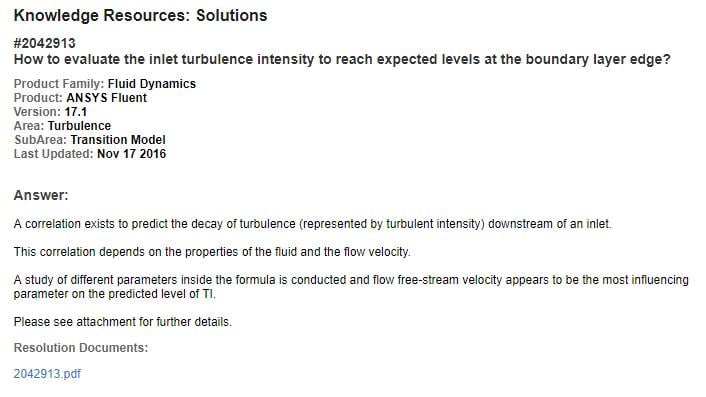


      Capture of Solution #2042913 in ANSYS Custom Portal


      Equation to calculate the decay of TI


      I have the following questions about this equation:


      1. The unit of the equation is not included. Could you please let me know the unit of this equation?


      2. Is ρ the air density and can be set as 1.225 kg/m^3 at standard atmospheric pressure assuming the equation is in SI unit?


      3. Is μ the dynamic viscosity and can be set as 1.81e-5 Pas?


      4. In the denominator, does μ(μt/μmean μ multiply μt/μ? μt/μ represents eddy viscosity ratio?


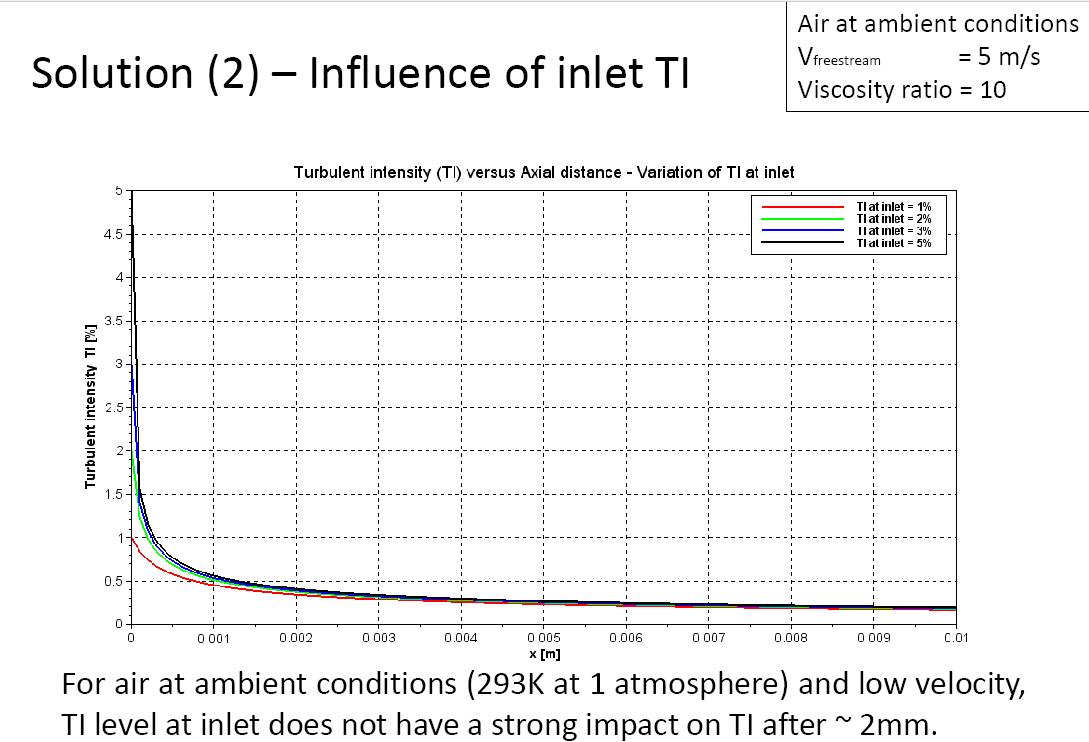
      I used the equation and above parameters to do the calculation, but I get different results from the provided solution, which is also attached. That's why I made these questions. Could you please give me some suggestions?


      This is what I got. The turbulence intensity at inlet is set to 0.5%. The V at freestream is 5 m/s and viscosity ratio is 10.
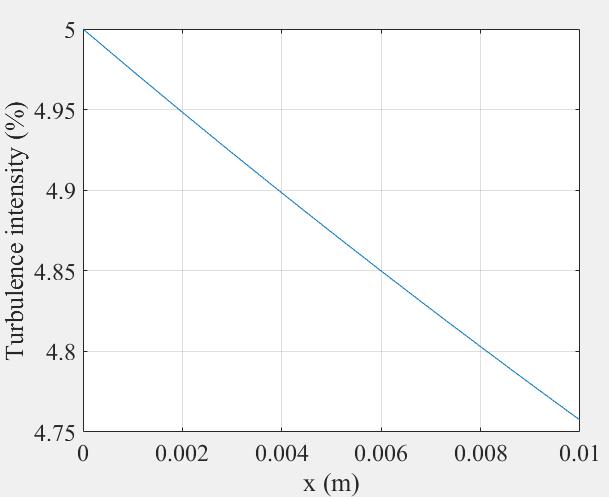


      This is the comparing case from ANSYS Custom portal.


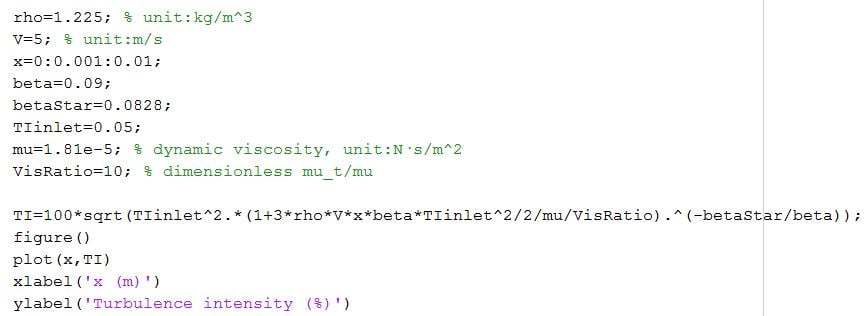
       For your convenience, the MatLab code I used for the calculation is copied here.


      Thank you very much! Any help is appreciated.


      Bests!

    • DrAmine
      Ansys Employee
      Do you have access to customer portal?
    • mutianzi1
      Subscriber

      Hello Amine,


      I do not have the access to customer portal.


      My advisor can access the customer portal and she gave me this information.


      Thank you!

    • DrAmine
      Ansys Employee
      Ti is dimensless. The material properties are specified at ambient conditions as highlighted in the solution. You need to adjust them to your local conditions. Mu_t to Mu is the viscosity ratio.
    • mutianzi1
      Subscriber

      Hello Amine,


      Thank you for your reply!


      I understood TI is dimensionless. I am confused about the units of air density ρ, velocity V, mu, etc. Because the coefficients, e.g. 2 and 3, are related to the units of these parameters. I was wondering the unit is in metric system or imperial system? 


      Also, does mu represent dynamic viscosity? In the denominator, it should multiply viscosity ratio?


      Bests!

    • DrAmine
      Ansys Employee
      The term in the bracket is dimensionsless and all viscosities are dynamic ones.
    • mutianzi1
      Subscriber

      Hello Amine,


      Thank you for your explanation. I have one more question. β and β* in the equation are two constants used in the Menter k-w SST (shear stress transport) turbulence model. In my CFD simulation, I use Large Eddy Simulation (LES) turbulence model to simulate the turbulence. Is this equation also applicable to LES model?


      Best Regards!

    • DrAmine
      Ansys Employee

      There is no eddy viscosity in LES bur the unresolved stress obeys the same boussinesq formalism deploying a SGS viscosity. Moreover in LES you need to account for resolved and unresolved TKE. You can use it as crude estimation but for LES you will need other type of inlet boundary condition. I have seen some other correlation for TKE decay which can be found in the WWW.

    • mutianzi1
      Subscriber

      Hello Amine,


      Thank you for your detailed explanation. It helps a lot. You mentioned some other correlation for TKE decay, which can be found in the WWW. Here, what do you mean by saying 'WWW'. Could you please share a little bit more info about this with me. I do appreciate your help.


      Best Regards!

    • Rob
      Forum Moderator

      I suspect Amine means World Wide Web, but probably doesn't have a specific reference. 

    • mutianzi1
      Subscriber

      Hello rwoolhou,


      Thank you for the info!


      Bests!

    • DrAmine
      Ansys Employee

      Yeah. Just look after decay of tke.

    • mutianzi1
      Subscriber

      Hello Amine,


      Thank you and sorry to bother you so long. May I ask one more question about the application of turbulence at the velocity inlet in Fluent.


      Does the turbulence has any directions when it is applied at the velocity inlet? I used LES and turbulence is applied as turbulence intensity and turbulence length scale. I only applied one value as turbulence intensity. But I don't know whether it is applied in along-wind direction, or in all three directions, i.e. along-wind, across-wind, and vertical directions. 


      Is TI only applied at the velocity inlet and it will decay with distance, or it is applied to the entire computational domain?


      If it is applied to the entire computational domain, I do not have to consider the decay of TKE.


      Best Regards!

    • DrAmine
      Ansys Employee

      Check inlet boundary condition for scale resolving simulation. Vortex method is recommended. Do not worry about decay but rather focus on establishing a good LES run with precursor URANS 

    • mutianzi1
      Subscriber

      Hello Amine, 


      I studied the section of inlet boundary condition for scale resolving simulation. I am still confused about one thing. I only input one value for turbulence intensity, as well as turbulence length scale. How are these values actually applied to the inlet? Do they apply to he entire face zone of inlet, or only apply to curtain height? In reality, turbulence intensity and length scale may vary with height. Can I achieve this in Fluent and how? Could you please throw some light on this?


      Also, could you please explain a little bit more about "establish a good LES with precursor URANS"? I don't quite understand the meaning of " with precursor URANS". Do you mean running a few time steps using URANS before using LES?


      Thank you! HAPPY NEW YEAR!

    • DrAmine
      Ansys Employee

      You assess a LES spatial and temporal resolution based on precursor RANS run and start if possible from it after making the velocity field bit instantaneous. For thé LES inlet and assuming perturbation ANSYS FLUENT expects your input of TKE or TI to prescribe the fluctuations.

    • mutianzi1
      Subscriber

      Hello Amine,


      I am not familiar with what you mentioned about precursor RANS run. Do you have an example, or reference, or video that I can follow? 


      Thanks!

    • DrAmine
      Ansys Employee

      Check best practice guidelines for scale resolving simulation by Florian Menter as well as this tutorial produced by Raef.


      https://youtu.be/NOmrcarpYn8

Viewing 17 reply threads
  • The topic ‘Question about the equation used to predict the decay of turbulence intensity’ is closed to new replies.
[bingo_chatbox]








