Ansys Assistant will be unavailable on the Learning Forum starting January 30. An upgraded version is coming soon. We apologize for any inconvenience and appreciate your patience. Stay tuned for updates.
Fluids

Fluids

Topics related to Fluent, CFX, Turbogrid and more.

phase change model in a microchannel

    • mossaied2
      Subscriber

      Hi


      My model is a micorchannel of cross-section 50umX100um in XY plane, and extended in Z direction for 500um. This channel has inlet at XY plane with water flowing inside at 323.15K at a flow rate of 1e-5 Kg/s. The upper wall of this channel has a heat source of 190e6 W and the water is saturated and I set the operating pressure equal to the saturation pressure of the (12352 Pa from NIST webbook). The 190e6 was calculated such that I have 2e-6 Kg/s of vapor at the outlet where 


      outlet_mass_flow_rate_vapor = input heat x upper surface area / latent_heat


      although I did not get any vapor at the outlet? so what would be the reason for that? 


      Thanks

    • DrAmine
      Ansys Employee
      Please add more details regarding the phase model used. Is the water inflow saturated at the operating pressure?
    • mossaied2
      Subscriber

      Yes Mr Amine, the inflow of the water at the inlet is entring to the microchnnel with temperature = saturation temperature 323.15 K and I set the operating pressure at 12352 Pa. I got the numbers (sat pressure and corresponding sat temp) from nist webbook. 


      I set the phase change model as follows Elurian -> evaporation-condensation -> Thermal Phase Change


      The flow is laminar 

    • DrAmine
      Ansys Employee

      So you are getting zero vapor at outlet. Can you post-process the mass transfer variable and post screenshot here?

    • mossaied2
      Subscriber

      Yes I am getting zero vapor at outlet Mr Amine


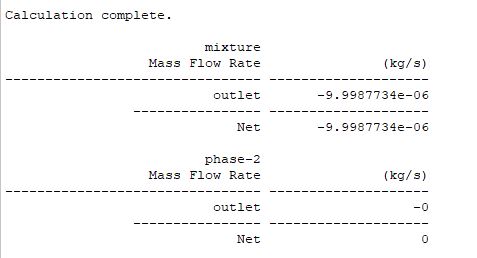
      here is Flux report for mixture (should be 1e-5)  and phase 2 - vapor (should be 2e-6)


    • DrAmine
      Ansys Employee

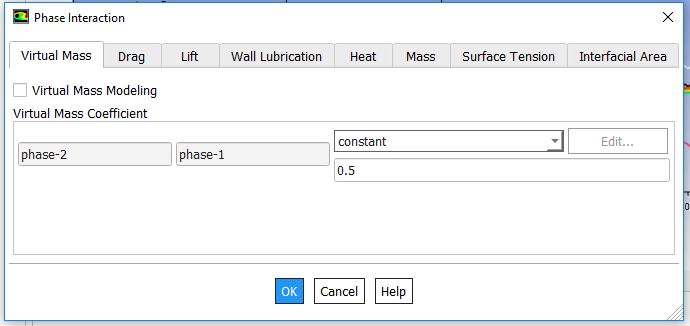
      I asked for Mass transfer rate under phase interactions.

    • mossaied2
      Subscriber

      sorry for the misunderstandiong, it was 0.5


    • DrAmine
      Ansys Employee

      No I asked for the contour plot or volume integrals of the phase interaction to check if it is always zero overall

    • Rob
      Forum Moderator

      Please can you add images of the mesh too: micro channel flows aren't quite as easy as they look. I assume you're using double precision too?

    • mossaied2
      Subscriber

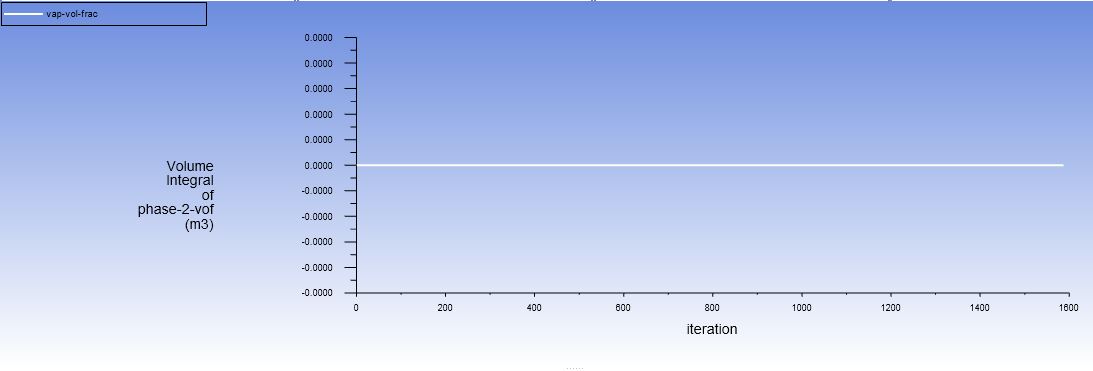
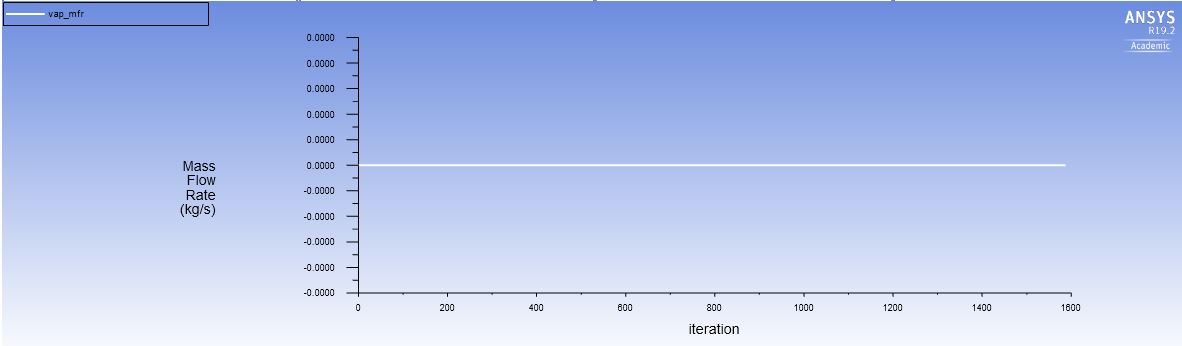
      Sorry again, actually I made a monitor at the outlet surface to monitor mass flow rate of vapor , and another one for the volume fraction of the vapor. I hope that what you meant Mr Amine


      vapor volume fraction


      vapor mass flow rate


    • DrAmine
      Ansys Employee

      There is a mass tranafer rate variable please do a contour plot for it at a certain plane in the middle and draw mesh on it as my colleague has already pointed

    • mossaied2
      Subscriber

      Thanks a lot for the support. I am trying to report that mass transfer rate variable but I do not know from where in fluent I can set it.


      in post-processing module there is a variable called "phase mass source"? is that the one required?


      Thanks

    • DrAmine
      Ansys Employee

      Under phase interaction.


      And ensure that the mass transfer is from liquid to vapor.

    • mossaied2
      Subscriber

      Sorry for late reply,


      I have made some changes and now my model can be highlighted as follows:


      Eulerian - evaporation-condensation - saturation temperature 323.15


      laminar flow


      I changed the material properties to be at operating temperature of 323.15 for both vapor and liquid water. I set the Enthalpy of water as 0 and vapor with the difference between the 2 enthalpies at 323.15 K (after conversion to j/kgmol by multiplying the difference by 18.0152 - the molecular weight of water). I get the material properties from NIST workbook


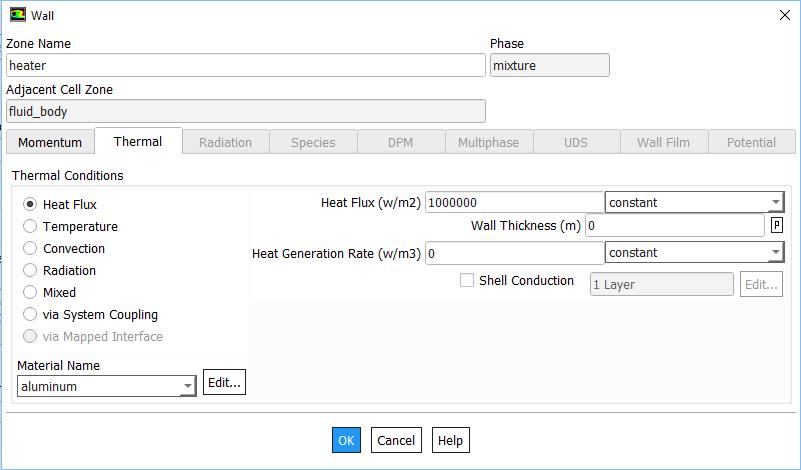
      still rectangular micro-channel with cross section of 50um width, 100um hight and 500 depth. The upper wall is heated with heat = 1e6 W/m^2 (100 W/cm^2)


      velocity inlet with liquid entering with speed 0.708 m/s - 323.15 K, and vapor entering with zero velocity and 323.15 K. This 0.708 m/s is equivalent to 700 kg/m.s mass flux 


      pressure outlet with zero gauge pressure and outlet temperature 323.15 K to avoid super heated vapor 


      operating conditions - pressure 12352 Pa = saturation pressure, no gravity


      methods -> Pressure-velocity coupling - scheme (coupled) -  Pressure (Presto) - others set to their defaults -  Pseudo transient


      initialization - Hybrid - and I patched vapor to fluid body with 0 volume fraction 


      calculations - time step method (User specified) - pseudo time step (0.001)


      All the convergence curves are below 10^-2, although I have made another check that did not show good result at all


      for 10^6 W/m2 I entered on the upper wall of the channel I should be getting 1.049 e-8 kg/s vapor at the outlet according to the following equation:


      mass flow rate of vapor * latent heat =  10^6 * area of the upper wall


      what I got from the simulation was :


      vapor


      Mass Flow Rate (kg/s)


      inlet -0


      outlet -1.2587459e-12


      Net -1.2587459e-12


      of course 1.2587459e-12 is very far from the theortical value 1.049 e-8 


      Here are the convergence curves
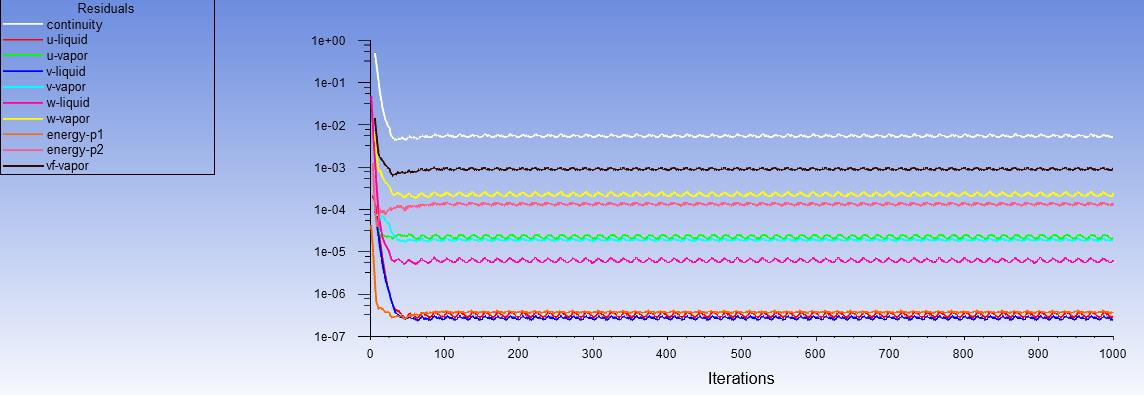


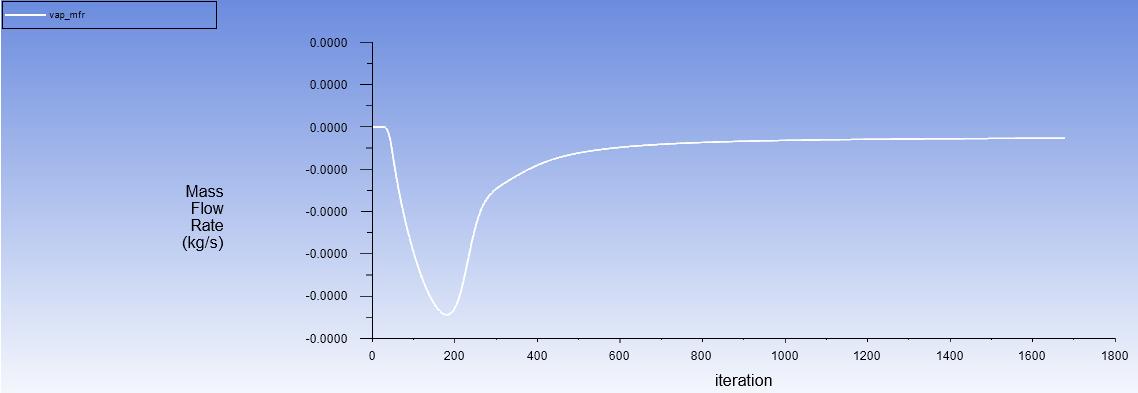
      Here is the mass integral (mass transfer rate) inside the fluid-body zone
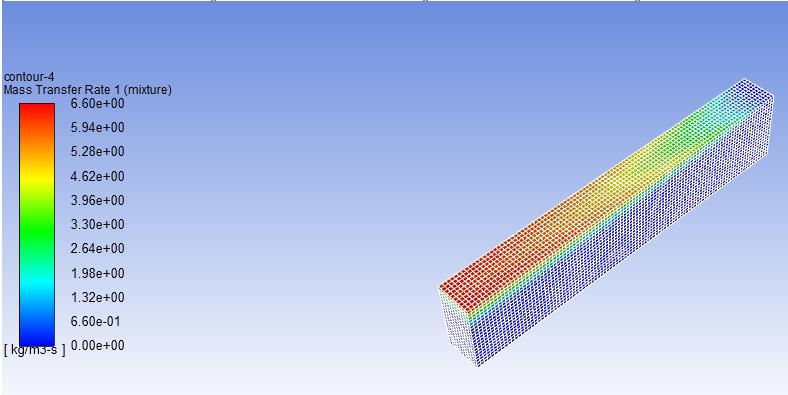


      mass transfer rate vs iterations
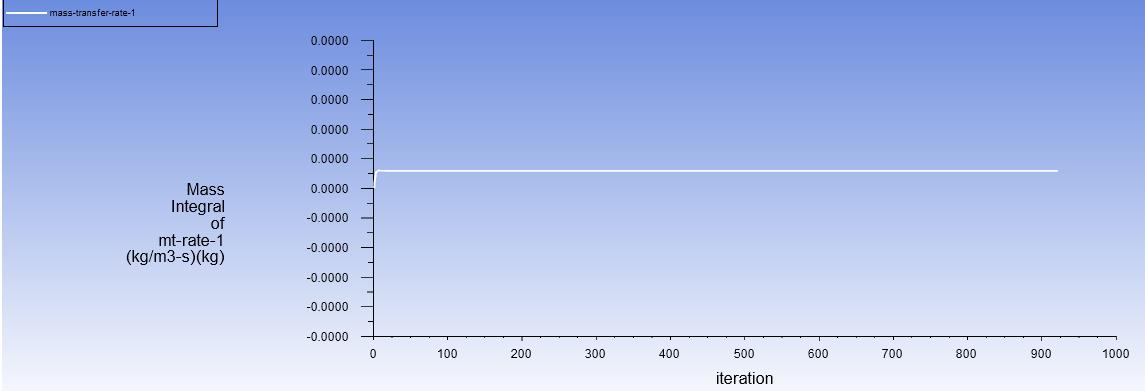


        Any help would be appreciated! 

    • DrAmine
      Ansys Employee

      I do not know why you are switching every time the multiphase method. Please stick to one configuration so that we might help you.


      What about the heat transfer in your new case? 


    • mossaied2
      Subscriber

      I am very appreciated Mr Amine for the reply and taking care of my case


      Actually the change was unintentional and by mistake, I was sticking to Eulerian -> evaporation-condensation - Thermal phase change but for some reason I forgot and set it to Eulerian -> evaporation-condensation - Lee. I am really sorry for that


      I reran the simulation and recorded the mass-transfer-rate and I found that continuity does not converge a lot, it stabilizes at ~0.3 also the I have a big error between the expected vapor mass flow rate and theoretical one. I was expecting 1.049e-8 kg/s while I got 1.e-9 kg/s only at the outlet 


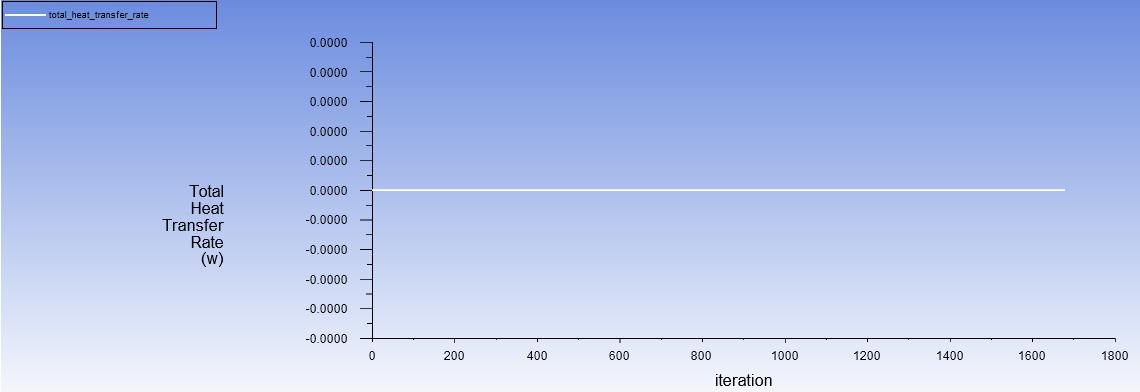
      I was recording the total heat transfer rate in the fluid-body and it seems there is a problem in that regard because I think it is almost zero as shown in the following picture. That is really strange since I am setting the heat correctly to 1e6 W/m2


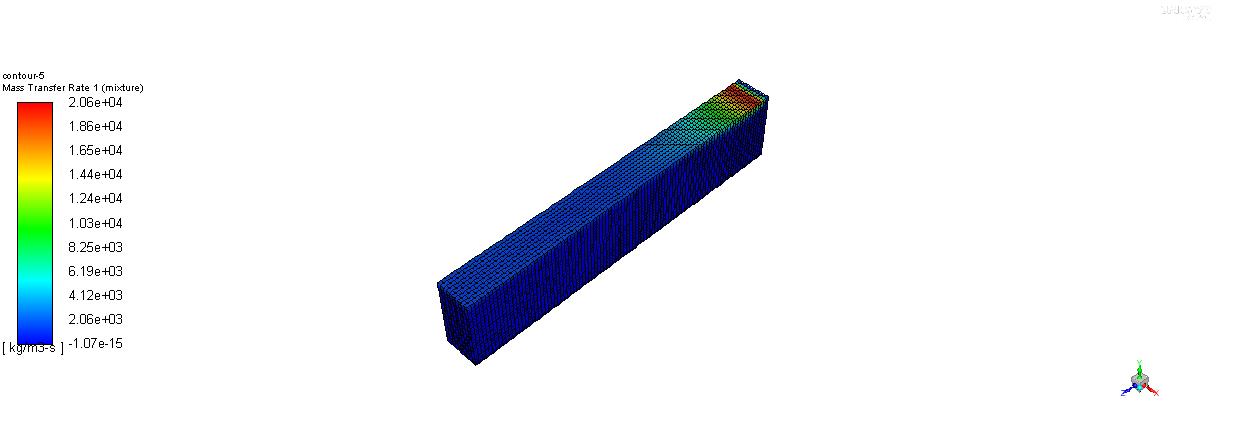
      Here is also the mass transfer rate. It looks strange since it is only high near the inlet! I was expecting that as the sat water flows more in the channel, more vapor is generated. 


      and vapor volume fraction at the outlet


    • DrAmine
      Ansys Employee

      Run for more iterations at first and then report.


      What about the heat transfer between the phases?

    • mossaied2
      Subscriber

      Ok Mr Amine I'll do that, I just wonder how to report heat transfer between phases, what I am reporting right now in the simulation, is from Report Definitions -> Flux -> Heat Transfer Rate then I choose once liquid and once vapor, is that right?


      Thanks  


    • DrAmine
      Ansys Employee

      No thats ist not right and is not easy to do. Once again please add a screenshot of the heat tranfser interaction panel. 

    • mossaied2
      Subscriber

      OK Mr Amine, so how to report "heat transfer between the phases" I googled that with no useful results.


      Also where is this "heat tranfser interaction panel" so I can report?


      Thanks  

    • DrAmine
      Ansys Employee
      Is not stored in Fluent. You will need to reconstruct it.

      Phase Interaction Panel> Heat transfer.
    • mossaied2
      Subscriber

      Hi Mr Amine


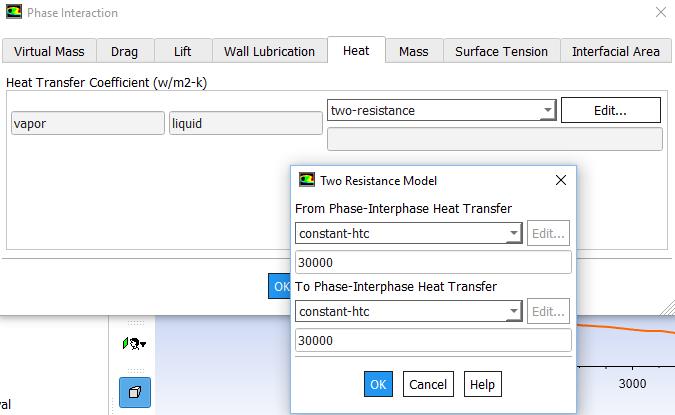
      Actually when I choose evaporation-condensation, ansys automatically switches to two-resistance model with no options to change. I also left the default setting of the two-resistance model which is From phase ranbze-marshall and to phase "zero resistance" 


      I really doubt this the to-phase setting "zero resistance" as I think vapor has more resistance than water? 


    • mossaied2
      Subscriber

      I set both From/to Phase-Interaction Heat Transfer to constant  instead of ranbze-marshall and zero resistance as default setting. The constant as shown is 30000 W/m^2.k, where I got this value from some paper. what I am really worried about is the dimensions that ansys waiting in these two settings. so is W/m^2.k is right. ?


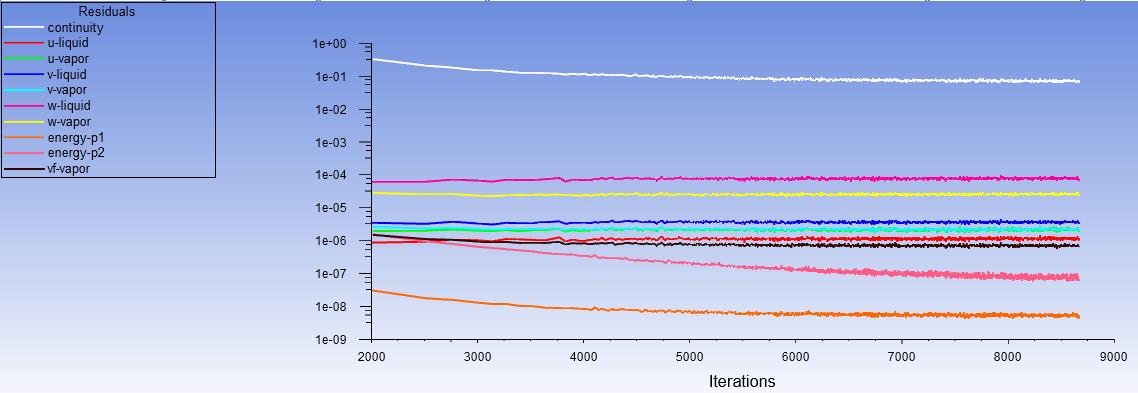
      I got the best convergence I could ever get since I start this work, with all residuals below 10^-4 except continuity it was bouncing between 6.8e-02 and 7.2e-02 (still very much better than my previous trials).


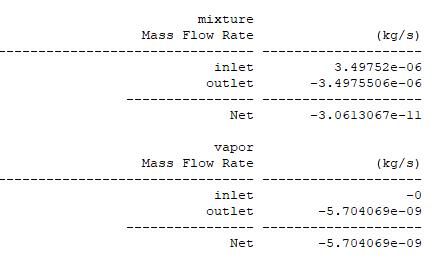
      The error between mass flow rate from fluent and the theoretical value get reduced although it is still big difference, now while I should be getting ~1.049e-8 kg/s at outlet I am getting 5.7e-9. The error yes still big 45% but before it was 1000 times less than the expected value. 


      I think the problem really was in the Heat Transfer Mechanism between phases. I think also the correct setting of HTC would lead to more convergence.


      Thanks in advance for your help 


    • DrAmine
      Ansys Employee

       The volume integral of mass transfer rate has to be equal to the mass of the vapor from outlet. If this is true then it is fine. Your case is not realistic and consequenlty convergence by residual will not be amazing. What is your application?


      The whole run is sensible for interfscial, area and htc. A part of the heat to the wall will be used to heat up the vapor which is formed. you will not get the ideal mass of vapor as it does not remain saturated. For this eutopic case it is better to assume water as saturated and as such to use zero resitance for it. 

    • mossaied2
      Subscriber

      Thanks for the reply Mr Amine


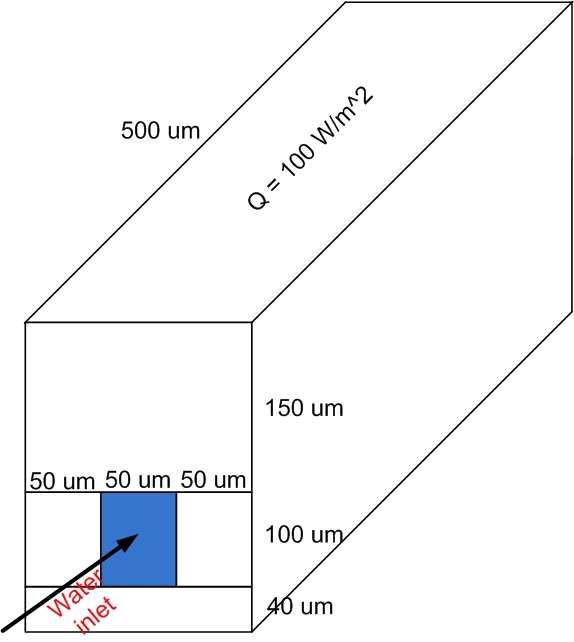
      My application a lot similar, a rectangular micro-channel for silicon cooling as shown bellow.


      I was only simulating the fluid part because in that case I am sure all the 100 W/cm2 heat applied will be consumed in sat water and hence I can estimate the vapor flow rate at the outlet and compare that value to the one coming from my simulation. After becoming sure that this simplified model is working by getting the expected vapor rate at the outlet by changing the heat input, then I can go safely to the complete model shown above.


    • DrAmine
      Ansys Employee

      -Micro Channels are always challenging: scale of bubbles and channel geo.


      -Vapor formed at wall won't leave the wall prompt after getting formed (might be due to lift and co) and this thin film of vapor might be superheated: not all heat will be used to evaporate water. This applies for the case you created and the example from the portal (for both I obtained satisfying results but not the 100% you are expected)


      -For these cases as interaction is quite unknown: I will prefer using a single fluid approach and use very fine mesh. 

    • mossaied2
      Subscriber

      Thanks Mr Amine for that explanation but could you plz clarify more about this "single fluid approach"? do you mean VOF?


      also what was your setting for phase-interactions (drag, lift, etc.) especially the two-resistance model (From Phase-Interphase Heat Transfer and To Phase-Interphase Heat Transfer)? 


      Thanks in advance  


    • DrAmine
      Ansys Employee

      1/Yes VOF or Mixture Model


      2/I used default drag, zero resistance for water and constant nusselt number for vapor (6).

    • mossaied2
      Subscriber

      Thanks Mr Amine for the very useful information,


      could you plz refer to me the reference that you got the nusselt number of 6 from , or you just make your own calculations?


      Thanks


    • DrAmine
      Ansys Employee

      Check CFX documentation.

    • amaligaadi2018
      Subscriber

      PLZ mossaied2, I need the value of Supersonic/Initial Gauge Pressure that you have used

    • mossaied2
      Subscriber

      I am still on the way and I think the key in the Heat transfer coefficients settings of the two resistance model 


      but anyways it was zero amaligaadi , based on the advice of ansys forum also. However I set the operating pressure to the saturation pressure. 


      Plz let us know what was the best settings that works for you


      good luck

Viewing 31 reply threads
  • The topic ‘phase change model in a microchannel’ is closed to new replies.
[bingo_chatbox]