-
-
October 11, 2023 at 12:30 pm
deepesh.p.gurdasani
SubscriberIn Engineering data, when trying to change density, shouldn't Young's modulus also change? (As young's modulus is proportional to density). There is no effect on Young's modulus when density is changed in Engineering data. Can someone guide ?
-
October 11, 2023 at 12:37 pm
ErKo
Ansys EmployeeHi
There is no relation between them (density and Young’s mod.).
What you mean probably is when you change Young’s modulus or Poisson’s ratio then the Shear Modulus changes. See here for their/such relation:
https://en.wikipedia.org/wiki/Shear_modulus
All the best
-
October 12, 2023 at 5:42 am
deepesh.p.gurdasani
SubscriberHello
can you have a look at the below link ? It shows relation between Density and Young's Modulus.
https://www.vedantu.com/question-answer/if-the-density-of-the-material-increases-the-class-11-physics-cbse-5fb7bff76ad6283e70aead0b
-
October 12, 2023 at 6:17 am
ErKo
Ansys EmployeeHi
We are not allowed to open such links (but if it is education I would suggest to ask your teacher for an explalnation of what they mean), but as we said in Ansys there is no relation between density and Young's modulus, they are individual material inputs that you need to input separately (so one does not determine the other) and they are not dependent on each other (the dependency is between the elastic properties shown in the link provided in my first post).
Erik
-
October 12, 2023 at 6:23 am
deepesh.p.gurdasani
SubscriberThe link that I shared shows the proof of relation between Density and Young's Modulus. So, I just wanted to understand why in ANSYS, it is not taken as a co-relation. Or if may be I am going wrong somewhere. That's why I created this discussion. May be someone else can help me out on this forum.
Anyway, thanks Erik.
I would wait for some more replies to this discussion.
-
October 12, 2023 at 10:37 am
peteroznewman
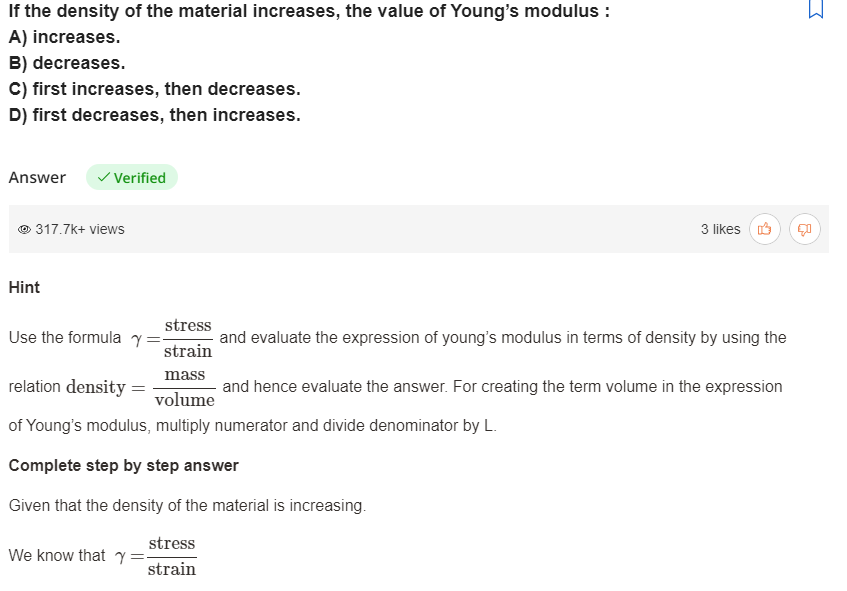
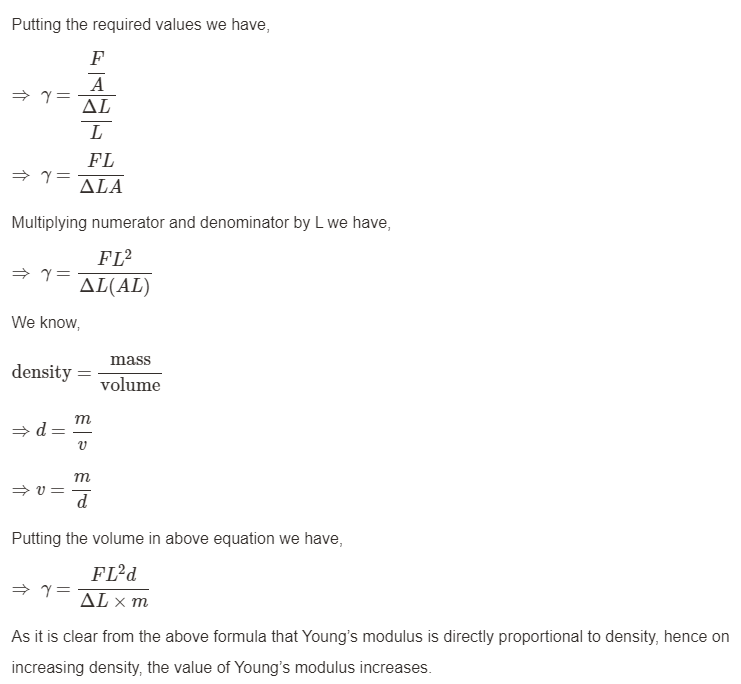
SubscriberBelow is a copy of the question and answer.
This example fails to explain Young's modulus or elasticity and draws incorrect conclusions.
This example does not introduce the concept of Poisson's Ratio, where the cross-sectional area increases as the length decreases due to compression. Poisson's ratio must be used in the calculation of the volume with the compression becuase if the Poisson's Ratio is 0.5, then there is no volume change. Only when Poisson's ratio is 0 will the volume change in the equations used in this example be correct. There are very few materials that have a Poisson's Ratio near zero.
-
October 12, 2023 at 11:40 am
deepesh.p.gurdasani
SubscriberHi sir. Thanks for the reply.
Even if we introduce Poisson's ratio formula here, still the formula would contain Density in proportion to Young's Modulus and isn't poisson's ratio also directly proportional to Young's Modulus [Y=2G(1+μ)] ?
-
October 12, 2023 at 11:27 pm
peteroznewman
SubscriberI find the whole exercise is misleading and not worth discussing further. I suggest you watch the free course available on this site if you want to learn about elasticity.
-
- The topic ‘Density and Young’s Modulus in Engineering data’ is closed to new replies.

-
6455
-
1906
-
1457
-
1308
-
1022
© 2026 Copyright ANSYS, Inc. All rights reserved.