TAGGED: boiling-flow-in-fluent
-
-
January 25, 2023 at 3:08 pm
Shawn Ren
SubscriberHello everyone,
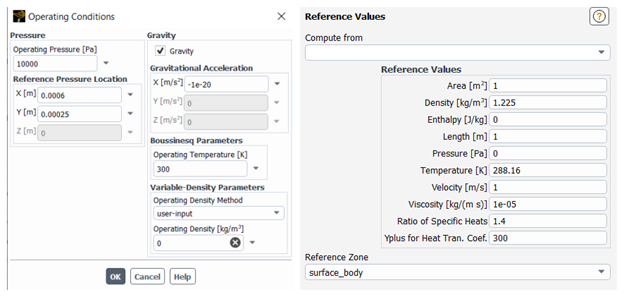
I am currently simulating water boiling in a micro tube with low pressure and microgravity.  The inlet radius is 0.5 mm, the near inlet part was set to isotherm wall, followed by > 6mm heating walls. The axial length is about 7 mm, the outlet radius is 0.25 mm.  I ran the case at 10 kPa pressure, -1e-20 m/s2 gravity in X-direction (I’d like to set it to zero, but the boiling model requires it to calculate some parameters like bubble departure diameter), using the 2D axisymmetric condition. The mesh has a structured grid of about 25400 cells and a focused inflation layer in the wall surfaces, I estimated the y plus is about 50. The heat flux of outer and inner walls was set to 75 000 W/m2 and 60 000 W/m2 respectively, it’s supposed to be enough to evaporate all the low mass-flow liquid, so I chose the Critical Heat Flux wall boing model.
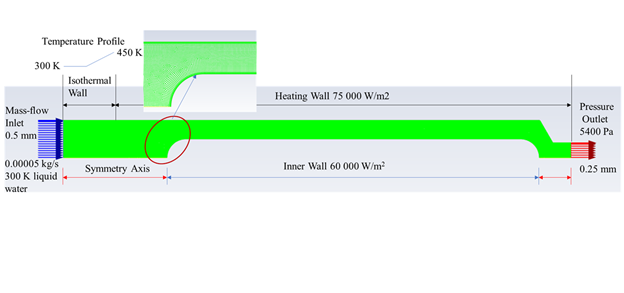
For the FLUENT setups, I am using :
Â
Gravity On in the -x direction
Multiphase -> Eulerian -> Boiling Model -> Critical Heat Flux
Energy On
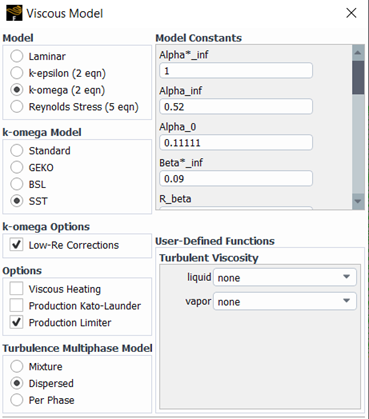
SST k-ω model with Low-Re Correction
Phase Interactions:
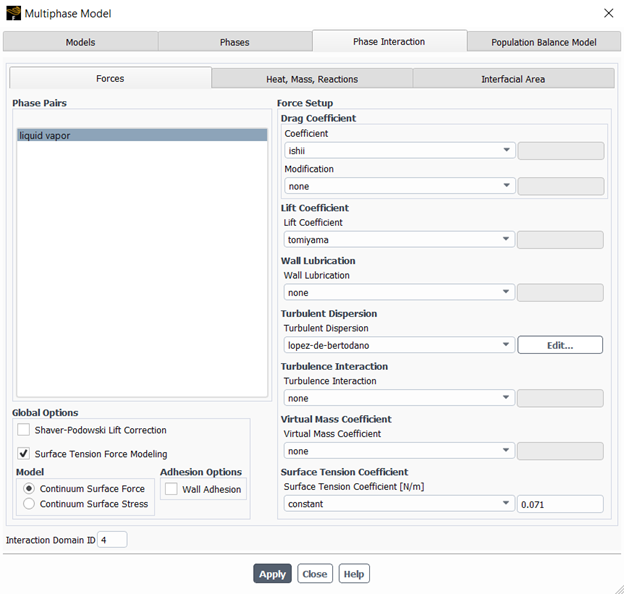
Forces (I tried just keep Drag (Universal) and Dispersion Force (Burns) because of some ANSYS staff’s answers from this Forum, but it didn’t work)
Drag model -> Ishii
Lift model -> Moraga or tomiyama
Turbulent dispersion force -> lopez-de-bertodano
Surface tension -> Constant -> 0.071 N/m or 0.032 N/m
Heat transfer -> ranz-marshall
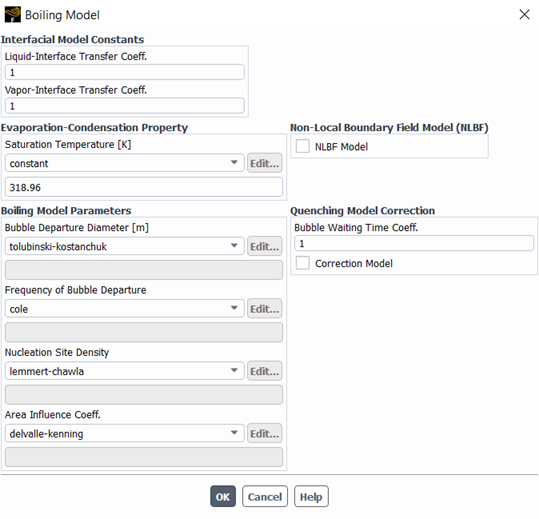
Mass transfer -> Boiling from Liquid to Vapor at 318.96 K saturated temperature (10 KPa)
Bubble departure diameter -> Tolubinski-Kostanchuk
Frequency of bubble departure -> Cole
Nucleation site density -> Lemmert-Chawla
Area influence coefficient -> Delvalle-Kenning
Interfacial area -> ia-particle
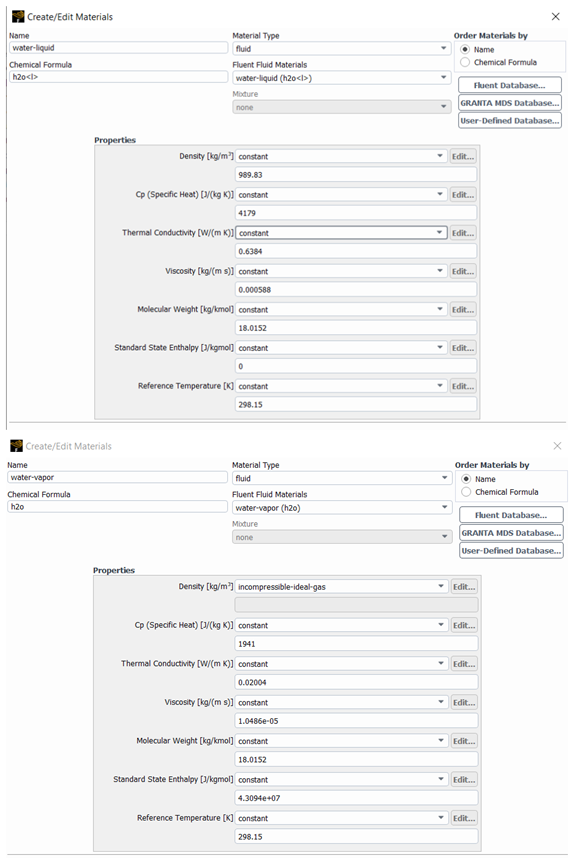
I defined the fluid properties referring to the water properties corresponding to 10 KPa. I kept the reference temperature by default here, I’m not sure of the exact value I should input.
Â
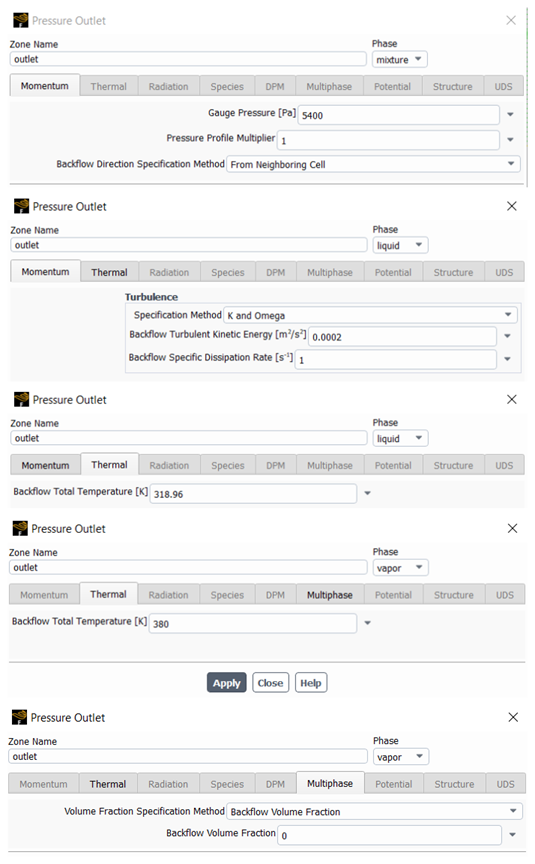
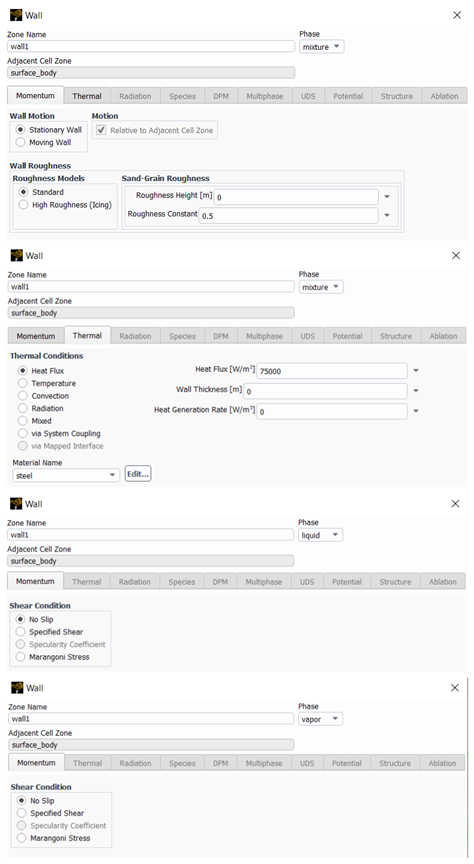
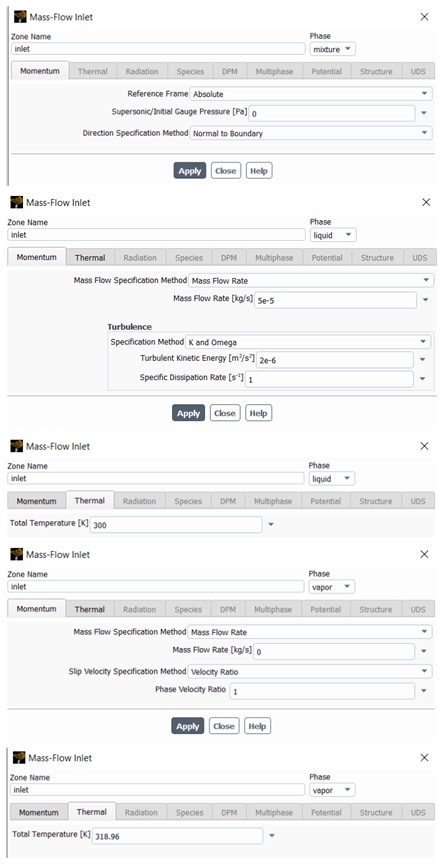
Since I set up this case based on replacing mesh into CHF boiling tutorial VMFL067_FLUENT-1 and modifying boundary conditions, some inlet and outlet profiles like inlet k and ω, outlet k and ω, the outlet backflow temperatures were set by default or in line with the tutorial case. In addition, the inlet mass flow rate is 0.00005 kg/s and outlet gauge pressure is 5400 Pa.
Â
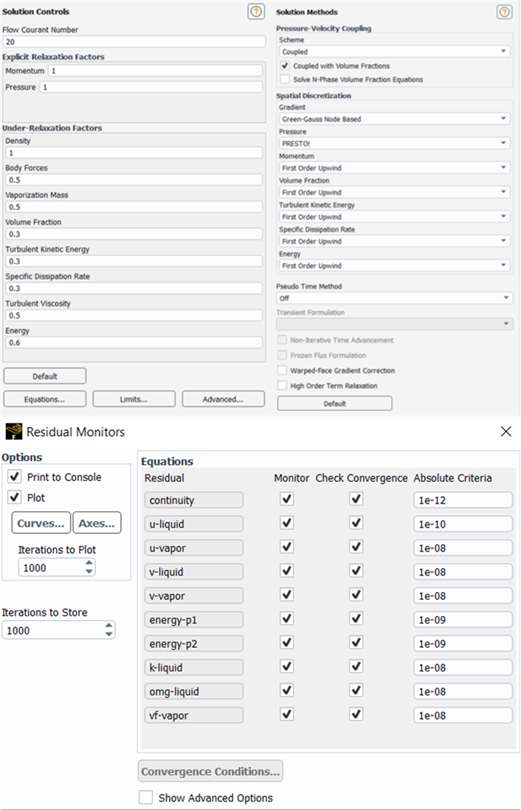
For a solver, I tried Coupled with and without Pseudo time, but both eventually got crushed. I also tried a transient solver.
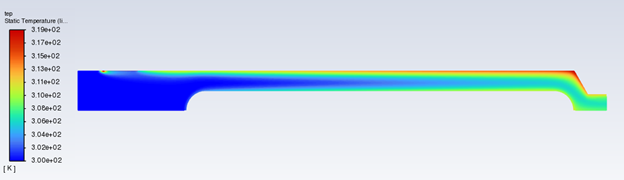
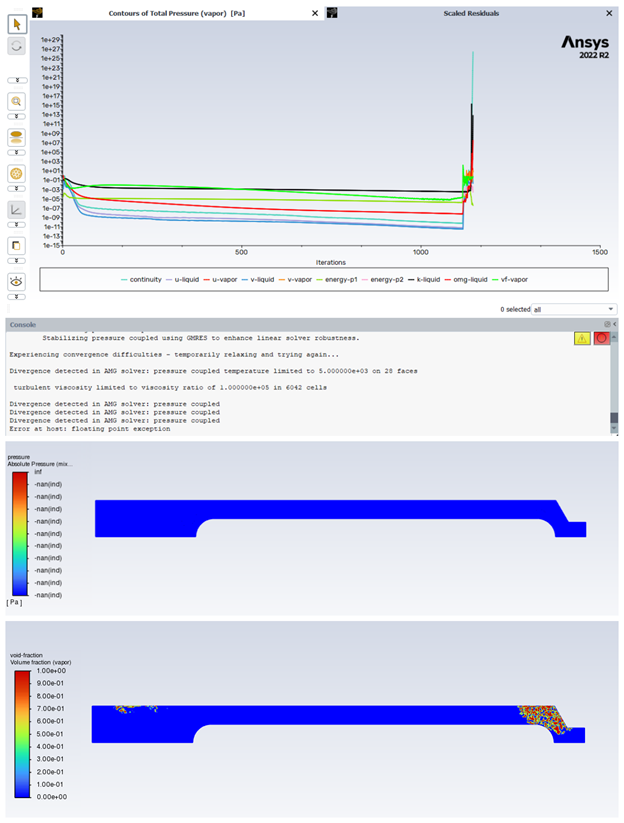
I increased the heating wall heat flux from 10 000 W/m2 gradually, there was no vapor generation with relatively low heat flux. After the heat flux increased to 75 000 W/m2, it seemed OK before the fluid reached the saturation temperature; With further iterations, the mode would diverge, resulting in the discontinuous vapor phase and invalid pressure contours. However, I've seen in previous work that the model achieves convergence but I am not getting the same type of convergence when this high heat flux has been applied.
After liquid water reached saturation temperature
Does anybody know how to achieve convergence for this CHF modeling?
By the way, it would be good if anyone can explain the reference temperature when defining the fluid properties and inlet/outlet turbulence profiles further.
Any help that can be provided is very much appreciated!

-
February 7, 2023 at 1:45 pm
Shawn Ren
SubscriberDoes anyone have a clue and could you please give me some advice? Thank you in advance!!! -
February 14, 2023 at 7:29 am
Prashanth
Ansys EmployeeHiÂ
I'm writing as nobody else has reponded. Does this divergence issue happen when you set default g as gravitational acceleartion?
-
February 14, 2023 at 8:18 am
Shawn Ren
SubscriberDear Mr. Prashanth, Â
Thank you so much for your kind reply.Â
Yes, it diverged with fewer irritations when I set default g, so I gradually decreased the magnitude of |g| until e-20 (I also tried to set g as zero), the only difference is that the case would have more iterations before the divergence.
After posting this, I tried only doing a single change in the tutorial case VMFL-067-FLUENT-1. As I changed the density of liquid water or the specific heat of vapor water, the tutorial case just diverged. So I also would like to know if the CHF wall boiling mode is sensitive to the material properties, and the applicability to the low operating pressure. Thank you so much.
Look forward to your reply.
Best regards,
Shawn
-
-
February 14, 2023 at 8:18 am
Shawn Ren
SubscriberDear Mr. Prashanth, Â
Thank you so much for your kind reply.Â
Yes, it diverged with fewer irritations when I set default g, so I gradually decreased the magnitude of |g| until e-20 (I also tried to set g as zero), the only difference is that the case would have more iterations before the divergence.
After posting this, I tried only doing a single change in the tutorial case VMFL-067-FLUENT-1. As I changed the density of liquid water or the specific heat of vapor water, the tutorial case just diverged. So I also would like to know if the CHF wall boiling mode is sensitive to the material properties, and the applicability to the low operating pressure. Thank you so much.
Look forward to your reply.
Best regards,
Shawn
-
February 14, 2023 at 9:44 am
Prashanth
Ansys EmployeeYes, it is recommended to use temperature dependent properties with pressure dependent saturation (pt-sat or ptl-sat) or even better, real gas property (RGP) tables with saturation tables.
But using constant properties won't lead to sudden divergence like this. Can you check your y+? Boiling models won't work with low y+ and it is better to maintain y+ greater than 15 or so for stability.
-
February 14, 2023 at 10:40 am
Shawn Ren
SubscriberThank you for your prompt response. For my own case, I set the y+ as about 50, and I also tried coarser or finer mesh. Once the fluid was heated to saturation temperature, the case would diverge soon.Â
For the tutorial case, technically speaking, it's from the Fluid Dynamics Verification Test Cases, I did not know the y+, but the number of the radial grid nodes is indeed very small. It was running with constant properties at a certain pressure point. I guessed it might be sensitive to the fluid properties, however, the model corrections are tuned fine for that setup in the verification case, the current situation is that only one value change causes the result to diverge.
Of course, I learned the verification case for getting some clues for my own setup, could you please give me further suggestions now? Thank you.Â
Â
-
-
February 14, 2023 at 11:23 am
Prashanth
Ansys EmployeeShawn,
I have the 22R2 verification cases with me. The y+ for both phases is more than 20 in them. And you can't really play with that setup by changing the density and specific heat values. That affects the LH heat calculation. Also the saturation temp is set as constant in that setup. Incompatible values can cause that. They are indeed fine tuned to match literature.
Can you try without lowRe model?
-
February 14, 2023 at 2:56 pm
Shawn Ren
SubscriberHello Mr. Prashanth,Â
Thank you so much for your detailed answer to the verification case part. It helps me a lot. Yes, I also worked with 22R2 version.Â
Sorry for the late reply. I need to confirm whether having lowRe model disabled has a big impact. I remember I used to disable the lowRe model in the previous case, but at that time I used fixed temperature wall boundary conditions, although some former cases didn't crush, there was no vapor generation even with a very high wall temperature. Later I changed to simulate it with heat flux wall boundary conditions as this post shows.
Unfortunately, I just tried the current case without lowRe model, and it ran for more irritations but still diverged. I looked through all threads about boiling in our ANSYS forum, tried most of the general suggestions like ensure enough y+, keep only more important interphase forces first, etc. but it didn't work for my case. So I wonder about the applicability of the CHF boiling model.Â
Any further help is very much appreciated.Â
-
-
November 6, 2023 at 11:36 am
azim
SubscriberHi,
Did you manage to solve this problem?
Thanks,
Azim
-
- The topic ‘Critical Heat Flux boiling model always diverged’ is closed to new replies.
-
6379
-
1906
-
1457
-
1308
-
1022
© 2026 Copyright ANSYS, Inc. All rights reserved.