
-
-
April 3, 2022 at 3:51 pm
20082304052
SubscriberApril 4, 2022 at 3:01 pmGuilin Sun
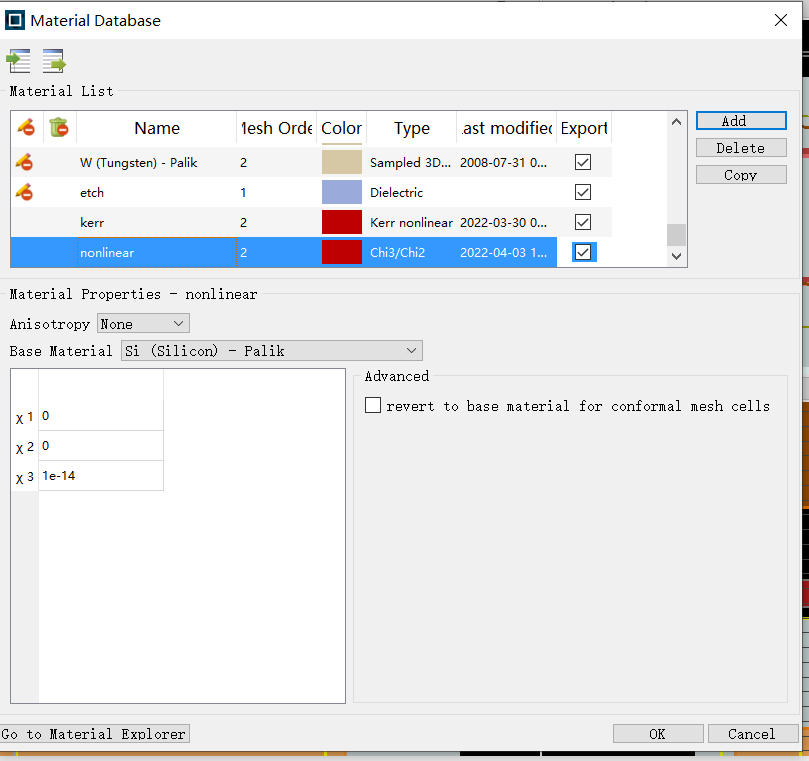
Ansys Employee如果仅仿真Kerr效应,只需要使用Kerr模型即可,不要使用chi3/chi2,因为后者是为其它现象设计的。虽然理论上让Raman系数为零没有问题,在算法上可能有些问题。April 4, 2022 at 3:11 pmSubscriber好的,谢谢老师!那如果还要仿真硅基波导的双光子吸收,我该怎么设计材料呢?April 5, 2022 at 1:53 amAnsys Employee双光子吸收two-photon absorption涉及到能级跃迁吧?这个需要特殊的材料模型,很可能需要自己开发。好像还涉及荧光辐射,这个还需要新的算法。
参见 FDTD Analysis of Two-Photon Absorption and Free-Carrier Absorption in Si High-Index-Contrast Waveguides
Journal of Lightwave Technology Vol. 25, Issue 9, pp. 2495-2501 (2007)Viewing 3 reply threads- The topic ‘请问如何在FDTD中仿真硅基波导的光学克尔效应?’ is closed to new replies.
Innovation Space Trending discussions
 Top Contributors
-
peteroznewman
 5994
5994 -
scabo
 1906
1906 -
Dennis Chen
 1425
1425 -
javat33489
 1308
1308 -
Shyam Prasad V Atri
1021
Top Rated Tags
© 2026 Copyright ANSYS, Inc. All rights reserved.
Ansys does not support the usage of unauthorized Ansys software. Please visit www.ansys.com to obtain an official distribution.
-


The Ansys Learning Forum is a public forum. You are prohibited from providing (i) information that is confidential to You, your employer, or any third party, (ii) Personal Data or individually identifiable health information, (iii) any information that is U.S. Government Classified, Controlled Unclassified Information, International Traffic in Arms Regulators (ITAR) or Export Administration Regulators (EAR) controlled or otherwise have been determined by the United States Government or by a foreign government to require protection against unauthorized disclosure for reasons of national security, or (iv) topics or information restricted by the People's Republic of China data protection and privacy laws.

 You are navigating away from the AIS Discovery experience