
How velocity and pressures are matched at the transition regions between porous and free flow domain

-
-
March 1, 2022 at 2:11 pm
DenizSS
SubscriberHello,
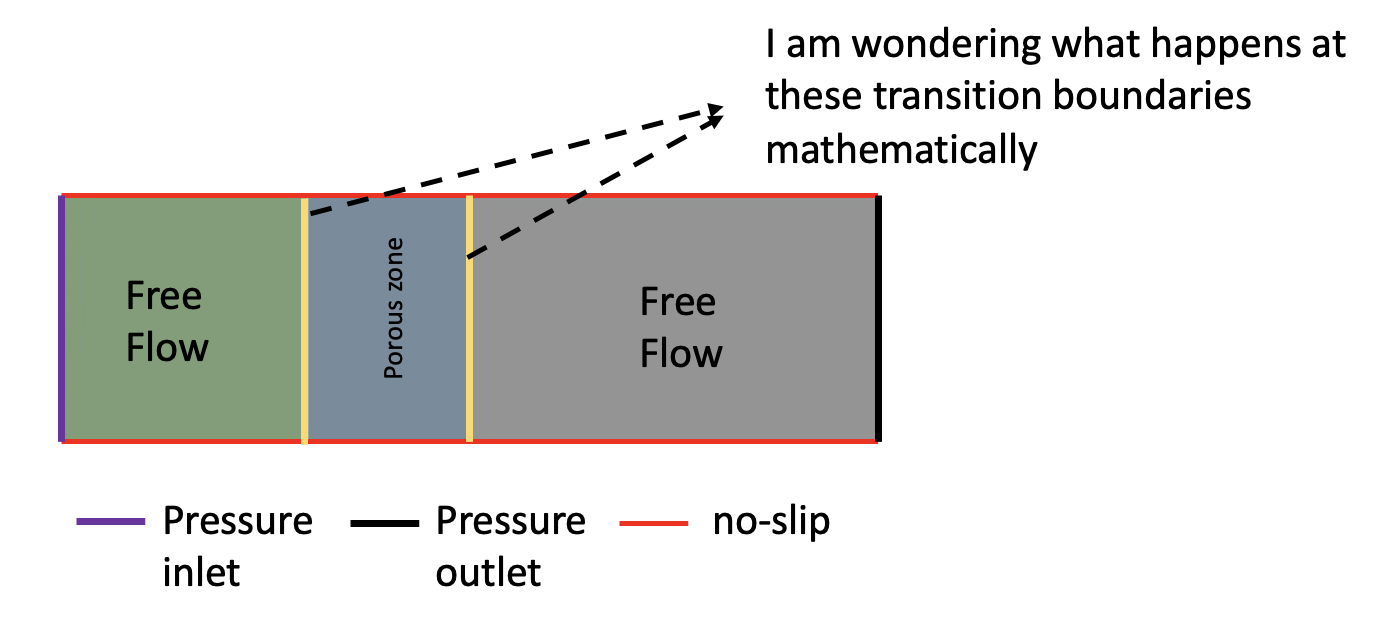
I am wondering about the mathematics of pressure and velocity match at the transition faces from the free flow to the porous region and similarly from the porous region to the free flow region. In the below picture, at the yellow-colored faces how does ANSYS match velocities and pressures? I would be appreciated it if you can help me to understand this issue also if you can tell me which section am I supposed to be looking at in the ANSYS manual for my question. Which face boundary should I select, porous jump or interior?
March 1, 2022 at 4:27 pmRob
Forum ModeratorHave a look at porous zone (cell zones) and interior (boundary conditions). Porous Jump (boundary conditions) is worth reading too.
March 7, 2022 at 9:20 amSubscriberHi Rob,
Thanks for your reply.
I have checked all of them. But unfortunately none of them are answering my question. I understood that when we apply the porous media model to the cells, it simply adds a momentum sink to the Navier-Stokes Equation in terms of pressure drop. My question is, when the coefficient matrices are calculated for the finite volume solver, are those matrices prepared separately for both porous and free flow cell zones and solved separately? If so, how does the coupling mechanism work?
Another question:
There were not enough information for interior type face boundary in ANSYS manual. What does it do mathematically? How is this face boundary incorporated into the finite volume solver? Could you please give me a reference link. Any help is appreciated :)
March 7, 2022 at 10:28 amForum ModeratorThe matrix should be for all cells, we don't couple the porous media as such. However, this may not be fully covered in the manual, and I'm not permitted to expand on the documentation.
Interior is a geometry surface that's meshed and brought into the solver. A good example is the CAD face that exists between two volumes. Flow will pass though this surface (it doesn't do anything) but it's useful in that we can run monitors etc on it with more precision than an iso-surface or plane. There won't be a reference as it's just a label. The "other" interior surface(s) contain all of the facets for the cell volumes.
March 7, 2022 at 10:43 amSubscriberThanks for the quick reply Rob. Now it's clear.
"The matrix should be for all cells, we don't couple the porous media as such." I thought the same but just wanted to make sure about it. ƒæì
So as the last question:
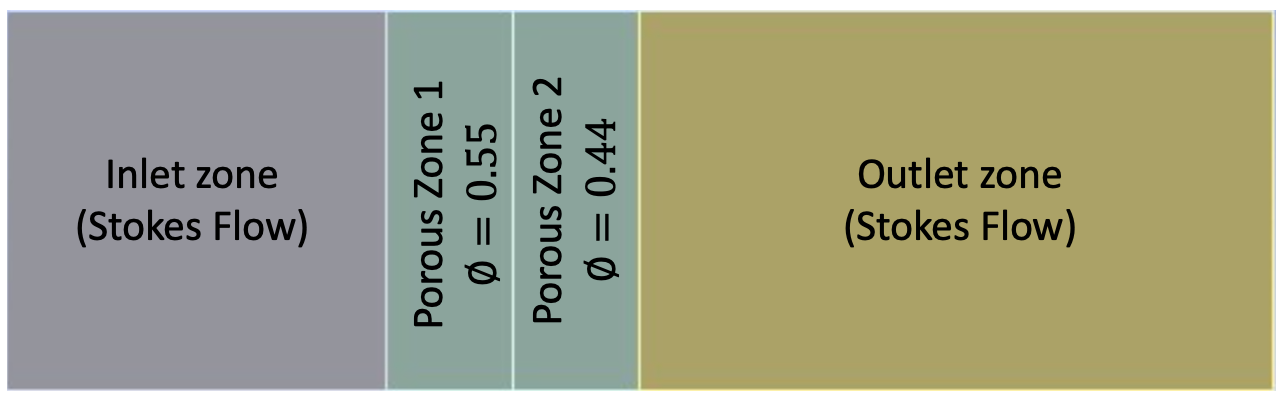
As far as I understood, assigning a porous jump boundary condition to the cell faces is meaningless when the cells are already defined as a porous medium, am I right? Therefore interior boundary condition will be enough for those cell faces. Similarly, when I add two porous zones right next to each other (which have different permeabilities and porosities), the cell faces that separate these two zones will be defined as interior instead of a porous jump for a more realistic model that represents the flow dynamics for permeability variation between two zones? (See below figure).
March 7, 2022 at 2:31 pmForum ModeratorThat's not what you asked. If you have a porous media you can either have a porous jump OR interior on the bounding face. If there is no additional resistance and you're not needing a surface to catch particles then interior is correct. If you want a membrane (eg perforated plate covering a filter) or want to catch particles then porous jump is the correct choice.
-
March 24, 2023 at 5:34 pm
James
SubscriberHi Rob, can I have more information on this? I am trying to model adsorption in porous media, and I have a porous region spanning a few centimeters. So in this case, do you recommend porous jump or will defining the bounding face as interior suffice? Also, I read somewhere that porous jump condition is only applied for thin films, not regions spanning a few centimeters (which is my case).
And an additional question: When one defines a porous region, does it use Navier Stokes with added terms for porous region?
March 7, 2022 at 6:01 pmSubscriberThanks, Rob. Crystal clear, both physically and mathematically.
Viewing 6 reply threads- The topic ‘How velocity and pressures are matched at the transition regions between porous and free flow domain’ is closed to new replies.
Innovation Space Trending discussions
 Top Contributors
-
peteroznewman
 6379
6379 -
scabo
 1906
1906 -
Dennis Chen
 1457
1457 -
javat33489
 1308
1308 -
Shyam Prasad V Atri
1022
Top Rated Tags
© 2026 Copyright ANSYS, Inc. All rights reserved.
Ansys does not support the usage of unauthorized Ansys software. Please visit www.ansys.com to obtain an official distribution.
-


 You are navigating away from the AIS Discovery experience