

TAGGED: cavitation, convergence, residuals, venturi
-
-
December 15, 2021 at 10:07 am
Paffu
SubscriberHello everyone,
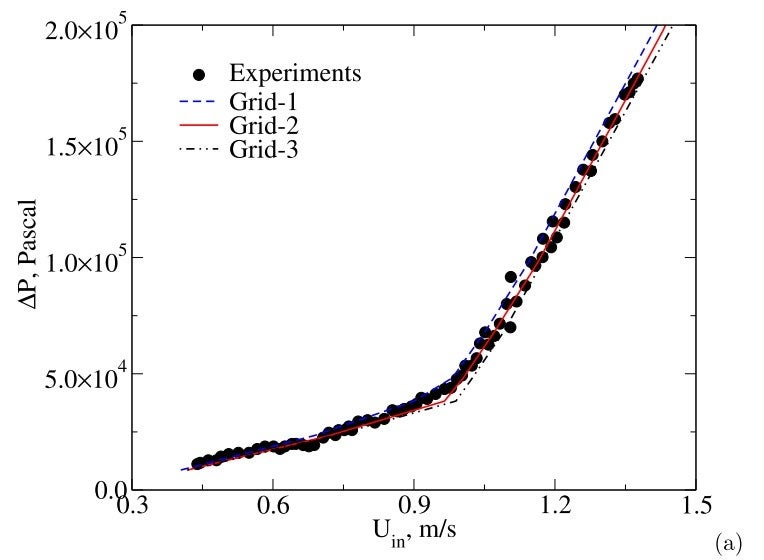
I'm currently studying the flow inside a venturi tube. The aim of the simulation is to investigate the cavitating behavior depending on the inlet velocity and reproduce the plot found in the literature (please see the first picture).
December 17, 2021 at 4:10 pmRK
Ansys EmployeeHello,
Did the mesh check pass? What is the mesh quality? Also refer to this tutorial to see if you are following best practices : Chapter 20: Modeling Cavitation (ansys.com)
December 18, 2021 at 8:01 pmSubscriberThe coarse grid has the following mesh quality parameter:
Minimum Orthogonal Quality =9.46164e-01
Maximum Aspect Ratio =3.10504e+00
Another grid (that doesn't work) has:
Minimum Orthogonal Quality =9.38112e-01
Maximum Aspect Ratio =1.05249e+01
But I noticed with a different turbulence model (and only that one), the realizable k-epislon with enhanced wall treatment, the residuals fall down. It could be possible? What could I infer from that?
Thanks Best regards A.S.
December 21, 2021 at 3:32 pmRob
Forum ModeratorHow does the flow look with the inflated mesh? The residuals are one guide for convergence, mass flux balance and and monitors are two others. Depending on where the cavitation occurs you may find the finer near wall mesh also needs a finer axial mesh too.
December 24, 2021 at 10:51 amSubscriberDear Rob Yeah, I kept a low maximum aspect ratio in order to reduce the cell dimension in both streamwise and spanwise directions. I also have monitored the mass flux balance and the inlet velocity and outlet velocity vs iterations. I observed that with a relatively high value of pressure inlet , apart from the residuals, the continuity is not respected and the velocity in outlet waves like a sinusoid around the inlet one and is not capable to tend to the inlet velocity value to reach the convergence.
The contour of the finer mesh seems acceptable, similar to the coarse one, and I report a comparison of the velocity profile at the axis between the coarse and fine mesh:
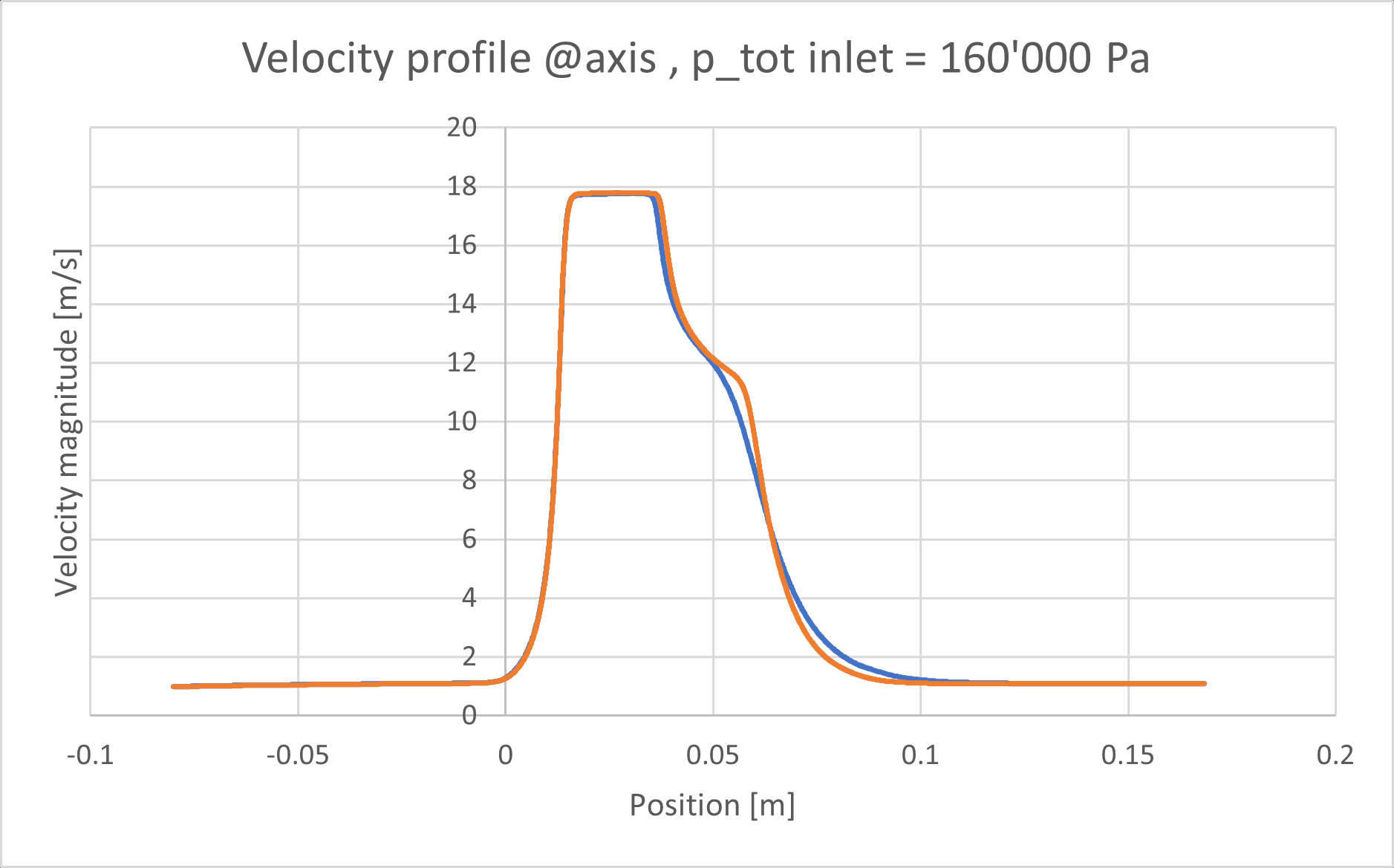 It could be a problem between a very fine mesh (Yplus <= 1) and the cavitation model Schnerr-Sauer? Because I have no other ideas to solve this issue.
Thank you very much.
Best wishes A.S.
December 24, 2021 at 11:42 amForum ModeratorIf you're using the steady solver it sounds like the cavitation isn't stable and the problem is down to that. A very fine mesh may pose some stability problems if the vapour is added into one cell, but it's more likely the motion of the vapour.
December 24, 2021 at 5:06 pmSubscriberThanks for your quick reply. So I could switch to a transient simulation and hope to resolve the problem. I'll let you know about further updates.
Best regards A.S.
Viewing 6 reply threads- The topic ‘CFD Cavitating Venturi’ is closed to new replies.
Innovation Space Trending discussions
 Top Contributors
-
peteroznewman
 6450
6450 -
scabo
 1906
1906 -
Dennis Chen
 1457
1457 -
javat33489
 1308
1308 -
Shyam Prasad V Atri
1022
Top Rated Tags
© 2026 Copyright ANSYS, Inc. All rights reserved.
Ansys does not support the usage of unauthorized Ansys software. Please visit www.ansys.com to obtain an official distribution.
-


The Ansys Learning Forum is a public forum. You are prohibited from providing (i) information that is confidential to You, your employer, or any third party, (ii) Personal Data or individually identifiable health information, (iii) any information that is U.S. Government Classified, Controlled Unclassified Information, International Traffic in Arms Regulators (ITAR) or Export Administration Regulators (EAR) controlled or otherwise have been determined by the United States Government or by a foreign government to require protection against unauthorized disclosure for reasons of national security, or (iv) topics or information restricted by the People's Republic of China data protection and privacy laws.

 You are navigating away from the AIS Discovery experience