


-
-
November 5, 2021 at 5:15 pm
Ranjan13
SubscriberHello all!
I want to simulate the compression testing of a gyroid unit cell using two rigid plates at the top and bottom. For this, I have imported the gyroid unit cell from nTopology and made bonded connection with two rigid plates at the top and bottom. The material used in the gyroid unit cell is Titanium alloy NL. But after running the simulation I am getting an error message which says:
"Element 30896 located in Body "Solid Body 1(External Model)" (and maybe other elements) has become highly distorted. You may select the offending object and/or geometry via RMB on this warning in the Messages window. Excessive distortion of elements is usually a symptom indicating the need for corrective action elsewhere. Try incrementing the load more slowly (increase the number of substeps or decrease the time step size). You may need to improve your mesh to obtain elements with better aspect ratios. Also consider the behavior of materials, contact pairs, and/or constraint equations. If this message appears in the first iteration of first substep, be sure to perform element shape checking. Named Selections for the offending element can be created via the Identify Element Violations property on the Solution Information Object."
I have already tried with auto time stepping ON and increasing the number of steps for the load. But I am still getting the same error message. Can anyone please tell me how I can rectify the error and run the simulation successfully?
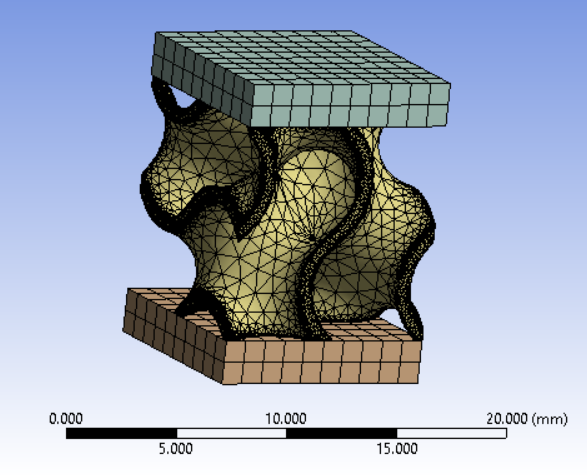
The screenshot of the model is shown below.
Thank you in advance!!
Best, Ranjan
November 17, 2021 at 11:00 pmSheldon Imaoka
Ansys EmployeeHi Ranjan You have the ability to store intermediate results - do you have any substeps that have a converged solution? If you review intermediate results, it may give an idea of what is happening to the model.
Also, what kind of contact do you have between the rigid plates and the gyroid part? If it is frictionless contact, the part can move laterally and have rigid-body motion. Do you have any constraints preventing rigid-body motion? Using frictional contact can work instead, as the coefficient of friction prevents motion in the lateral directions.
Lastly, the rigid plate seem to be the same size as the gyroid part. You may wish to make the 'rigid' plates bigger to prevent the possibility of some nodes of the gyroid slipping off.
Regards Sheldon
November 18, 2021 at 5:25 amSubscriberHi Sheldon Thanks a lot for the reply!
Yes I tried solving the problem using the Bonded contact between the plates and Gyroid structure. I was able to find the solution in this case . Please find attached the model of the assembly along with results.
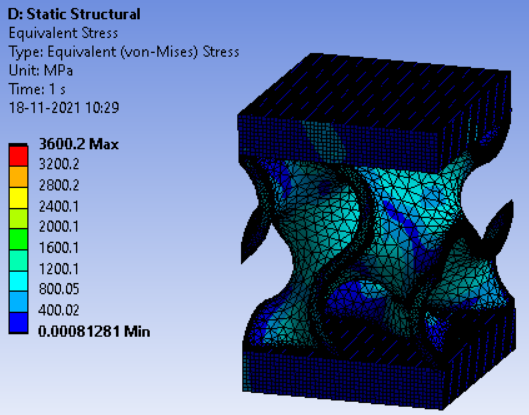 I have two doubts from above:
Will using a frictional contact affect the results of the compression test? Since the friction will introduce additional load in the lateral direction at the gyroid-plate interface.
Is the size of the plates matter in the result I am getting? To define the plate as rigid, I have created a material with a very high elastic modulus (2e12 MPa) and assigned to the plates.
Thanks a lot in advance for your kind reply!
Regards Ranjan
November 18, 2021 at 9:53 pmAnsys EmployeeHi Ranjan Regarding your questions:
If you are using bonded contact, that is similar to situation of frictional contact with very large coefficient of friction ("mu"). Using frictional contact just introduces the possibility of sliding occurring whereas bonded contact prevents any relative sliding between your gyroid structure and rigid plate.
If the plates have high stiffness, they will probably be rigid. You can scope results just on the plate to be certain that the plate has no local relative deformation. In such cases, you can actually use a much coarser mesh to speed up the solution, and you don't need to increase the thickness. Increasing the lateral dimensions of the plate is only needed if you have frictional (or frictionless) contact since relative sliding can occur between gyroid structure and plate.
Regards Sheldon
November 19, 2021 at 6:15 pmSubscriberHi Sheldon Thanks for the reply! I tried to change the modeling of my design as explained by increasing the lateral dimensions of the plate. I have also changed the contact type to frictional with mu = 0.01.
But I have got some strain and stress values in the plates as shown in the figures below. But I don't want any stress/strain values on the plates as I want the plates to behave like a rigid body.
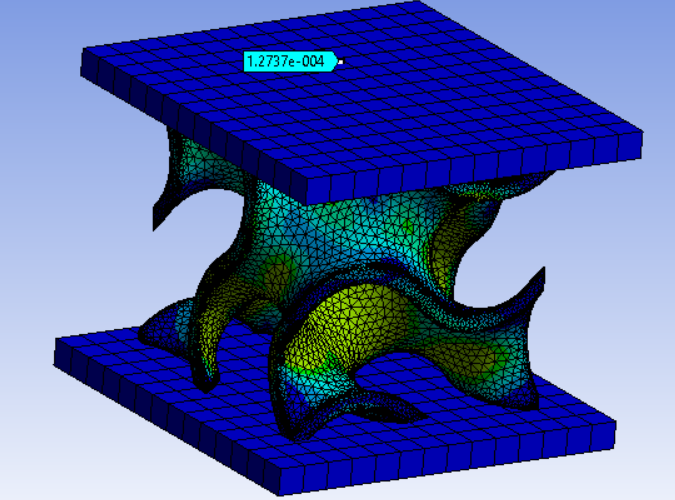
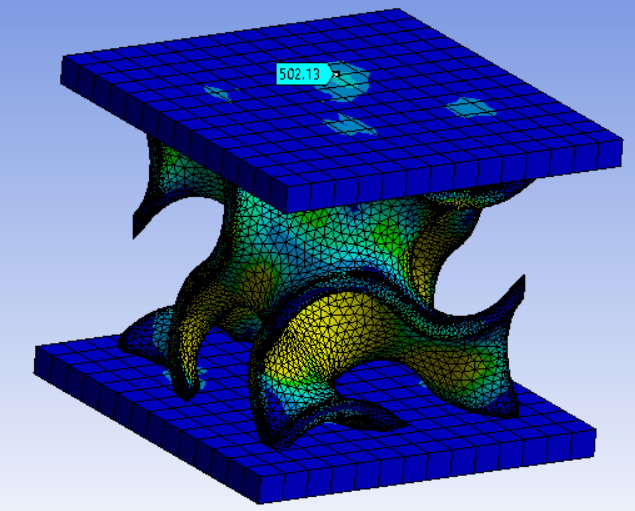 I had previously tried two ways to define the plates as rigid:
i) By defining the stiffness behavior as rigid under the Geometry tab. But doing so, couldn't generate the surface mesh on the connecting side of the plates which are required to connect with the flexible gyroid (I imported the Gyroid mesh from nTopology)
ii) By increasing the elastic modulus of the material used in the plates to a very high value (2e20 MPa). But using this material failed to converge the solution.
So, please let me know if there is a better way to define the plates as rigid and perform my simulation.
Thanks a lot in advance!
Regards Ranjan
December 1, 2021 at 6:19 pmAnsys EmployeeHi Ranjan You could try prescribing the boundary condition on all of the faces of the plate. Keep the plate with a relatively high elastic modulus (but not too high - 100x your gyroid structure is fine), and put the boundary condition scoped to all surfaces of the plate. That will prevent any relative deformation in the plates.
Regards Sheldon
December 2, 2021 at 12:37 pmSubscriberThanks a lot, Sheldon for the suggestions!
Regards Ranjan
Viewing 6 reply threads- The topic ‘Compression testing of a gyroid lattice’ is closed to new replies.
Innovation Space Trending discussions
 Top Contributors
-
peteroznewman
 6465
6465 -
scabo
 1906
1906 -
Dennis Chen
 1458
1458 -
javat33489
 1308
1308 -
Shyam Prasad V Atri
1022
Top Rated Tags
© 2026 Copyright ANSYS, Inc. All rights reserved.
Ansys does not support the usage of unauthorized Ansys software. Please visit www.ansys.com to obtain an official distribution.
-
Ansys Assistant will be unavailable on the Learning Forum starting January 30. An upgraded version is coming soon. We apologize for any inconvenience and appreciate your patience. Stay tuned for updates.


 You are navigating away from the AIS Discovery experience