Ansys Assistant will be unavailable on the Learning Forum starting January 30. An upgraded version is coming soon. We apologize for any inconvenience and appreciate your patience. Stay tuned for updates.
LS Dyna

LS Dyna

Topics related to LS-DYNA, Autodyn, Explicit STR and more.

If you use 2D axis symmetry, does that mean Autodyn also calculates data beneath negative y-axis?

    • Conorryan98
      Subscriber

      Hello,

      I'm using SPH in order to simulate a hypervelocity impact. I'm using 2D axis symmetry. I have written a user sub routine so that any SPH particles that pass through a numerical fence at the boundary of my target get their data read into a .dat file. This allows me to extract individual x-momentum data and do my calculations. I'm wondering if Autodyn takes into account the fact that I am using 2D axis symmetry or do I need to invert all of my results I get to cover the results in the negative side of the Y-axis?

      @cxquan any idea?

      Thanks

    • Chris Quan
      Ansys Employee
      Internally, the program assumes the unit length in circumferential direction in 2D axial symmetry.
      So I believe that you need to multiply the x-momentum you obtained by 2*pi*R, where R is the radius of the axial symmetry. R should be equal to the Y value of the SPH particle.
      Suggest you to run a small test problem first to verify the results from the user subroutine before applying it to your production runs.
    • Conorryan98
      Subscriber
      Many thanks.
      I also used CMASS in order to extract SPH particle mass.
      I was able to extract the projectile data before it had hit the target, and I got 148 sets of data ÔÇô the same amount of SPH particles in the projectile. The odd thing is that mass for a 1mm sphere packed with AL 2024-T4 (density = 2.785 g/cm3) should be 1.458 mg. I got a mass result of 0.43956 mg for a half circle, see excel sheet attached. When I compare the individual sph mass of the projectile that I obtain, it differs from "Cell Mass" value in the in-built Autodyn examine function. For example, for particle 148, index 1748, I get a mass of 0.00033 mg, whereas the examine function shows 0.001051 mg. All other variable results apart from mass are the same.
      When I multiply the mass by 2*pi*R, where R is value of Y particle, I only get 0.8133 mg. I would have expected to get ~1.458 mg.
      I am not sure what the difference between the 3 mass types outlined in the Autodyn user subroutine guide are. In 2D there is Node-mass, cell-mass and mass. It says that the only one available for SPH is the cell-mass, and thatÔÇÖs the one IÔÇÖve been using.
      Do you have any insight into this?
      Many thanks.
    • Chris Quan
      Ansys Employee
      Yes, CELL-MASS is the right variable to retrieve the mass of a SPH particle. Also, please be aware that in 2D axial symmetry, SPH particle is a circular ring in 3D space.
      Here are my calculations:
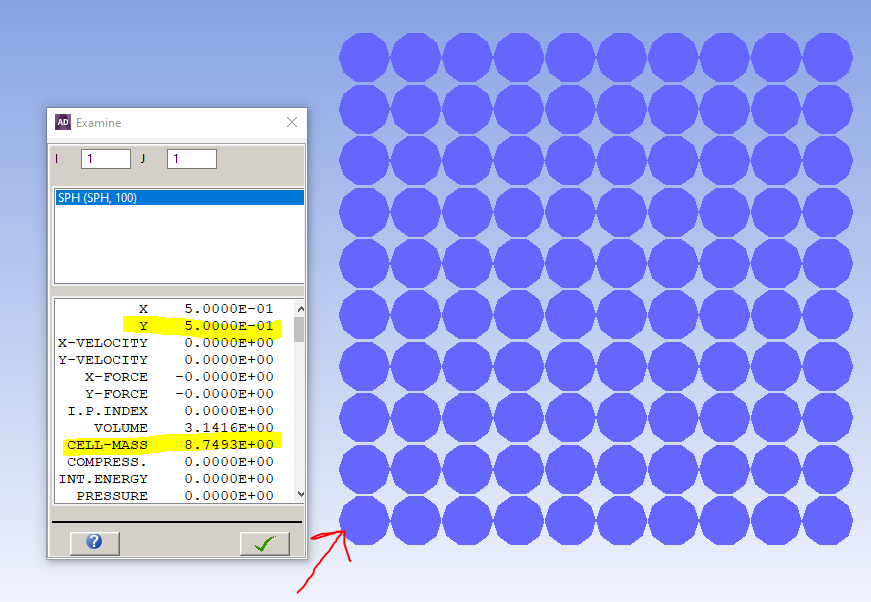
      For the SPH particle at the bottom left corner: X = 0.5 mm, Y = 0.5 mm, Particle Size = 1 mm, AL2024-T4
      Cell Mass = Density * R^2 * 2 * pi * Y = 2.785 mg/mm^3 * 1 mm^2 * 2 * pi* 0.5 mm = 8.7493 mg. See attached picture below.

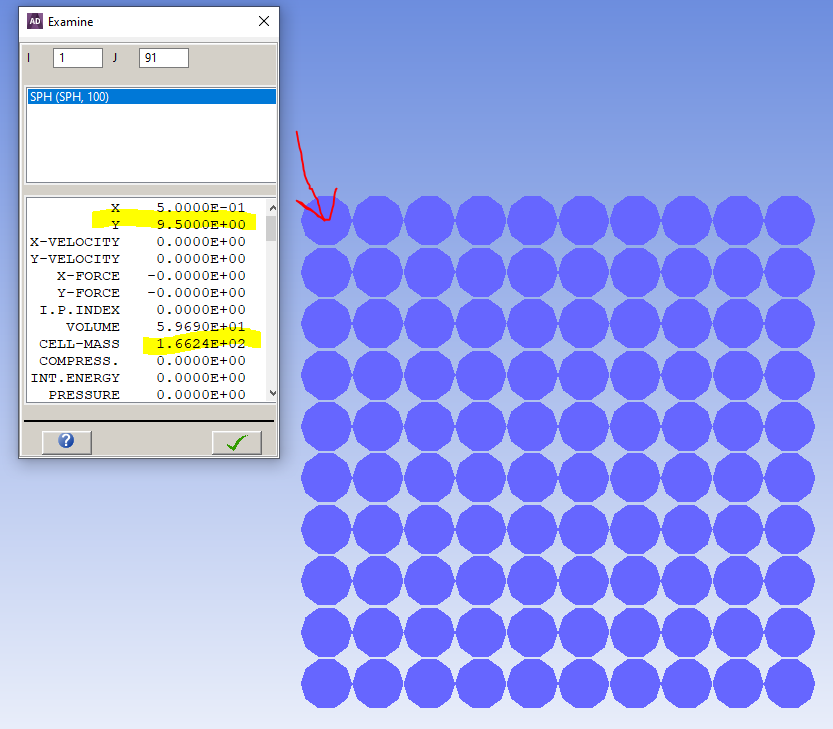
      For the SPH particle at the top left corner: X = 0.5 mm, Y = 9.5 mm, Particle Size = 1 mm, AL2024-T4
      Cell Mass = Density * R^2 * 2 * pi * Y = 2.785 mg/mm^3 * 1 mm^2 * 2 * pi * 9.5 mm =1.6624E2 mg. See attached picture below.


    • Conorryan98
      Subscriber
      Thank you,
      So in your calculation, the term:
      2*pi*Y refers to transforming the SPH particle from 2D particle to a circular ring in 3D space.
      Then you also multiply by R^2. Your particle size is 1mm, i thought this was diameter so should this R (radius?) term not be 0.5? What is this R^2 term doing? thanks

    • Chris Quan
      Ansys Employee
      R^2 is the area of the square where the SPH particle occupies.

    • Conorryan98
      Subscriber
      Great thank you!

Viewing 6 reply threads
  • The topic ‘If you use 2D axis symmetry, does that mean Autodyn also calculates data beneath negative y-axis?’ is closed to new replies.
[bingo_chatbox]







