

-
-
October 14, 2021 at 11:04 am
Jessevass
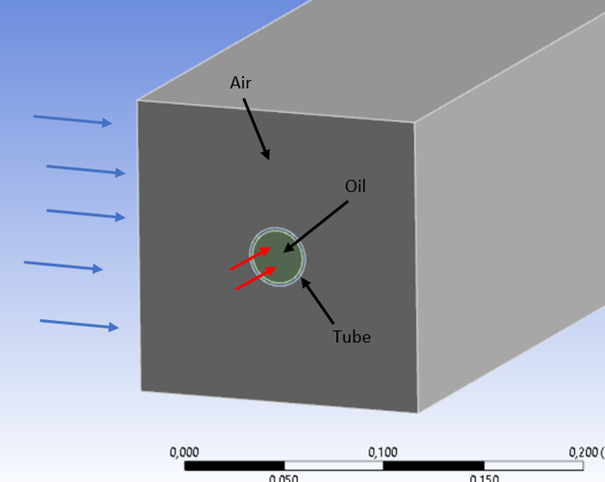
SubscriberI am simulating a tube with a hot oil flow inside and a cold airflow on the outside. (see the geometry below). In the meshing environment, I defined all the different bodies and wall functions (inlet, outlet, adiabatic wall).
October 14, 2021 at 1:05 pmKarthik Remella
AdministratorHello This looks like a conjugate heat transfer problem. When you make the geometry, please make sure your perform the Share Topology operation in Ansys SpaceClaim. This will avoid the creation of contact regions in your simulation (Fluent). You will see coupled wall - wall shadow boundaries and you don't have to manually supply the heat transfer coefficient anymore. Fluent will automatically compute the necessary heat fluxes in your domain.
Please have a look at the following example to see the usage of coupled wall - wall-shadow. These are part of your Ansys Innovation Courses, which are our free courses that you can take to learn to simulation physics. There are other examples as well. Please check our website for additional examples.
Cooling a Heat Sink with Convective Heat Transfer - Simulation Example - ANSYS Innovation Courses
Karthik
October 14, 2021 at 3:30 pmSubscriberHello Karthik Thanks for your answer. I understand what you mean. After doing the share topology operation in Ansys, the interfaces disappeared. So now I have another question. Because if Fluent is automatically computing all the heat fluxes, why can I still define a convection transfer coefficient at the Wall boundary conditions? Can you use this heat transfer coefficient to compromise the model for differences between the simulation results and real-life test results?
Thanks!
October 19, 2021 at 2:05 pmAdministratorAs these are internal boundaries, you will not be able to specify the heat transfer coefficient. The heat transfer coefficient, in a Conjugate heat transfer analysis, is part of the solution.
Karthik
Viewing 3 reply threads- The topic ‘What does the heat transfer coefficient exactly mean?’ is closed to new replies.
Innovation Space Trending discussions
 Top Contributors
-
peteroznewman
 6369
6369 -
scabo
 1906
1906 -
Dennis Chen
 1457
1457 -
javat33489
 1308
1308 -
Shyam Prasad V Atri
1022
Top Rated Tags
© 2026 Copyright ANSYS, Inc. All rights reserved.
Ansys does not support the usage of unauthorized Ansys software. Please visit www.ansys.com to obtain an official distribution.
-


The Ansys Learning Forum is a public forum. You are prohibited from providing (i) information that is confidential to You, your employer, or any third party, (ii) Personal Data or individually identifiable health information, (iii) any information that is U.S. Government Classified, Controlled Unclassified Information, International Traffic in Arms Regulators (ITAR) or Export Administration Regulators (EAR) controlled or otherwise have been determined by the United States Government or by a foreign government to require protection against unauthorized disclosure for reasons of national security, or (iv) topics or information restricted by the People's Republic of China data protection and privacy laws.

 You are navigating away from the AIS Discovery experience