

-
-
June 22, 2021 at 7:21 am
Emperor
SubscriberHello to all,
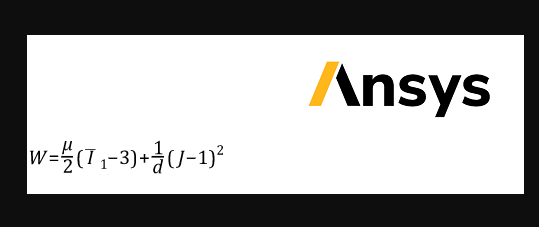
I am working on the structural simulation of hyperelastic models and I have some questions. Concerning the model of Neo, I have that the parameter d is the incompressibility of the material. For compressible material I saw that we could put d=0 or in the energy equation:
June 24, 2021 at 12:47 ampeteroznewman
SubscriberYou cannot set d=0. You must set d = 2/K where K is the Bulk Modulus of the material.
June 24, 2021 at 8:23 amSubscriberHow do I get the mass modulus of the material? I have a hyperelastic material for which I only have the shore hardness and the density. Thanks to the shore hardness I could deduce the Young's modulus of the material (Gent's formula) then the initial shear Go. So I chose a Neo-Hookean model with a value of mu. But to find the parameter D1, I wanted to put the value of 0 for the incompressible material. Is it the same "d" or is it different?
T
June 24, 2021 at 12:01 pmSubscriberThere is an equation that computes the bulk modulus if you have the shear modulus and the Young's modulus. That equation is coded into the Isotropic Elasticity material model in Engineering Data.
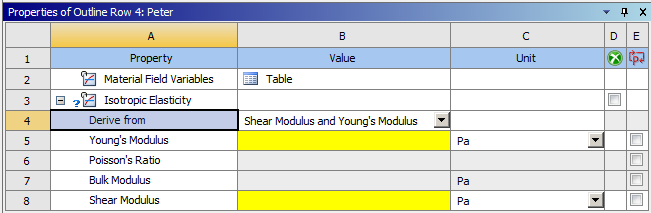 June 24, 2021 at 1:28 pmSubscriberthanks for your answer.
So in my case I calculate the bulk modulus as follows
 then I calculate d=2/k = 2/487.67 = 0.0041
and I enter the value in Neo's model as follows:
 it is the same d (there is no difference between the lower case d and the upper case D?)
June 24, 2021 at 8:51 pmSubscriberYes, I believe that is all the same parameter.
June 25, 2021 at 7:06 amSubscriberthank you for your answers best regards.
Viewing 6 reply threads- The topic ‘Neo-Hookean Hyperelasticity’ is closed to new replies.
Innovation Space Trending discussions
 Top Contributors
-
peteroznewman
 6750
6750 -
scabo
 1906
1906 -
Dennis Chen
 1485
1485 -
javat33489
 1325
1325 -
NickFL
1087
Top Rated Tags
© 2026 Copyright ANSYS, Inc. All rights reserved.
Ansys does not support the usage of unauthorized Ansys software. Please visit www.ansys.com to obtain an official distribution.
-


The Ansys Learning Forum is a public forum. You are prohibited from providing (i) information that is confidential to You, your employer, or any third party, (ii) Personal Data or individually identifiable health information, (iii) any information that is U.S. Government Classified, Controlled Unclassified Information, International Traffic in Arms Regulators (ITAR) or Export Administration Regulators (EAR) controlled or otherwise have been determined by the United States Government or by a foreign government to require protection against unauthorized disclosure for reasons of national security, or (iv) topics or information restricted by the People's Republic of China data protection and privacy laws.

 You are navigating away from the AIS Discovery experience