

TAGGED: 3d, fluent, fully-developed, steady-state
-
-
April 30, 2021 at 1:45 pm
MarkA
SubscriberDear all,
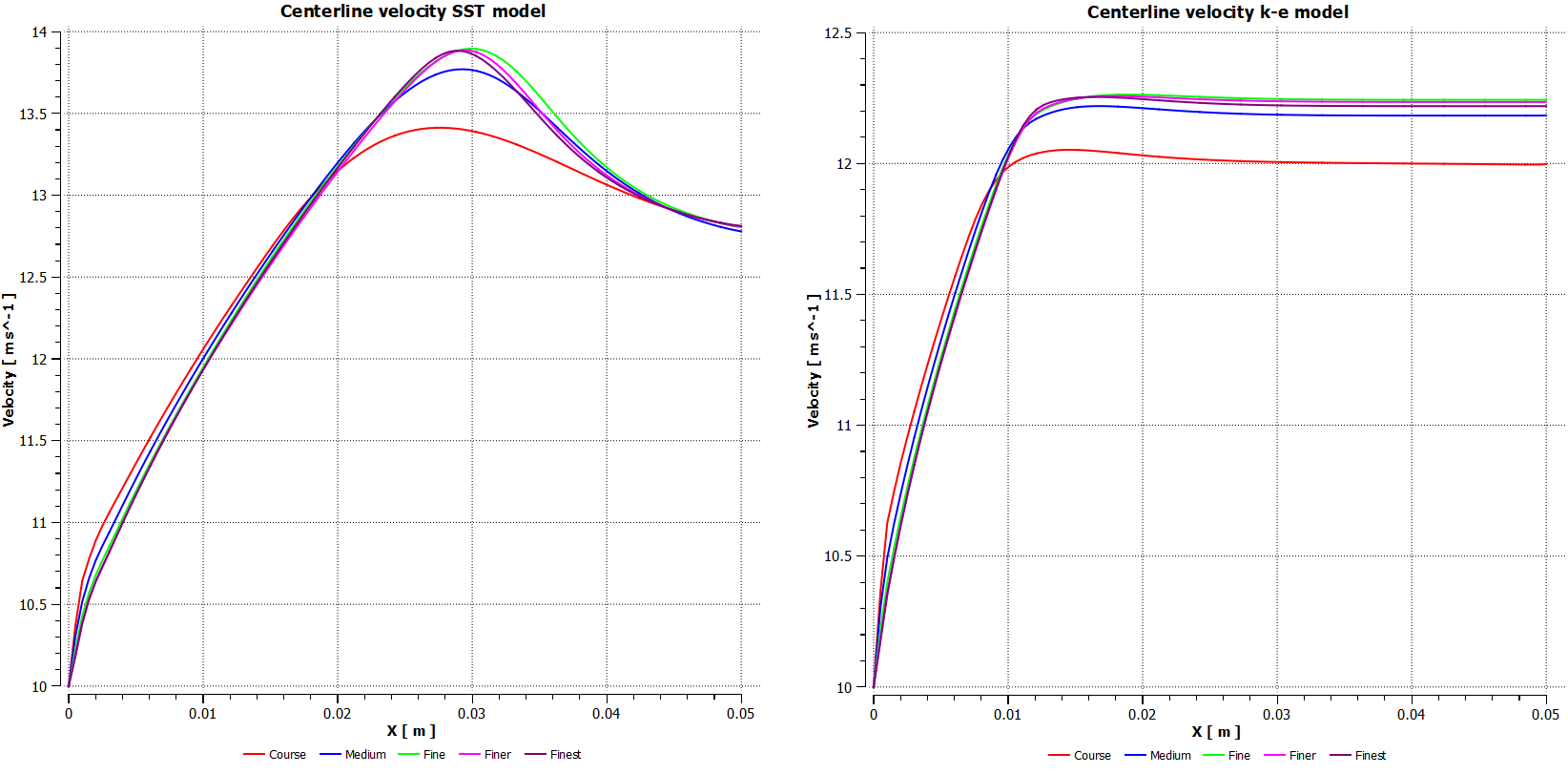
During a simulation of a 3D tube with square cross-section using two different viscous models in steady state I noticed a big difference in the resulting centerline velocity. Please see the below images, which show the solution to the problem for different mesh sizes (resulting from a mesh convergence study).
May 4, 2021 at 1:45 pmKalyan Goparaju
Ansys EmployeeHello,
The developing boundary layer is effectively a flat-plate kind until it becomes fully developed. If you calculated Re based on the entrance length, the value (~200,000) is less than the transition Re for the flat plate. So, effectively, high-Re models are being used to model a low-Re flow, which they are not designed to do, and its probably just fortuitous that one of the models is doing less of a bad job than the other model. One possible solution is to employ a transition turbulence model. Please do consider the mesh resolution requirements for transition modeling before embarking on that route.
Thanks Kalyan
May 6, 2021 at 9:39 amSubscriberThey Reynolds number I calculated was based on the hydraulic diameter of the tube (Dh = 1 mm).
I think I understand your point about the square cross-section resembling flat plates. My interpretation is that the tube consists of 4 flat plates as long as the viscous boundary layers do not interfere with each other / do not overlap. To this end I have used Blasius' approximation to determine at what position x along the length of the tube the viscous boundary layer becomes larger than the distance between opposing plates, which in this case is the channel height/width (actually half of that, but this does not change the argument). In the top figure below, we can see that a transition from laminar to turbulent (Re ~ 5e5) around 50 mm, which is the length of the tube, hence the setup of the current simulation is indeed about flat plates.
The second picture shows Blasius' approximation for twice the inlet velocity, namely u = 20 m/s. Here we can observe that the transition from laminar to turbulent occurs within the domain of my current setup, which is at x = 25 mm. This means that the flat plate approximation should not be visible throughout the whole domain, but some sort of pipe flow should be present as well.
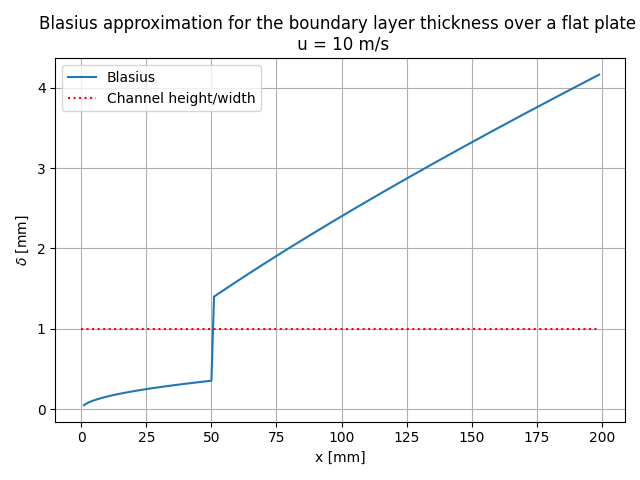
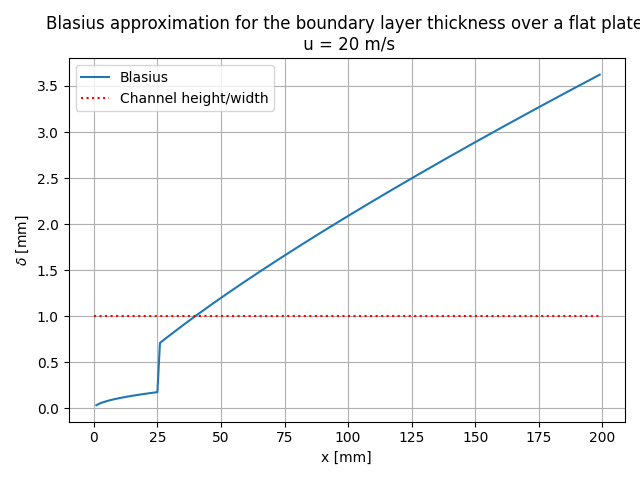 The simulations for u = 20 m/s are being run while this is being posted, so the above is still hypothetical.
can you provide some reading material about the mesh requirements for transition models? I am having a hard time finding any.
May 6, 2021 at 12:17 pmDrAmine
Ansys EmployeeSST does predict the natural velocity overshoot on the centerline which is what I expect.
Continue running and doing assessments on iteration error, discretization errors. Do not rely much on all of these correlations: estimate the entrance length from them only and multiply by a factor and run the cases.
May 6, 2021 at 12:31 pmAnsys EmployeeFor the u=20 m/s case, from the beginning of the tube to ~ x=25 mm, the flow is laminar (i.e. Re < Re_transition of flat plate). In such a case, it doesn't make sense to use a fully turbulent model to simulate this problem. You should instead use one of the transition models. As for the grid requirement, the general rules of thumb are
First cell centroid aty+~ 1
Expansion ratio of grid in wall normal direction not to exceed~ 1.1
Grid clustering should be dense and expansion ratio should be small even in the streamwise direction in order to properly capture the transition location.
Hope this helps.
Viewing 4 reply threads- The topic ‘Different entrance length k-epsilon vs k-w SST’ is closed to new replies.
Innovation Space Trending discussions
 Top Contributors
-
peteroznewman
 6455
6455 -
scabo
 1906
1906 -
Dennis Chen
 1457
1457 -
javat33489
 1308
1308 -
Shyam Prasad V Atri
1022
Top Rated Tags
© 2026 Copyright ANSYS, Inc. All rights reserved.
Ansys does not support the usage of unauthorized Ansys software. Please visit www.ansys.com to obtain an official distribution.
-


The Ansys Learning Forum is a public forum. You are prohibited from providing (i) information that is confidential to You, your employer, or any third party, (ii) Personal Data or individually identifiable health information, (iii) any information that is U.S. Government Classified, Controlled Unclassified Information, International Traffic in Arms Regulators (ITAR) or Export Administration Regulators (EAR) controlled or otherwise have been determined by the United States Government or by a foreign government to require protection against unauthorized disclosure for reasons of national security, or (iv) topics or information restricted by the People's Republic of China data protection and privacy laws.

 You are navigating away from the AIS Discovery experience