

TAGGED: courant-number, impingement, nozzle-jet, transient-analysis
-
-
April 28, 2021 at 9:03 pm
Maurok13
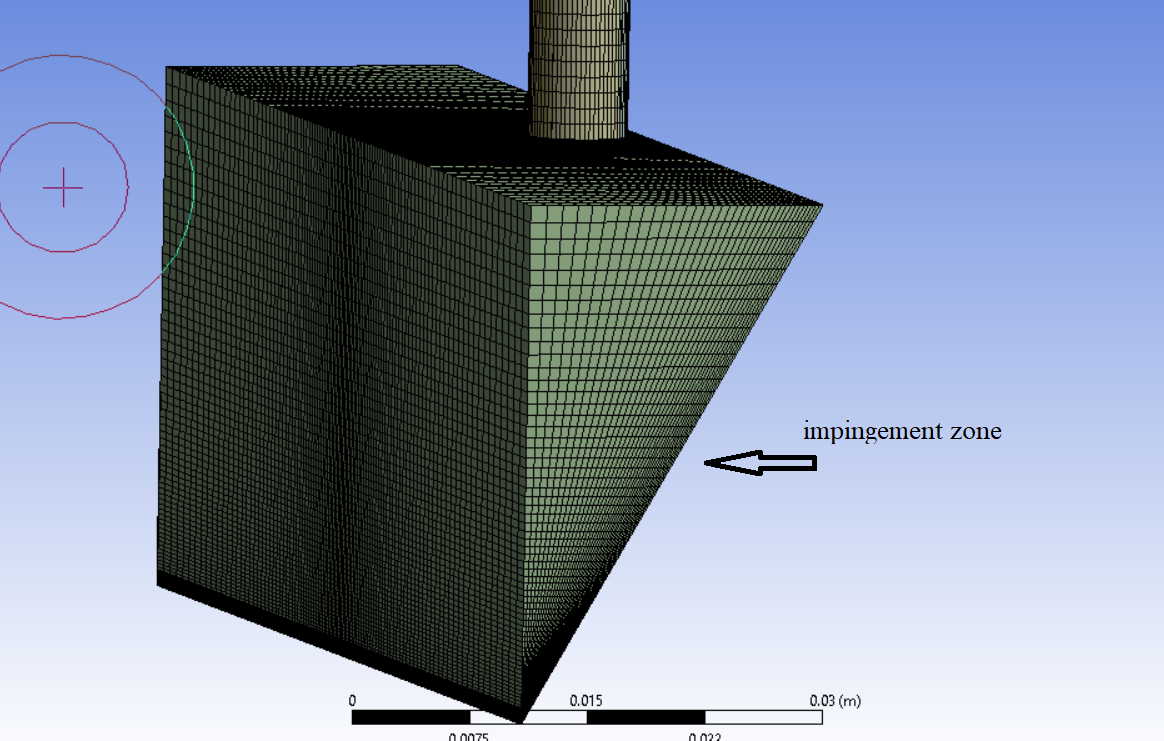
SubscriberIn context i'm simulating a 3d inclined plane, jet impigement, i decided to use this approach due to in next steps of my work i need to evaluate particle trajectories (DPM analysis, erosion analysis), the problem is transient so decided to take care with the courant number so i use a size of time step of 3e-6 and 1.5 e-6, i know the depency of the mesh with the courant number and the velocity (17 m/s in this case) so i try to put a "bed" to avoid the effect of the reverse flow at the outlet, also i use a good size in the wall to evaluate the boundary layer Y+ (i used a typical equations based on the Reynolds numer), i used pressure outlet or outflow boundary but in the two cases "reverse flow" appear (also the relation H/D is too short, 1 in this case) i hope a core of the jet not a developed region, the cuestion here is in what is the ralation in my result if i keep this reverse flow, the issue too is that the convegence is still remain (i used a 1e-6 value for residuals).
Is true mantain this approach because anyways a reach a convergence (only residuals, not constant pressure at the wall)
Additionally i use a report plot to monotoring the pressure in the wall impingement but this mantain a occilatory behavior until around 0.004 seconds.
I let you two screen of the mesh and the fluent GUI
April 29, 2021 at 1:39 pmKarthik Remella
AdministratorHello Regarding reversed flow, if you wish to completely avoid it, you might want to push your outlet a bit further, away from the nozzle exit. Plus, the way your jet is impinging (on the inclined face), I'm sure some of the reversed flow is because of this. I'd extend the domain further, apply the pressure outlet condition there, and let the simulation take care of the flow at your current exit.
I hope this helps.
Karthik
Viewing 1 reply thread- The topic ‘How to solve reverse flow?’ is closed to new replies.
Innovation Space Trending discussions
 Top Contributors
-
peteroznewman
 4708
4708 -
scabo
 1565
1565 -
Dennis Chen
 1386
1386 -
javat33489
 1242
1242 -
Shyam Prasad V Atri
1021
Top Rated Tags
© 2025 Copyright ANSYS, Inc. All rights reserved.
Ansys does not support the usage of unauthorized Ansys software. Please visit www.ansys.com to obtain an official distribution.
-


 You are navigating away from the AIS Discovery experience