

TAGGED: ansys-mechanical, ansys-workbench, mesh
-
-
September 6, 2021 at 1:11 am
HZank
SubscriberHi All,
I am modelling a simple rectangular section (geometry from ASTM D695) in an attempt to compare the creep characteristics of the model to practical values recorded. Before being able to complete this, however, I am running into an issue of the material failing at stresses lower than that recorded practically when I use a fixed support, which I believe is due to induced shear stresses.
In reality the sample is loaded at one end and compressed, upon switching to the compression support the material no longer fails but the deformation of the material is not distributed in the way I would expect and despite the simulation running I am getting a pivot warning and warning that there are not enough constraints. Originally I had the load applied as a force to a single face but even using a pressure on the same face the distribution of deformation is not uniform. This doesn't happen when I use the fixed support, in this case the deformation is evenly spread along the face.
Can anyone advise given the loading situation whether one of these assumptions is incorrect? I thought that the issue may be due to the mesh size but I am not sure and am relatively new to the software.
Thanks.
September 6, 2021 at 2:53 ampeteroznewman
SubscriberThe ideal setup is to use 1/4 symmetry. Use two planes through the centerline of the geometry to cut the sample in half one way and in half perpendicular to the first plane. The Symmetry Boundary Condition is X=0 on one face and Z=0 on the other face. Now the cross-sectional area is only 1/4 of what it was, but the beautiful thing is, you can use a Y = 0 on the bottom instead of the Fixed Support, because the symmetry BC will prevent motion away from the centerline. Put the pressure on the top and let the simulation run. You will get a perfectly uniform deformation profile and no pivot warnings.
September 6, 2021 at 3:07 amSubscriberThanks for the reply, I will give this a try and see what the results look like.
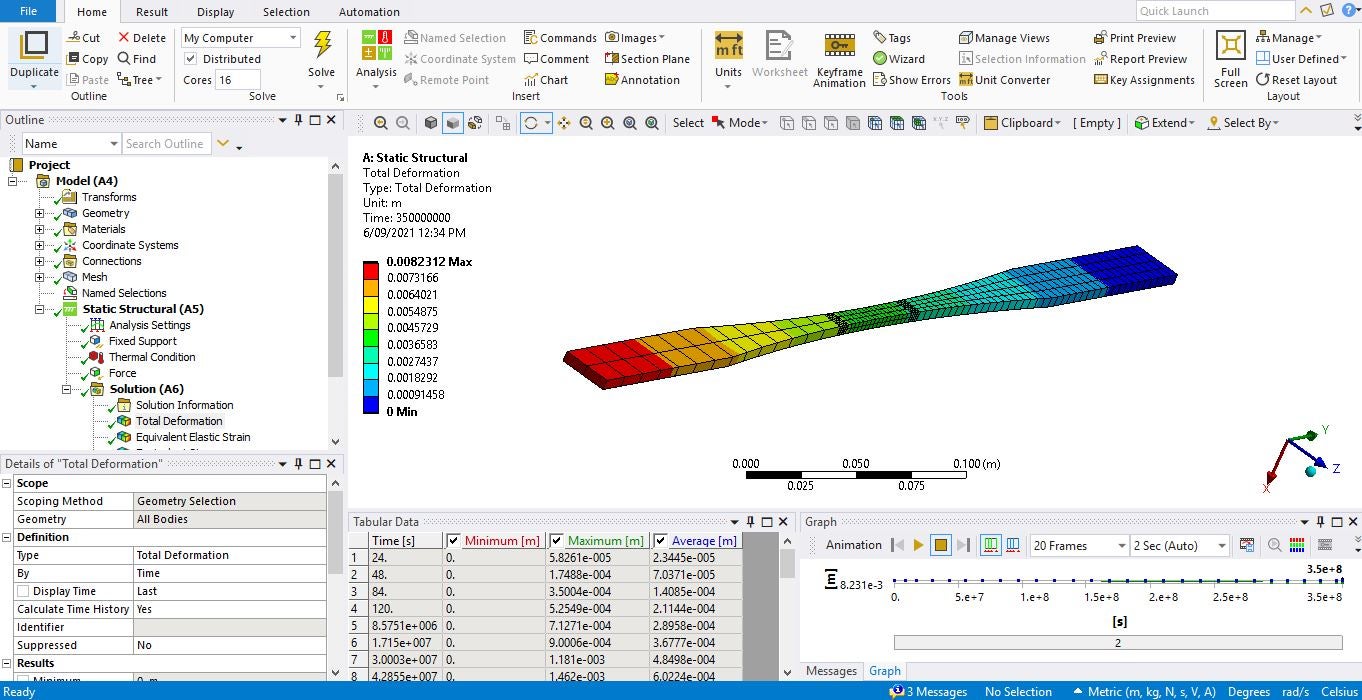
Is this recommended practice for any loading scenario/geometry? I also have a tensile sample which appears to be working well but I have not segmented the geometry (please see the attached).
September 6, 2021 at 4:21 pmSubscriberIt is recommend when the geometry is symmetric, the loads are symmetric and you accept that the solution is limited to symmetric results. Sometimes you don't want that last limitation, such as when buckling may be part of a large deflection solution.
Viewing 3 reply threads- The topic ‘What is better to use, fixed support or compression support?’ is closed to new replies.
Innovation Space Trending discussions
 Top Contributors
-
peteroznewman
 5104
5104 -
scabo
 1831
1831 -
Dennis Chen
 1387
1387 -
javat33489
 1248
1248 -
Shyam Prasad V Atri
1021
Top Rated Tags
© 2026 Copyright ANSYS, Inc. All rights reserved.
Ansys does not support the usage of unauthorized Ansys software. Please visit www.ansys.com to obtain an official distribution.
-


 You are navigating away from the AIS Discovery experience