I have been struggling to understand some of the behavior I have seen when analyzing a geometrically simple interaction between a few surfaces. I have simplified the original problem and provided an excel spreadsheet summarizing the results in this post.
Initially, there was a pair of surfaces, each with one node which interacts with a solar array. When analyzed as a SS solution, the two surfaces and the solar array have a Qflow between sub models totaling 65.633.
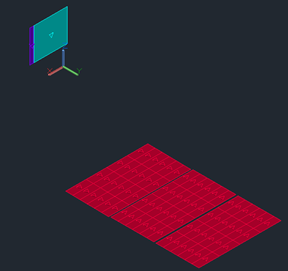
When adding nodes to the model, I noticed a significant decrease in the Qflow between sub models. With only a few additional nodes, the Qflow value drops to 38.76 W.
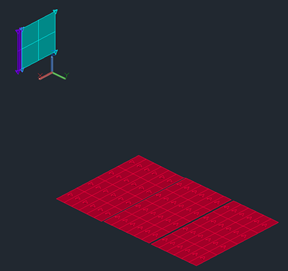

While this is common when looking at systems which are under nodalized to begin with, this does not seem to be the case here. There is no meaningful change to the view factors, and I have edited the two cases to shoot a similar total number of rays regardless of node count. I have tracked down a difference wihtin the .k file that explains why the model is reporting this difference. The Area*e*Bij value changes at the same rate as the report Qflow between sub models.

Given the simple nature of geometry, hand calculation should produce reasonably accurate results. When performing this calculation, it predicts a total radiative Qflow of ~69W. Slightly higher but in family with the 1 node results, but nearly 2x the multi node value. Given the two models have the same calculated view factor, same radiative environment, same material properties, and everything is modeled as 100% specular surfaces, I cannot think of a reason the Bij would so severely decrease between the two models.
My intuition and physical understanding trusts the hand-calc/one-node results. However, given the implementation of TD over many aerospace programs, I do not entirely distrust the model results. Let me know if you can think of a rationale behind this Bij decrease between the two nodalization schemes.
Thank you.

















 You are navigating away from the AIS Discovery experience