

-
-
September 14, 2020 at 5:58 pm
Nabuchadresar2
SubscriberHi guys, I'm again! xD
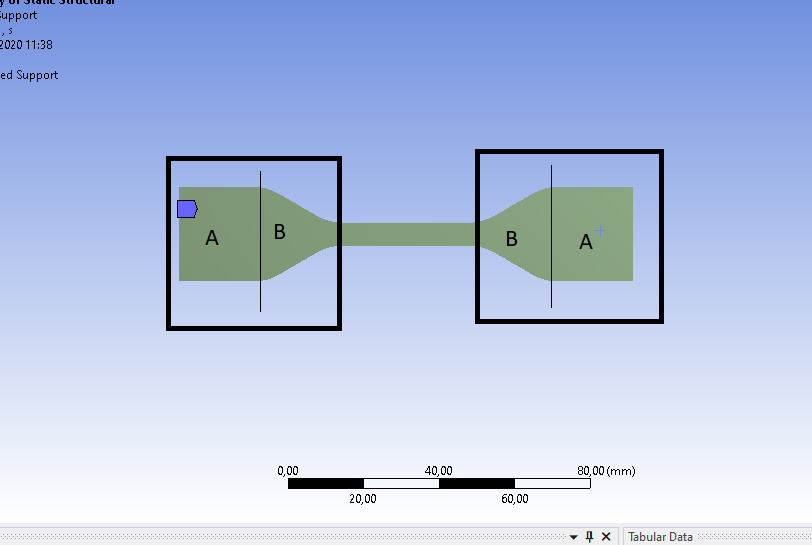
My name is André Moura, i'm try running a hyperelastic simulation. I have the uniaxial test data from experimental test. After some troubles and changes we reach some "good" results.
September 15, 2020 at 3:36 ampeteroznewman
SubscriberAll material testing is done by taking data over a Gauge Length. That is a portion of the sample where the section is uniform for some distance before and after the Gauge Length.nThe wider portions on the ends where the clamps go is always excluded.nThe strain that occurs in the Gauge Length is measured by an instrument called an Extensometer. That measurement is now done by a calibrated camera measuring the displacement of dots marking the surface of the specimen.nSeptember 15, 2020 at 11:44 amSubscriberYes, the area 'A' has been excluded, it was the first simplification. nWe use a extensometer like this (we have a more old than this) on lab (I have no photo now because lab is closed as the pandemic).n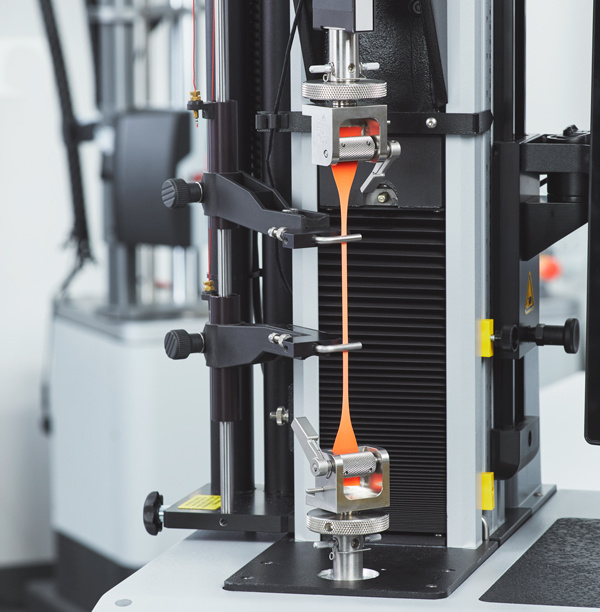 So, can I exclude the 'B' area too?nThanks a lotn
September 15, 2020 at 8:47 pmSubscriberYes, exclude the B area from the simulation. But how exactly are you going to do that? You can't just have a fixed support at the cut face. You need to allow the section to get smaller the way it does when you have area B.nUse three planes of symmetry and keep 1/8 of the narrow center section. The face opposite the center plane cut will have a displacement in Y only, leaving X and Z Free (assuming Y is vertical).nViewing 3 reply threads
So, can I exclude the 'B' area too?nThanks a lotn
September 15, 2020 at 8:47 pmSubscriberYes, exclude the B area from the simulation. But how exactly are you going to do that? You can't just have a fixed support at the cut face. You need to allow the section to get smaller the way it does when you have area B.nUse three planes of symmetry and keep 1/8 of the narrow center section. The face opposite the center plane cut will have a displacement in Y only, leaving X and Z Free (assuming Y is vertical).nViewing 3 reply threads- The topic ‘Tensile test hyperelastic’ is closed to new replies.
Innovation Space Trending discussions
 Top Contributors
-
peteroznewman
 4828
4828 -
scabo
 1587
1587 -
Dennis Chen
 1386
1386 -
javat33489
 1242
1242 -
Shyam Prasad V Atri
1021
Top Rated Tags
© 2026 Copyright ANSYS, Inc. All rights reserved.
Ansys does not support the usage of unauthorized Ansys software. Please visit www.ansys.com to obtain an official distribution.
-


The Ansys Learning Forum is a public forum. You are prohibited from providing (i) information that is confidential to You, your employer, or any third party, (ii) Personal Data or individually identifiable health information, (iii) any information that is U.S. Government Classified, Controlled Unclassified Information, International Traffic in Arms Regulators (ITAR) or Export Administration Regulators (EAR) controlled or otherwise have been determined by the United States Government or by a foreign government to require protection against unauthorized disclosure for reasons of national security, or (iv) topics or information restricted by the People's Republic of China data protection and privacy laws.

 You are navigating away from the AIS Discovery experience