

-
-
October 28, 2021 at 9:18 am
fabrypiro
SubscriberHello everyone,
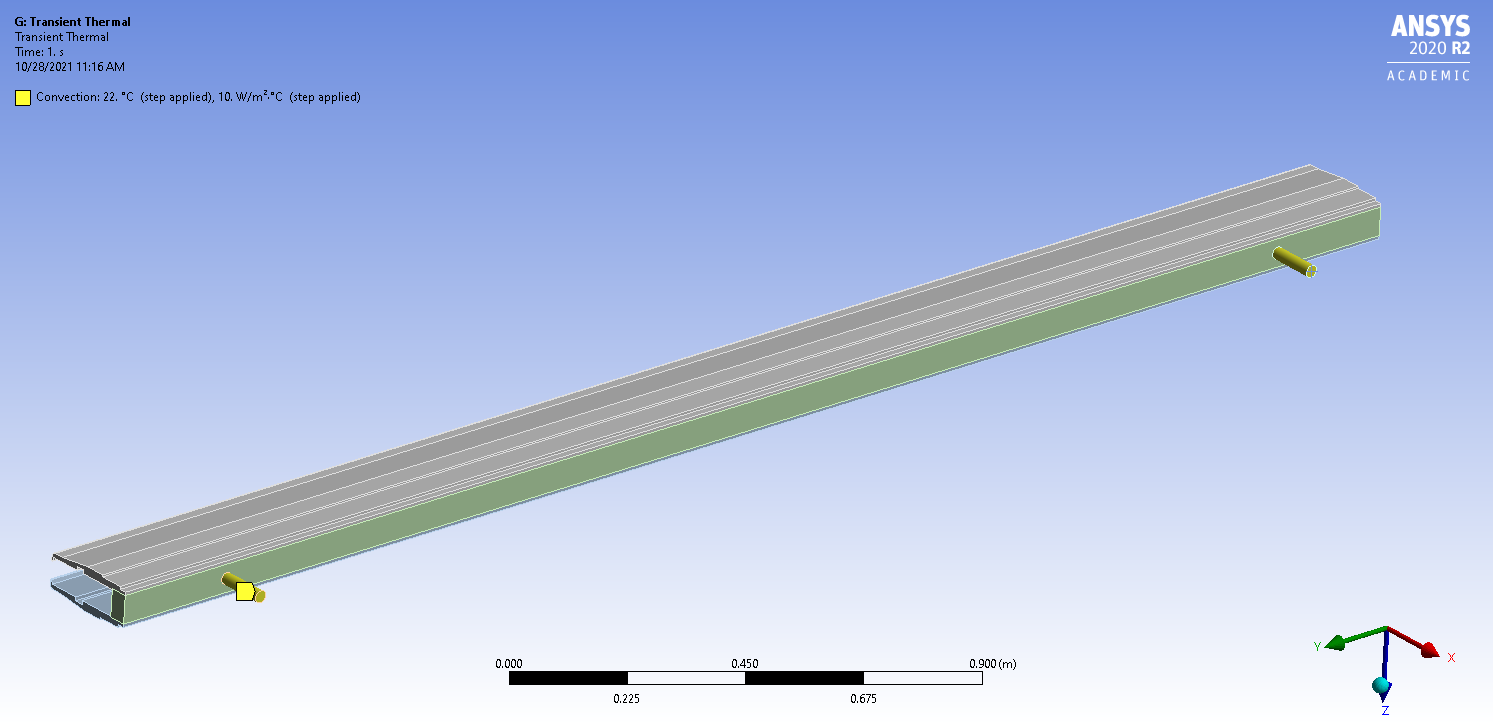
I'm setting up a transient thermal analysis to observe the cooling of a simplified assembly. The whole assembly starts from a temperature of 60 degrees Calsius and is cooled by convection through the surfaces of the two cylinders in contact with the air.
November 1, 2021 at 2:15 pmVigneswaran Sridharan
Ansys EmployeeHi,
I suggest you some help documentation on 'time stepping' in Transient Thermal Analysis.
Establish Analysis Settings (ansys.com)
Also, there is a good example on the Ansys Innovation Course - Transient Thermal Analysis of air-cooled engines.
Thermal Capacitance Simulation Examples | Ansys Courses
Vigneswaran
November 2, 2021 at 3:56 pmSubscriberHi Vigneswaran thank you vary much, the two links have been super helpful !!!
Could you also suggest some links about how to manage Step Controls in general ?
Thanks in advance Fabrizio
Viewing 2 reply threads- The topic ‘STEP CONTROL IN TRANSIENT THERMAL’ is closed to new replies.
Innovation Space Trending discussions
- LPBF Simulation of dissimilar materials in ANSYS mechanical (Thermal Transient)
- Real Life Example of a non-symmetric eigenvalue problem
- How can the results of Pressures and Motions for all elements be obtained?
- BackGround Color
- Contact stiffness too big
- Element Birth and Death
- Python-Script to Export all Children of a Solution Tree
- Which equations and in what form are valid for defining excitations?
Top Contributors
-
peteroznewman
 4597
4597 -
scabo
 1495
1495 -
Dennis Chen
 1386
1386 -
javat33489
 1209
1209 -
Shyam Prasad V Atri
1021
Top Rated Tags
© 2025 Copyright ANSYS, Inc. All rights reserved.
Ansys does not support the usage of unauthorized Ansys software. Please visit www.ansys.com to obtain an official distribution.
-


The Ansys Learning Forum is a public forum. You are prohibited from providing (i) information that is confidential to You, your employer, or any third party, (ii) Personal Data or individually identifiable health information, (iii) any information that is U.S. Government Classified, Controlled Unclassified Information, International Traffic in Arms Regulators (ITAR) or Export Administration Regulators (EAR) controlled or otherwise have been determined by the United States Government or by a foreign government to require protection against unauthorized disclosure for reasons of national security, or (iv) topics or information restricted by the People's Republic of China data protection and privacy laws.

 You are navigating away from the AIS Discovery experience