-
-
February 27, 2019 at 5:19 pm
liam
SubscriberHi,
I am currently using ansys as part of my project and am struggling with defining boundaries as the deck must be free to move in two axis,
An eccentric motor is used to induce vibration where the deck rests on a number of springs
Â
-
February 27, 2019 at 5:42 pm
jj77
SubscriberNot sure I follow 100%. If you have long. springs (fixed to ground) that add stiffness in the direction transverse direction to that plane defined by the two axis, then the model is not restrained well and lacks stiffness in that inplane dir. - you would need restraints in that plane or stiffness (e.g, spring that provide stiffness in that plane)
Â
(For your reference if you do not care about the machine then just include the forcing from the machine on the structure via a remote force say).
Â
-
February 27, 2019 at 9:45 pm
liam
SubscriberThe aim i am trying to acheive is as follows:
Simulate a screening machine which rests on springs which is vibrated via an eccentric mass,
The springs are set up where the spring stiffness' are to be altered to determine its effect on displacement of the screen.
I am unsure on what restraints are necessary, can i fix parts of the machine and still use it in a harmonic response analysis later when i require the freedom in both axis'?
I am unable to carry out the harmonic response until the static solution is attained.
Â
-
February 27, 2019 at 10:19 pm
jj77
SubscriberOK, not sure exactly how it looks like and what the two axis are, so to give you some feedback insert some images/sketches of the set up/model, on the two axis you refer to (their direction relative deck and springs), the excitation forces, and any other BC (also info about springs, and why you carry out a static analysis, is it for pre-stress for modal, or to do a linear comb. and envelopes of static and dynamic results).
Â
In general though say this deck will be forced in the XY plane and the long. springs provide of course only stiffness in the Z direction then there is no stiffness in the XY plane and it can not solve then for a load applied in the XY plane (or in Z). Thus there needs to be some stiffness in the XY plane,normally provided by whatever this deck is connected to - this connection/springs can not only have a stiffness in the Z direction, they must have some stiffness in the lateral dir. also, or any other lateral stiffness,since without the deck is free to translate in that xy plane, and that can not be I hope.
-
February 28, 2019 at 12:08 am
-
February 28, 2019 at 7:26 am
jj77
SubscriberThat is what I said Peter.
Â
Also there is not point in just assuming that the stiffness is 10 time higher or whatever, we might just then pick a random number.
Â
Â
If one wants an accurate model representing the actual model as close as possible one will need to find out where the stiffness in the different direction comes from, and how much it is.
Â
If I can see and understand the set up, I can give more advice.
Â
-
February 28, 2019 at 10:44 am
liam
Subscriber
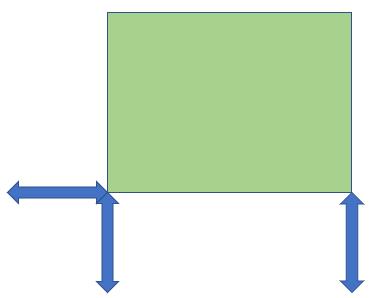
The springs have been added as shown with 4 springs acting in the Y direction and 8 springs (4 acting in positive X and 4acting in negative X) direction.
Yes the static analysis is only a prerequisite for the full harmonic analysis, I will add point masses to the deck to represent the preload on the springs.
The stiffness value for each spring is 13390NM for each spring and will be altered to carry out a number of analysis models.
Â
-
February 28, 2019 at 11:07 am
jj77
SubscriberUnless springs are nonlinear thus defined to act only in tension or compression only they will act in both directions (+ and -).
Â
From the above the model does not have stiffness in Z, and can not solve hence (if it does not have some enforced displ or fixed in that z dir.).
Â
Feel free to send you model also so I can have a look.
-
February 28, 2019 at 12:42 pm
liam
SubscriberÂ
 The springs should act only in compression, due to the eccentric mass the motion is circular meaning the springs should be defined as non linear.
I have added a remote displacement in an attempt to fix movement in the Z direction.
thanks
-
February 28, 2019 at 12:45 pm
jj77
SubscriberÂ
Â
have in mind that nonlinear elements cannot be used in a harmonic analysis (this is a linear type of analysis)
Â
What is the problem, it does not solve in static?
Â
In that case just attach the model here and we will sort it out.
Â
-
February 28, 2019 at 1:22 pm
jj77
SubscriberYou will need to archive the model (go to files/archive, this generates a wbpz file), and then attach it again.
(The one attached is empty)
-
February 28, 2019 at 5:39 pm
liam
SubscriberHi,
Please find the file attached,
Yes the problem will not solve in static, boundary conditions are not correct and therefore causing rigid body motion, the deck needs to be free so that the excitation force can vibrate the deck and therefore obtain a spring displacement result from the spring tracker.
Also an error occurs which says i have exceeded the licence although the number of elements are 1007, is this attributed to the analysis or the model or altogether?
Thanks
-
February 28, 2019 at 6:32 pm
jj77
Subscriberdid not look much, should be OK though since there is a remote disp., in z.
Â
I can not run it either with student ver. not sure why because the mesh is extremely coarse. Also some CFD settings are used on the mesh.
Â
Use also only the solid. I would though mid-surface the solid and use a shell mesh, since it is quite thin.
Â
Springs as I said will act in both directions, since they are linear, nonlinear ones need a nonlinear static (like the one you use), or transient solver, but not harmonic since this is a linear solver (small displ. linear material,..)
Â
Also you have a huge pre tension on the so that will pull them back a lot, down to their free lengths since there is nothing restraining the solid body in that direction (Y). You might need auto time steps on, and define some substeps, there is plenty of info on that here in the forum, on the internet and in the help manual.
-
February 28, 2019 at 8:57 pm
peteroznewman
SubscriberI wrote out the input.dat file and there are element ID numbers like 38134. The Student License checks if highest node or element number is < 32000 to allow it to run. I agree with jj77 that the thin wall geometry should be replaced with a mid-surface and use shell mesh.
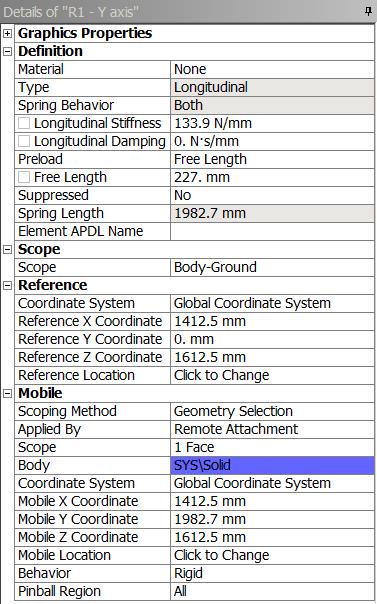
I found one mistake that contributes to the Static Structural not converging. You want the Y axis springs to balance the weight of the structure by their combined preload force. The Preload was defined using Free Length, which is 227 mm, while the Spring Length is 1982.7mm which means the spring has been stretched by 1982.7 - 227 mm. generating a huge Preload force in the wrong direction; tension. You want the Free Length to be longer than the Spring Length so that the preload force is in compression.
It may be easier to get close to static equilibrium by defining Preload by Load instead of Free Length, then you can take 1/4 of the weight and assign that as the spring load, using a negative sign to create a compression force that will support the weight of the structure.
-
March 1, 2019 at 10:06 am
jj77
SubscriberAnother thing to consider is that the stress stiffening effect on spring elements is none, thus there will not be any changes in freq. with or without pre-stress from a static analysis. At least on the bouncing mass-spring type of modes (with the mass here being the solid body that is placed on the springs).
Â
In the general case one would get it say for a 3D mesh of a turbine blade under large centrifugal loads, that would generate significant stress stiffening, increasing frequencies of say bending type of modes.
Â
Also again there must be some stiffness in the remote displ. direction, unless it is restrained like you have done, but I would doubt that.
-
March 5, 2019 at 7:49 pm
liam
SubscriberI have finally transferred the entire model to a usable state using the advice you have given me!
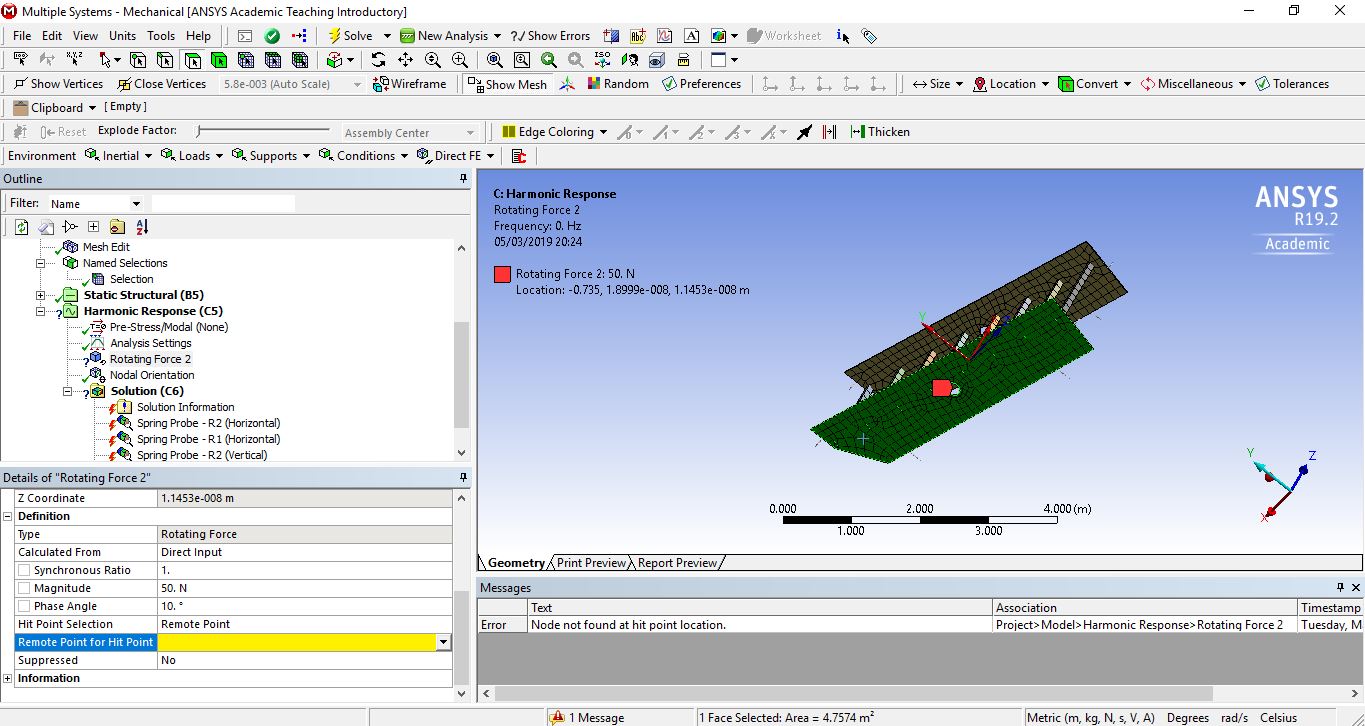
I cannot thank you both enough although i am now presented with another problem, I cannot get the rotating force to work for the harmonic analysis.
It will not select a node hit point for me.
-
March 5, 2019 at 8:16 pm
jj77
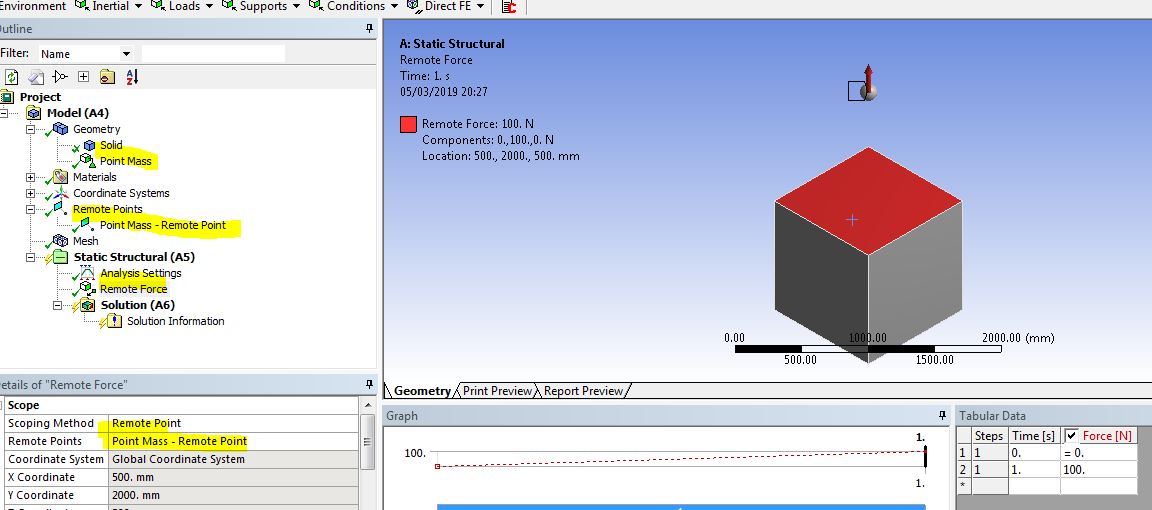
SubscriberYou can use a remote force load, that can act on a face edge,...
Â
Â
-
March 5, 2019 at 8:18 pm
liam
SubscriberAn option is presented for this but not giving me a selection to carry this out
-
March 5, 2019 at 8:23 pm
jj77
SubscriberCan you post a screenshot when trying to select a face for the remote force
-
March 5, 2019 at 8:31 pm
-
March 5, 2019 at 8:32 pm
-
March 5, 2019 at 8:42 pm
jj77
SubscriberRotating force is only for full and coriolis effects on, so rotating equipment.
Â
So do as I have shown with the remote force or remote point and define to components that are 90 degrees out of phase
-
March 5, 2019 at 8:43 pm
liam
SubscriberI have attached the most recent archive file to my first post today for your reference,
Thanks
-
March 5, 2019 at 9:07 pm
jj77
SubscriberSo do as I showed that is define a point mass and promote to remote point (right click on point mass and select promote)
Under remote point, you can set an apdl name, here I called it say cg (for centre of gravity of equipment)
Â
Then add the commands below as a command snippet under the harmonic resp/ and where BC and loads are applied.
These are two forces that are real and complex thus in the complex plane they are 90 degrees out of phase, which is a rotating force on the point mass called cg. THe out of balance load is m_outofbala x radius x omega^2
f0 = 100
f,cg,fy,f0
f,cg,fx,,-f0
Â
This is what you need, select Is Solution to close this discussion.
-
- The topic ‘spring mass static structural analysis to be used in harmonic analysis to determine displacement’ is closed to new replies.

- LPBF Simulation of dissimilar materials in ANSYS mechanical (Thermal Transient)
- Real Life Example of a non-symmetric eigenvalue problem
- How can the results of Pressures and Motions for all elements be obtained?
- BackGround Color
- Contact stiffness too big
- Element Birth and Death
- Python-Script to Export all Children of a Solution Tree
- Which equations and in what form are valid for defining excitations?
-
4592
-
1494
-
1386
-
1209
-
1021
© 2025 Copyright ANSYS, Inc. All rights reserved.