-
-
November 21, 2018 at 8:19 am
sentenza
Subscriber
Hi to all, this is my first post here and I want to thank you for all the useful information you give.
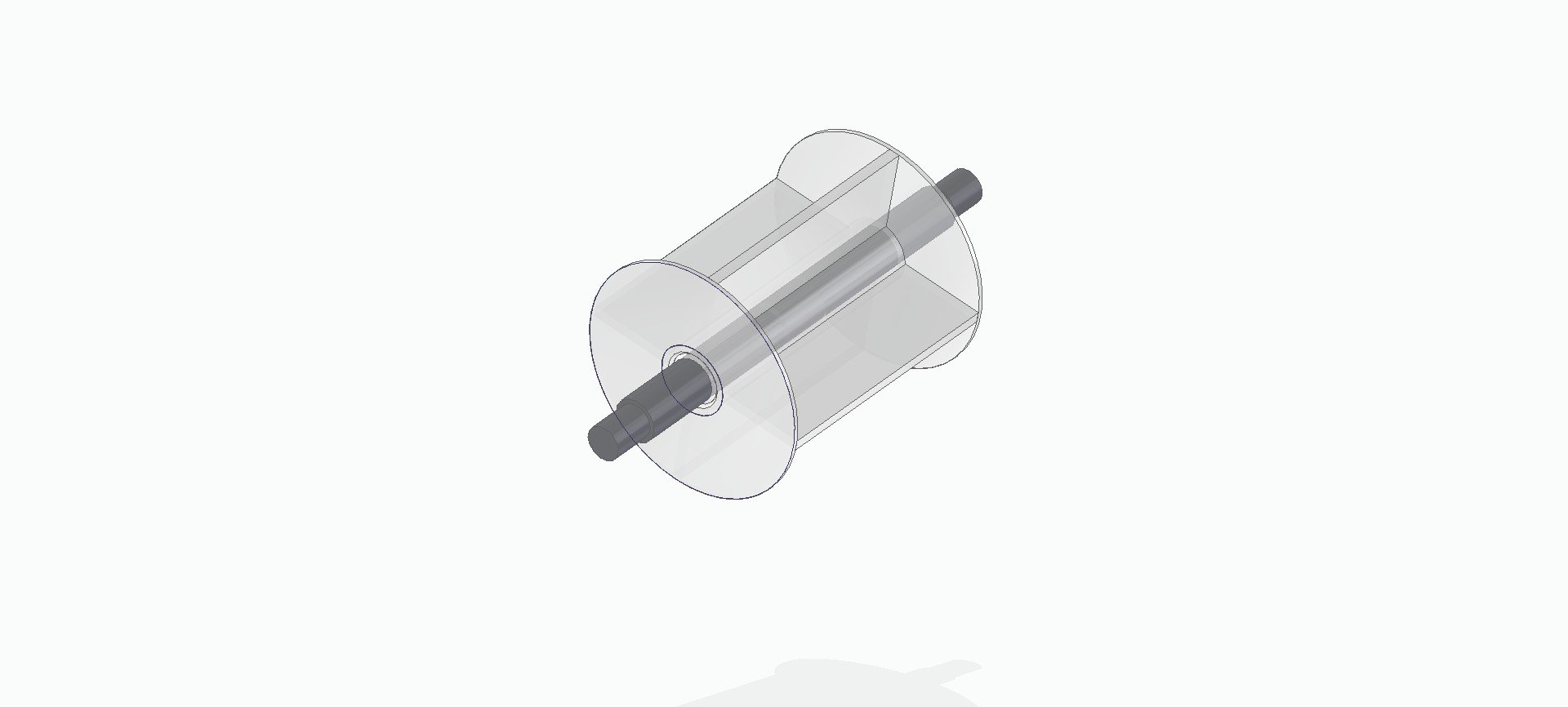
I need some help to analyze the shaft you see in the attacched image: it's a rotor turning with very low speed and subjected to a pressure of 1 bar on upper side. I have also a torque on one side and two self alignment bearings on both ends. I want to analyze just the shaft not considering the rotor, so my questions are:
1) how to represent the pressure load on the shaft , if I suppose that the shaft is not bending on the middle part due to the rotor rigidity
2) how to put boundary condition correctly to represent bearings and prevent body motion
thanks for your help
-
November 21, 2018 at 2:35 pm
Aniket Chavan
Forum Moderator
ANSYS Employees do not have access to attached files. Can you insert the image inline of your post? -
November 21, 2018 at 4:08 pm
sentenza
Subscriberdone, thanks
-
November 21, 2018 at 4:57 pm
peteroznewman
SubscriberANSYS Mechanical has a connection called Bearing. See this post.
You need more than two Bearings to have a Static Structural solution. Two bearings only take away 4 DOF, you have to remove two more DOF, axial position and axial rotation. See this post.
If you model the shaft and the rotor, you can apply pressure to the rotor and use contact between the shaft and the rotor. If you want a simplified model, split the shaft at the ends of the rotor, suppress the rotor, and apply two forces to the shaft at the split line to represent the pressure on the rotor.
-
November 21, 2018 at 5:59 pm
sentenza
Subscriberthanks for the suggestion, i will give a look. What about question number 1? I want to transfer the pressure to the shaft and avoid bending of the shaft where the rotor is positioned. I was thinking to slice the shaft in design modeler and consider the middle part as a rigid body: the ploblem is that in that way i can't insert a load on that part. Any other idea?
-
November 22, 2018 at 2:38 am
peteroznewman
SubscriberHow is the shaft assembled into the rotor? Is there clearance? Is there some kind of shim at each end to take up the clearance? If so, then it is reasonable to assume that the shaft can bend within the available clearance. In that case, the method of splitting the shaft at each end of the rotor and applying the total force from the rotor onto those two split faces seems reasonable.
If the rotor is a close press fit with the shaft and there is no clearance, then include the pipe section of the rotor and bond it to the shaft to increase the stiffness.
If you have a cylindrical face, Mechanical provides a Bearing Load. This load provides a way to define a vector for the direction of loading. It then applies that loading to the compression side of the cylinder only, and does so using a cosine function so the highest force is at the center of the cylinder, and the force falls off to zero at the sides of cylinder, 90 degrees away from the center. The total force, integrated around the cylinder, equals the force entered into the Magnitude field.

-
November 22, 2018 at 8:20 am
sentenza
SubscriberHi Peter, the shaft is press fitted in the rotor with no clearance. I tried to put a remote force on the middle surface equal to max pressure force and set the behavior to rigid. It seems to me i have a good result. Can be a solution?
-
November 22, 2018 at 7:08 pm
peteroznewman
SubscriberThat sounds reasonable.
-
- The topic ‘rotor shaft’ is closed to new replies.
-
5014
-
1683
-
1387
-
1248
-
1021
© 2026 Copyright ANSYS, Inc. All rights reserved.