-
-
March 15, 2026 at 9:43 am
alexander.helbok
SubscriberHi all,
I have been trying to set up a cornering simulation in fluent but am struggling a bit to set up the rotating reference frame correctly.
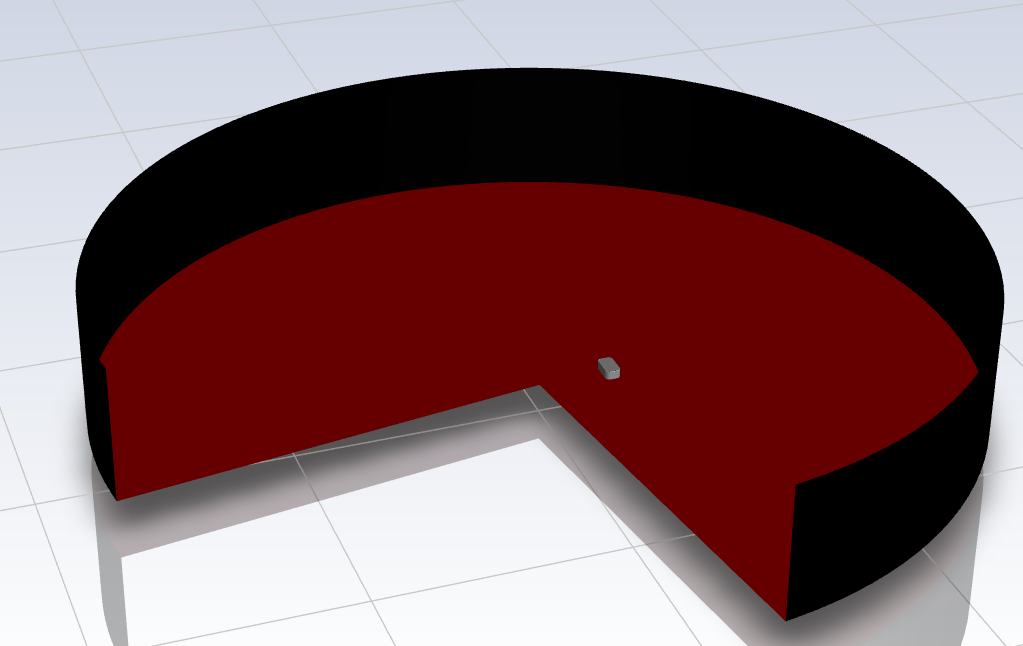
My current setup can be seen below, its a cake segment style domain meshed with periodic boundary condition on the inlet and outlet. The car is modeled as box to keep things simple for now.
To get the air to move I prescribe a rotating frame motion for the fluid cell zone. The side and top are then set to have 0 relative motion, the floor counters the rotation of the fluid and the car has a some linear speed (rotating floor and linearly moving car is physically not quite correct but thats an approximation I am happy to live with for the moment).
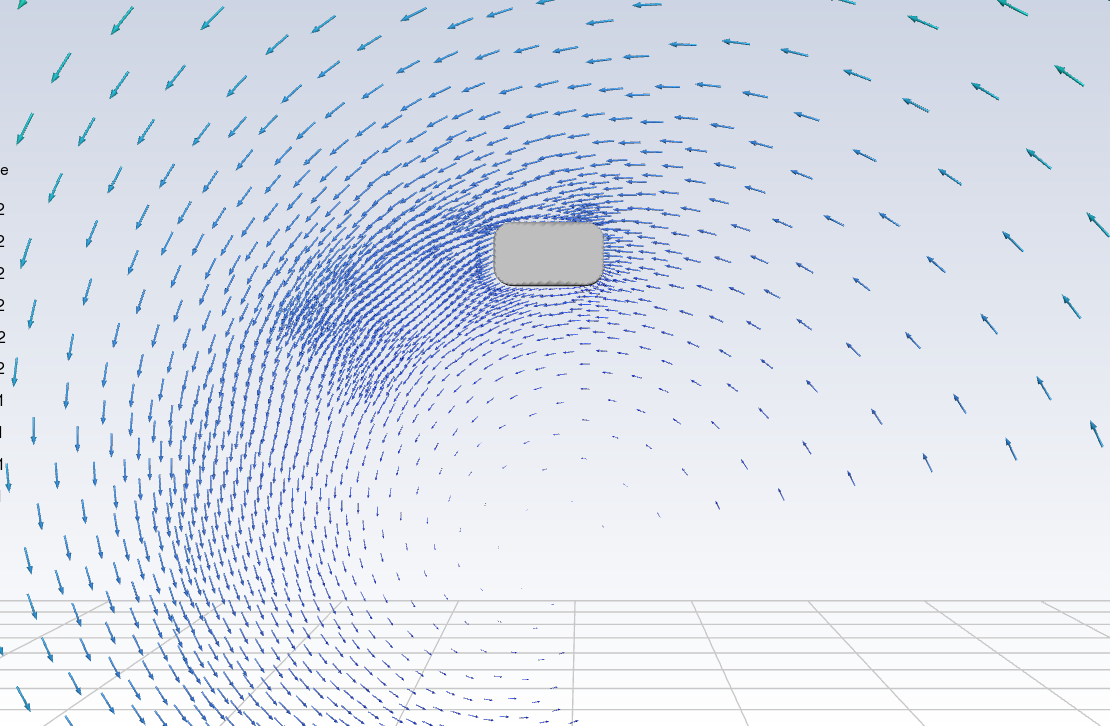
Now to the issue, when I do this and look at some grahics to validate the correctness of this approach against intuition I am a bit confused. Below is a screenshot of velocity vectors around the car. The air nicely swirls around the car but I am missing the interaction with it, the most obvious being that there is no wake region behind the box. This probably has something to do with how a rotating frame is implemented behind the scenes (adding some velocity to each point Id guess) but I was hoping the moving wall boundary condition would lead to the correct fluid object interaction.Â
How can I get a simulation with a stationary object in a rotating fluid domain to interact?
Thanks in advance!
-
March 16, 2026 at 3:18 pm
Ahmed Hussien
Ansys EmployeeYour setup is not entirely clear, but a few aspects may need reconsideration.
First, periodic boundaries are only appropriate if the flow solution is expected to repeat across the boundary. For vehicle aerodynamics this is generally not the case, especially if you want to capture asymmetric features such as separation and wake development. It may be more appropriate to simulate the full domain with standard inlet and outlet boundary conditions.
If the goal is to model rotational flow at a fixed angular velocity, a Multiple Reference Frame (MRF) approach can be used by assigning a rotational speed to the fluid cell zone. In this case the car should remain stationary relative to the reference frame so that the relative motion between the fluid and the body is properly resolved.
If the problem truly involves time-dependent motion of the car (e.g., combined rotation and translation), then a dynamic mesh approach with prescribed motion in a transient simulation would be required.
However, for most vehicle cornering studies it is often simpler and more robust to represent the effect using a yawed inlet velocity with a stationary car, moving ground, and rotating wheels.

-
March 18, 2026 at 11:07 pm
alexander.helbok
SubscriberThanks for the relply,
whilst true that periodic boundaries are usually not appropriate, if the domain is large enough for the car wake to dissipate the effect should be negligible. Thats something I actually want to check once the sim workflow is up and running.
"If the goal is to model rotational flow at a fixed angular velocity, a Multiple Reference Frame (MRF) approach can be used by assigning a rotational speed to the fluid cell zone. In this case the car should remain stationary relative to the reference frame so that the relative motion between the fluid and the body is properly resolved."
This is pretty much what I want and what I tried to set up. I assigned a frame motion to the fluid cell zone and then used translational/rotational moving wall boundary conditions to model the floor and car. I have not added any additional reference frames though so there is only the default "global" reference frame. What Im trying to avoid is to introduce fictious forces (coriolis and centrifugal) since they are unphysical in this scenario.Â
Transient simulations are a bit overkill at the moment and I already did yawed inlet simulation (which is also not quite what is actually happening when driving around a corner as the front of the car sees different flow conditions than the back) and would like to compare that with simulations where the air is rotating around the car.
-
- You must be logged in to reply to this topic.
-
5674
-
1890
-
1419
-
1305
-
1021
© 2026 Copyright ANSYS, Inc. All rights reserved.