-
-
February 4, 2020 at 7:10 pm
masud407
SubscriberI was trying to find the relative displacement of the center of the nucleus with respect to the bottom surface along the direction of the force due to applied vibration. My idea was getting the displacement along the force for both center of the nucleus and the bottom surface and then subtracting them to find the relative displacement. However, I am not getting any relative displacement here. Can anyone please explain? I have attached the wbpz.file.
-
February 6, 2020 at 1:54 pm
Aniket
Forum ModeratorAnsys employees are not allowed to download the files from the community.
But please check if the following free extensions fits your needs
https://catalog.ansys.com/product/5b3bc6857a2f9a5c90d32eaf/relative-displacem
-Aniket
Guidelines on the Student Community
-
February 7, 2020 at 9:19 pm
masud407
Subscriber I was unable to download it. Is there any other solution without downloading it??
-
February 10, 2020 at 9:05 pm
masud407
SubscriberHello Peter,
Â
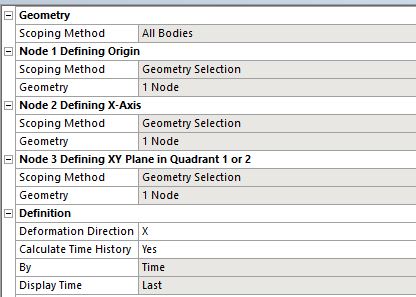
Thanks a lot for your suggestion. I have managed to install it. However, I was supposed to get a relative displacement at the center after applying force/vibration at the bottom surface. Unfortunately, I am getting zero relative displacement. Is this happening because there is no fixed support? I have attached the file above.
-
February 11, 2020 at 2:11 am
peteroznewman
SubscriberI'm looking at your model, I don't like the geometry condition where the element thickness goes to zero. It would be better if you made a small thickness rather than have zero thickness. Also, you seem to have a cut boundary face as if for a symmetry condition, but I don't see any symmetry boundary condition.
The mass of the bodies, m = 4.56e-12 kg
The force on the bodies, f = 6.7e-18 N is the amplitude of a sinusoid with about a 1.9 Hz frequency.
If you add a Modal analysis and use a fixed support on the blue face that the translational joint holds to apply the sinusoidal force to the bodies, you will find the body has a natural frequency of 22.6 kHz. That seems very high for biology. Maybe good for bone.
Using a simple single DOF calculator, you would only expect 7.2e-14 mm of relative motion between the mass and the base.
Is this what you intended to simulate?
-
February 11, 2020 at 4:39 am
Aniket
Forum ModeratorHi peteroznewman,
I have deleted the post with the extension attachment. Users should download the extensions only after agreeing to clickwrap agreement. Kindly do not share it with the users directly!
Best Regards!
Aniket
-
February 11, 2020 at 4:40 am
masud407
SubscriberThanks Peter.
Yes, I am expecting relative displacement in nanometer sclae. I will try with a non-zero thickness, however, I didn't get the comments on "symmetry boundary condition". Would you please describe a bit?
I actually applied 30 Hz frequency which was inside the sin (2*pi*frequency). How did you get this 1.9 Hz?
Where did you add that single DOF calculator?
-
February 13, 2020 at 5:38 pm
-
February 13, 2020 at 10:01 pm
masud407
SubscriberHello Peter,
As per your suggestion, I have changed the following things:
1) increased the thickness between the nucleus and bottom surface.
2) Applied symmetric boundary conditions.
Still for 30 Hz or 100 Hz of vibration, I am not getting any relative displacement. How did you manage to get that small relative displacement? Any suggestions?
-
February 14, 2020 at 5:11 pm
peteroznewman
SubscriberHi Aniket,
I won't download files like that again.
It seemed okay because they are available for everyone, but I didn't think of the clickwrap issue.
Best Regards,
Peter -
February 14, 2020 at 5:12 pm
masud407
SubscriberHello Aniket,
Â
I actually didn't download the file that peter uploaded. I followed the process that was given in your link.
Thanks.
-
February 14, 2020 at 7:22 pm
peteroznewman
SubscriberHello masud407,
There are two analysis systems in the attached file. Which one should I look at? I looked at system B.
Here is the graph of the Joint Force load.
See that the period of one cycle is 0.575 seconds. This means the frequency = 1/Period = 1.74 Hz.
Here are the Joint Force Details. Note that the Angular Measure is Degrees.
You only have 628*time but you need 10800*time in the sin function to get 30 Hz (30*360).
-
February 14, 2020 at 7:42 pm
peteroznewman
SubscriberHello masud407,
Add a Modal analysis to the Model cell of the A system block. Under the Modal section of the outline, pick the bottom face (where the joint is scoped to) and apply a Fixed Support. Solve.
The first natural frequency is 24.5 kHz. The mass of half of the blob is 4.4e-12 kg.
When you have a particular set of values for a mass and a spring rate, it is easy to compute a natural frequency of that mass-spring system. In fact, if you have any two quantities, you can calculate the other one. A mass-spring is called a one DOF system and there are well know equations that dictate its oscillatory motion. A specific amplitude and frequency of force applied to the mass will result in an amplitude of displacement that can be simply calculated. That is what I did above.
-
February 15, 2020 at 4:08 am
masud407
SubscriberHello Peter,Â
Â
Thanks for your suggestion. I changed the frequency (used sin(10800*time) in the B part.However, it looked like a straight-line and showed no relative displacement. Am I missing any boundary conditions?
I have done the modal analysis and found the exact results that you mentioned. However, I didn't use the process (single-DOF) that you mentioned to find the relative displacement yet.Rather, I used the ANSYS app for the relative displacement.
-
February 15, 2020 at 4:45 am
peteroznewman
SubscriberI also don't see meaningful displacements, even when I use 100 G accelerations. I don't know why. Maybe it has something to do with working in the micron size? Someone from ANSYS would have to dig in here. Try a simple model in a millimeter size part, where you know what the answer should be and see if you get meaningful displacements.
-
February 16, 2020 at 11:16 pm
masud407
SubscriberHello Peter,
I checked with different geometry (large scale in mm) and used the same conditions as my previous one. It showed the relative displacement clearly.Â
For my previous geometry, am I making anything wrong with boundary conditions or ANSYS is unable to read the smaller relative motion?Â
-
February 17, 2020 at 12:03 am
peteroznewman
SubscriberI think your model was good.
Maybe the way ANSYS is handling micron sized geometry is causing it to lose all the significant digits in the solution and produce garbage output. The way to prove that is with a really simple model where you know the analytical solution. Build a mm scale model and show the solution with the correct result while a micron scale model has a solution that is garbage.
-
May 4, 2023 at 2:54 pm
reza reza.ahmadi
Subscriberhi
i tested a set of pla specimen, and i analysed the model in ansysworkbench. i applied force and boundary condition on it. the resulted stress and strain are the same as test but i need displacement in model and i used total deformation in ansys and it is not the same quantity which i earned from the test. can anyone help me with that?
-
- The topic ‘Relative displacement calculation’ is closed to new replies.
-
4607
-
1515
-
1386
-
1209
-
1021
© 2025 Copyright ANSYS, Inc. All rights reserved.