TAGGED: boundary-condition
-
-
January 7, 2026 at 10:44 am
rachel
SubscriberHello,
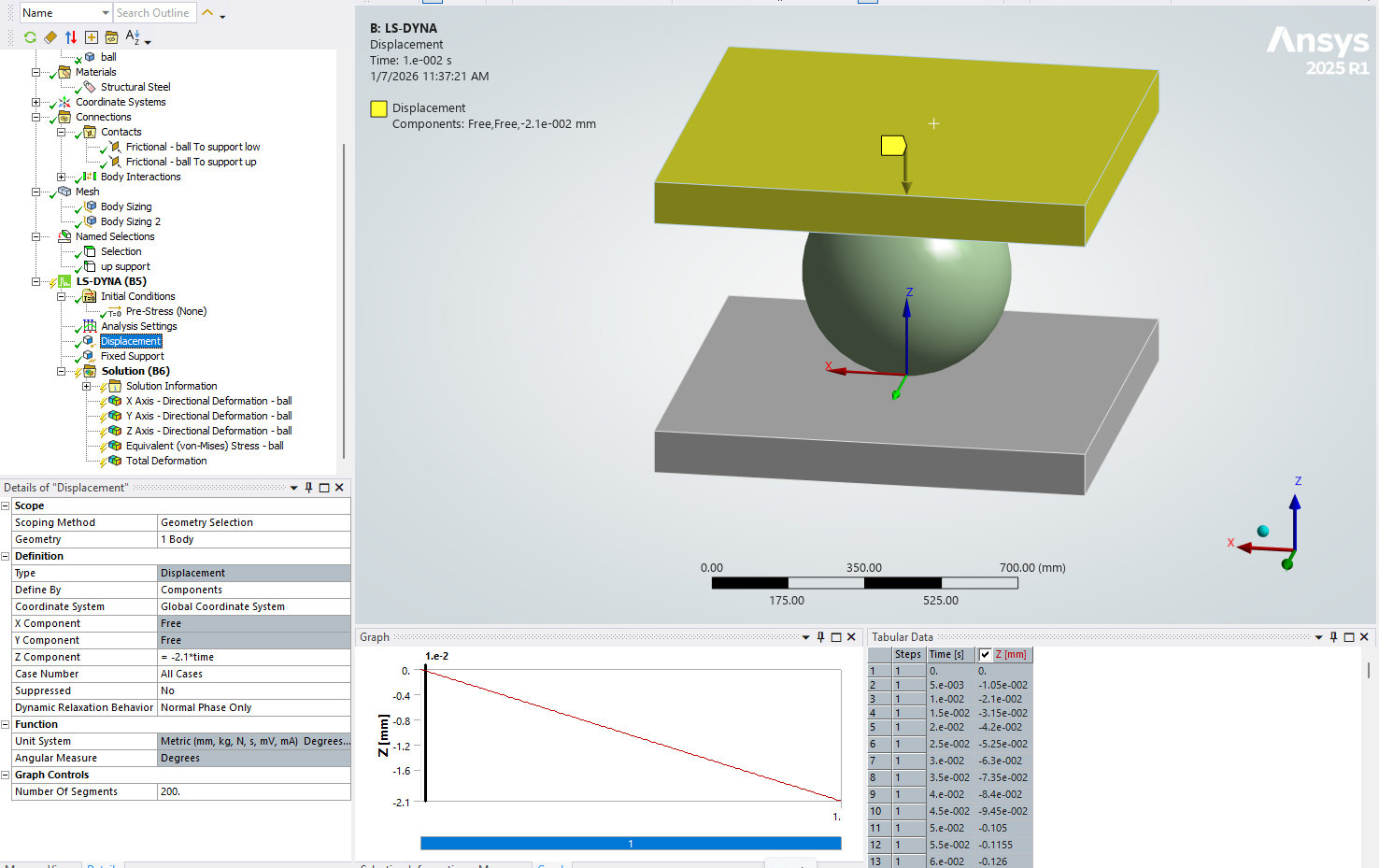
I recently started using LS-Dyna. In AnsysMechanical, I used to define boundary conditions in terms of displacement fields. Apparently, I cannot do the same thing in LS-dyna. It seems that the displacement command is ignored.
Nevertheless, I can define other boundary conditions in terms of initial velocity and load. But as I want to study the buckling problem in structure, load conditions can lead to non-stable solution.
I suppose I missed something, does anyone have a solution? Thank you !
The picture below is from a ball compression test. The lower support is fixed, while the displacement command is defined for the upper one.
-
January 7, 2026 at 2:37 pm
Armin
Ansys EmployeeHi Rachel,
Under Analysis Settings, ensure that the End Time is defined to properly cover the entire event. I noticed that you have your displacement applied over the course of 1 second.
Additionally, you may find the following course on Explicit Dynamics theory helpful. It is applicable to LS-DYNA simulations with explicit time integration: Explicit Dynamics Theory - Ansys Innovation Course - YouTube
-
January 7, 2026 at 3:00 pm
peteroznewman
SubscriberHi Rachel, you said you wanted to study the “buckling problem” but compressing a solid sphere isn’t a buckling problem. Buckling problems are usually long slender columns with a compressive load or thin-walled shell structures. If the ball is a thin-walled hollow sphere, then buckling can occur. In that case, if there is an enclosed gas or liquid inside the ball, that will affect the deformation results so must be included in the model. LS-Dyna has an airbag model that you could use in that case. Here is a relevant video:
You have posted in the LS-Dyna channel, but if your simulation is done at low velocity, you can also solve it in a Static Structural Mechanical APDL as I have demonstrated in this video:
Regards,
Peter
-
- You must be logged in to reply to this topic.
-
4969
-
1645
-
1386
-
1242
-
1021
© 2026 Copyright ANSYS, Inc. All rights reserved.